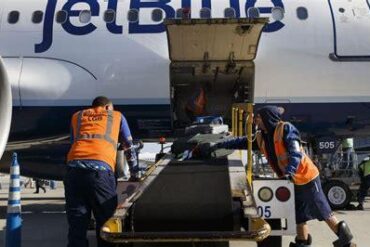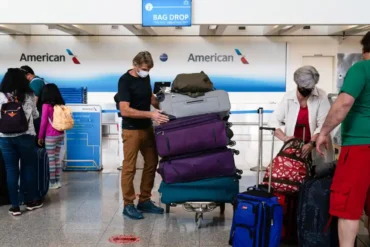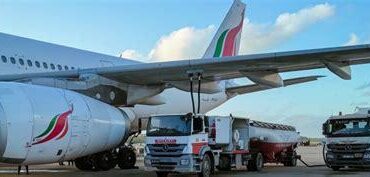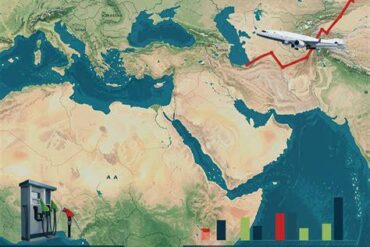
The era of inexpensive checked baggage on US airlines is fading even faster as major carriers move aggressively to offset soaring operating costs. American Airlines and Alaska Airlines have both announced another round of baggage fee increases, joining a growing list of carriers responding to a dramatic spike in jet fuel prices triggered by instability in the Middle East and disruptions through the Strait of Hormuz.
For millions of travelers, the latest increases mean the total cost of flying is climbing well beyond the base airfare. What once appeared to be a budget-friendly ticket can now quickly become a far more expensive journey after baggage fees, seat selection charges, and other ancillary costs are added at checkout.
Airlines argue the changes are necessary to protect margins as fuel expenses explode. Passengers, however, are increasingly feeling squeezed by a pricing model that separates nearly every part of the travel experience into an additional charge.
The pressure intensified after jet fuel prices reportedly surged by more than 132% during the ongoing US-Israel-Iran conflict, sending shockwaves through the global aviation sector and forcing carriers to rapidly adjust pricing strategies across their networks.
American Airlines Expands Checked Bag Charges Across Key Routes
American Airlines confirmed that its revised baggage fee structure applies to tickets purchased from April 9, 2026 onward. Travelers flying within the United States, Canada, Puerto Rico, the US Virgin Islands, Hawaii, Alaska, and several short-haul international destinations now face significantly higher charges for checked luggage.
Passengers paying at the airport will now spend $50 for a first checked bag and $60 for a second bag. Customers who prepay online receive a modest $5 discount, bringing those fees down to $45 and $55 respectively.
The increases hit Basic Economy travelers particularly hard. On many routes across Mexico, the Caribbean, Central America, and parts of South America, first checked bag charges now range from $55 to $70 depending on the destination and payment method. Second checked bags on several international Basic Economy routes now cost as much as $100.
The airline also confirmed that third checked bags remain exceptionally expensive at $200, a figure designed both to generate ancillary revenue and discourage excess luggage on increasingly full flights.
Despite the increases, some passengers will continue receiving complimentary baggage allowances. Premium cabin travelers, elite frequent-flyer members, select co-branded credit card holders, and active-duty US military personnel remain exempt from many of the new charges.
Basic Economy Restrictions Continue Expanding Beyond Baggage Fees
The baggage fee hikes are only one piece of a broader strategy reshaping how airlines monetize lower-cost fares. American Airlines also announced additional restrictions for Basic Economy passengers beginning May 18.
Under the updated rules, travelers purchasing the airline’s cheapest fares will face new seat selection fees, further increasing the final ticket cost after purchase. Even elite-status customers buying Basic Economy tickets will lose eligibility for systemwide upgrades, reducing one of the key perks traditionally associated with loyalty status.
The move reflects a broader industry trend in which airlines increasingly separate the core airfare from optional services. While the advertised ticket price may appear competitive, airlines are relying more heavily than ever on post-booking purchases to generate profit.
For consumers, the distinction between a low-cost fare and a full-service travel experience continues to widen.
Alaska Airlines and Hawaiian Airlines Introduce Parallel Increases
Alaska Airlines implemented its own baggage fee increases beginning April 10 for North American flights booked through both Alaska Airlines and its partner carrier, Hawaiian Airlines.
The airline raised first checked bag fees from $40 to $45, while second checked bags climbed from $45 to $55. Third and additional checked bags now cost $200 each, matching the increasingly aggressive pricing structure spreading across the US airline market.
One notable change is the elimination of Alaska’s previous online prepayment discount. Travelers who once saved money by paying for baggage several hours before departure will no longer receive reduced rates.
Still, Alaska preserved several existing exemptions. Club 49 members traveling within or to Alaska maintain their complimentary baggage benefits, while Huakaʻi travelers within Hawaii continue receiving existing allowances. Elite frequent flyers, oneworld alliance members, and active-duty military personnel also retain many of their current baggage privileges.
Oversized and overweight luggage charges remain unchanged, with some fees still reaching as high as $400 for exceptionally large or heavy bags.
The synchronized increases across Alaska Airlines and Hawaiian Airlines demonstrate how rapidly ancillary fee strategies are spreading throughout airline groups seeking additional revenue streams.
Jet Fuel Prices Become the Driving Force Behind Airline Fee Hikes
Behind the baggage fee increases lies a much larger financial problem confronting the aviation industry: fuel.
The closure and disruption of shipping lanes through the Strait of Hormuz created severe instability in global energy markets, sharply limiting oil transportation capacity and sending jet fuel prices soaring. According to industry figures from the International Air Transport Association, jet fuel costs jumped from roughly $85–$90 per barrel before the conflict to approximately $209 per barrel within weeks.
That sudden increase dramatically altered airline operating economics almost overnight.
Fuel is traditionally one of the largest expenses for airlines, often representing a major percentage of operational costs even during stable market conditions. When prices spike this aggressively, carriers face immediate financial pressure that cannot easily be absorbed internally.
Unlike airfare adjustments, which can take time to influence booking demand and competitive positioning, ancillary charges can be increased almost immediately. Baggage fees, seat assignments, premium boarding, and onboard purchases provide airlines with faster mechanisms for recovering rising expenses without fully restructuring ticket pricing.
That flexibility explains why baggage fees have become one of the industry’s preferred tools during periods of economic uncertainty.
US Airlines Move Toward Industry-Wide Standardized Bag Pricing
American Airlines and Alaska Airlines are not acting alone. Similar increases have already been announced by Delta Air Lines, United Airlines, JetBlue, and Southwest Airlines.
The result is a rapidly forming industry standard in which first checked bag fees across major US carriers now generally fall between $45 and $50 on many domestic routes.
For travelers, the growing uniformity means fewer opportunities to avoid baggage fees simply by choosing a competing airline. Instead, passengers are increasingly forced to adapt by packing lighter, relying on carry-on luggage, or paying significantly more for premium fare bundles that include checked baggage.
The latest fee increases also highlight a larger transformation in airline economics. Base fares remain highly competitive and heavily advertised, but profitability increasingly depends on the additional purchases travelers make after selecting a ticket.
As fuel costs remain volatile and geopolitical instability continues affecting global energy markets, ancillary revenue is becoming even more central to airline survival strategies. For passengers, that likely means baggage fees are not only here to stay — they may continue climbing long after fuel markets stabilize.