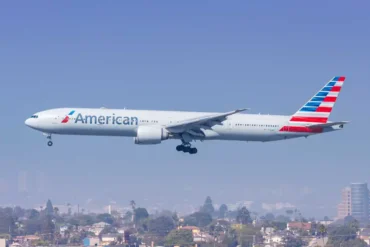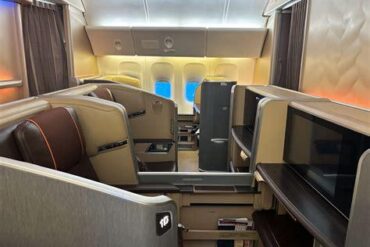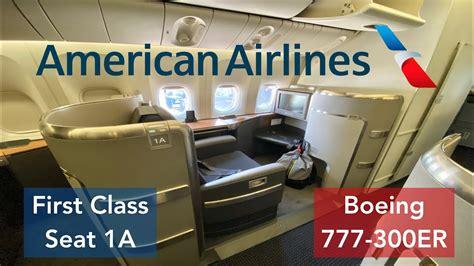
American Airlines is transforming its Boeing 777-300ER fleet through a sweeping cabin retrofit known as Project Olympus, and the result is a striking change in how the airline uses space aboard its flagship long-haul aircraft. The most visible change is the disappearance of Flagship First Class, but the bigger story is what American is doing with the space it recovers. Instead of simply reducing the number of premium seats or squeezing more passengers into economy, the airline is adding 26 seats overall, expanding business class and premium economy while keeping the same total number of economy seats.
The refurbished aircraft will move from 304 seats to 330 seats, creating a substantially more premium-heavy configuration. American is also introducing its latest generation of seats, larger entertainment screens, Bluetooth connectivity, USB-C power, and Viasat Wi-Fi. At the front of the aircraft, the new Flagship Business cabin will contain 70 suites, compared with 52 business-class seats previously. That represents an increase of 18 premium business seats, while the former eight-seat international first-class cabin disappears completely.
The strategy reflects a major shift in the economics of long-haul airline cabins. For years, international first class occupied valuable space at the very front of widebody aircraft, but increasingly sophisticated business-class products have narrowed the practical difference between the two cabins. American is now using that space for a larger business-class operation built around privacy, direct aisle access, modern technology, and a more consistent premium experience. The result is an aircraft designed to generate more premium capacity without sacrificing the existing number of economy seats.
American Airlines Boeing 777-300ER Moves From 304 To 330 Seats
Before Project Olympus, American’s Boeing 777-300ER configuration contained 304 seats. The cabin was divided into eight Flagship First seats, 52 Flagship Business seats, 28 premium economy seats, 28 Main Cabin Extra seats, and 188 standard economy seats. When the Main Cabin Extra seats are included, the aircraft therefore had 216 economy-class seats in total.
The new configuration increases total capacity to 330 seats, a gain of 26 seats or roughly 8.6%. Yet the headline capacity increase does not come from adding more conventional economy seating. American retains 216 total economy seats, consisting of 186 standard economy seats and 30 Main Cabin Extra seats. The airline has therefore found additional capacity primarily by eliminating first class, expanding business class and premium economy, and redesigning the aircraft’s interior infrastructure.
The new layout includes 70 Flagship Business suites, 44 premium economy seats, 30 Main Cabin Extra seats, and 186 standard economy seats. The combination produces 330 seats without increasing the total number of economy seats. That is one of the most interesting aspects of Project Olympus because it demonstrates how much capacity can be recovered from cabin architecture, seat design, galleys, lavatories, and unused space.
The additional 26 seats are therefore not simply the result of American installing narrower seats throughout the aircraft. Instead, the airline has undertaken a much broader redesign. Some seat pitch has been reduced, but changes to the lavatories and galleys are equally important to the final capacity calculation.
70 Flagship Business Suites Replace International First Class
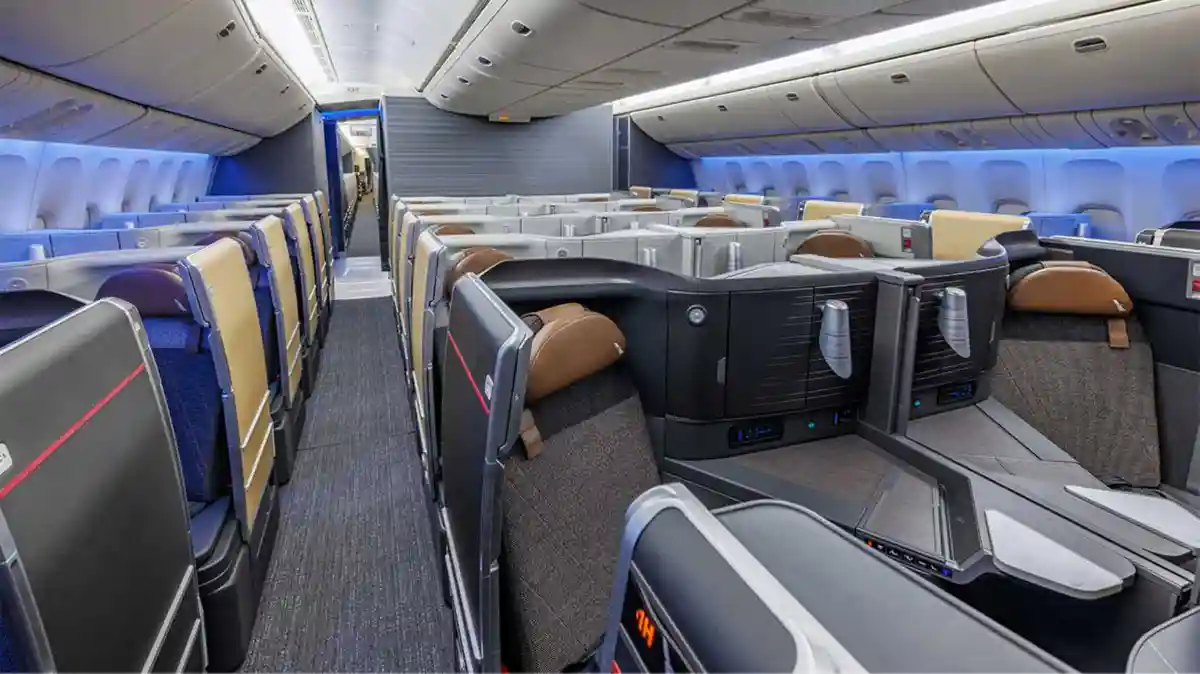
The biggest premium-cabin change is at the front of the aircraft. American is eliminating its eight-seat Flagship First cabin and replacing the space with additional Flagship Business capacity. The new 777-300ER will have 70 business-class suites, giving the aircraft 18 more business seats than before even after accounting for the removal of first class.
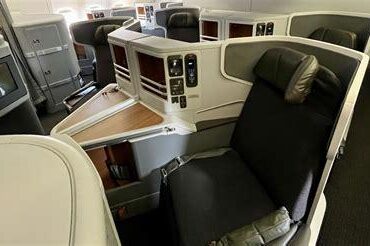
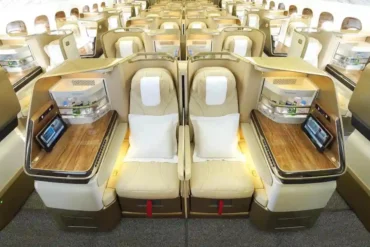
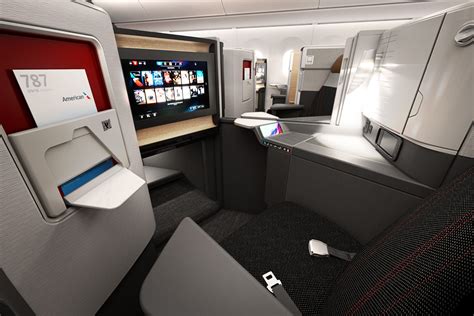
The centerpiece is the Collins Aerospace Elevate Ascent suite. The reverse-herringbone design provides direct aisle access, a high degree of privacy, and sliding doors. American had already introduced the seat on newer Boeing 787-9 Dreamliners, but the refurbished 777-300ER becomes an important part of the airline’s wider effort to establish a more consistent premium long-haul product.
The Elevate Ascent is also a significant evolution of the reverse-herringbone concept already used throughout American’s widebody fleet. Instead of treating business class simply as a larger recliner or a lie-flat seat, the new suite is designed around privacy and personal space. The sliding door is particularly important because it gives the seat a more enclosed environment that can replicate some of the privacy traditionally associated with international first class.
American is also adding eight Flagship Preferred suites at the front of the business-class cabin. These seats offer additional space, a larger entertainment display, and a counter area. The product effectively creates a premium layer within business class rather than maintaining a separate first-class cabin.
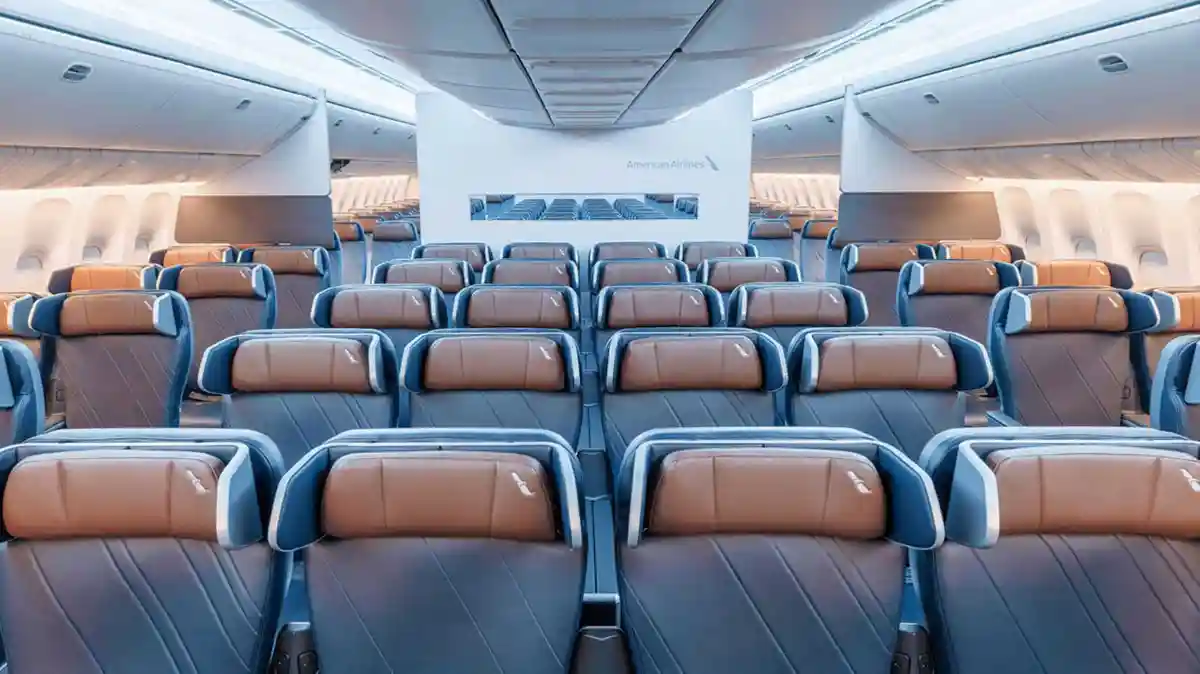
Premium Economy Expands From 28 To 44 Seats
American is also expanding its premium economy cabin from 28 seats to 44. That is an increase of 16 seats, making premium economy one of the largest beneficiaries of Project Olympus.
The cabin remains positioned behind the third set of exits, while the business-class cabin continues to occupy the forward section of the aircraft. The increased premium economy capacity follows the broader industry trend toward creating more intermediate products between traditional economy and business class.
For airlines, premium economy can provide an attractive balance between space and revenue. Passengers receive a more substantial seat and additional comfort than standard economy without paying for a full business-class experience. For American, adding 16 premium economy seats also allows the airline to monetize some of the space previously associated with the first-class operation.
However, there is a trade-off. The seat pitch in premium economy has been reduced by approximately one inch under the new configuration. While the cabin gains seats and remains more spacious than standard economy, the change shows that Project Olympus is designed around space efficiency as much as passenger comfort.
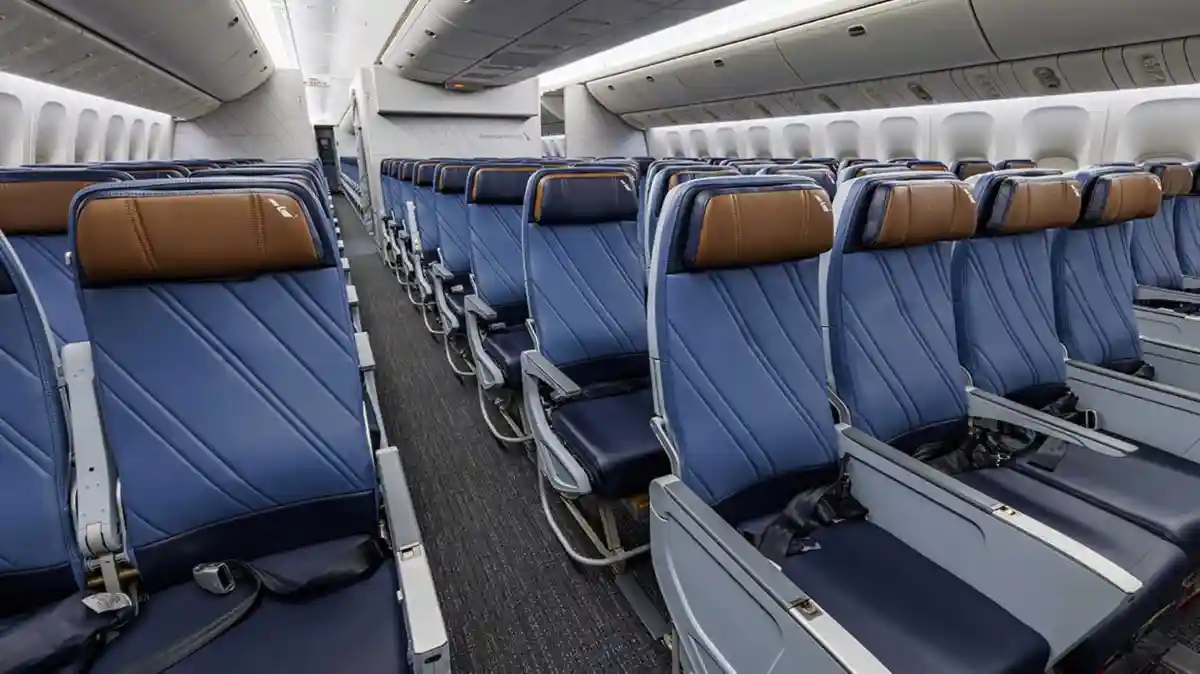
Main Cabin Extra also increases slightly, moving from 28 to 30 seats. This is a relatively modest expansion for such a large aircraft, but it gives American another way to offer additional legroom without changing the basic structure of the economy cabin.
American Keeps 216 Economy Seats
For economy passengers, the most important fact is what did not happen. American did not reduce the total number of economy seats.
The previous 777-300ER had 216 economy seats when Main Cabin Extra was included. The new aircraft also has 216 economy seats, although the internal distribution changes from 188 standard economy seats and 28 Main Cabin Extra seats to 186 standard economy seats and 30 Main Cabin Extra seats.
That means the airline has created room for 26 additional passengers without taking capacity directly away from economy. Instead, the cabin redesign removes the eight first-class seats and creates a much larger business-class section, while premium economy grows substantially.
The economics are especially interesting because American has managed to add 16 premium economy seats and 18 business-class seats while preserving the same total economy capacity. The arithmetic is possible because the old first-class cabin contained eight seats, while changes elsewhere in the aircraft recover additional usable floor space.
The major cost of that efficiency comes from the aircraft’s galley and lavatory configuration.
Project Olympus Reduces Lavatories From 12 To Nine
American’s new 777-300ER layout contains nine lavatories, compared with 12 in the previous configuration. That three-lavatory reduction is one of the clearest examples of how the airline has created space for additional seats.
Ahead of the first set of exits, American now uses two standard-size lavatories rather than one larger unit. Other lavatories have been removed or relocated around the second, third, fourth, and fifth sets of exits. The changes are closely connected to the additional business and premium economy seating installed throughout the aircraft.
The rear section receives a particularly significant redesign. American has installed a new rear galley incorporating two lavatories, while reducing the number of trolleys and the amount of dedicated working space available to cabin crew.
From the airline’s perspective, this is an efficient use of the aircraft’s footprint. A lavatory occupies floor area but does not directly generate revenue. Reallocating some of that space to passenger seats allows American to increase the number of customers carried on each flight.
For passengers and crew, however, the compromise is more noticeable. Fewer lavatories can mean greater demand during busy periods, while smaller galley areas may make meal preparation and onboard service more challenging. Project Olympus therefore illustrates the fundamental tension between aircraft efficiency and passenger convenience.
Business Class Seat Pitch Also Becomes More Efficient
The new business-class suites are not simply packed into the recovered first-class space. American has also adjusted seat pitch throughout the premium sections.
The new Flagship Business seats have a pitch of approximately 42 inches, around one inch less than the previous business-class seats. Premium economy and Main Cabin Extra also lose approximately one inch of pitch.
A single inch may sound insignificant, but the cumulative effect becomes meaningful when it is repeated across several rows. On a large aircraft with dozens of premium seats, even a small reduction in longitudinal spacing can create enough additional floor area for more passengers.
At the same time, the new seats provide features that the previous products did not offer to the same degree. The business-class suites have greater privacy, sliding doors, modern entertainment systems, and improved connectivity. American is therefore exchanging some physical pitch for a different type of premium experience.
This is an increasingly common approach in long-haul aviation. Airlines are not necessarily maximizing the number of inches around every passenger. Instead, they are trying to allocate space to features that customers may value more, including privacy, direct aisle access, storage, power, and larger entertainment screens.
Flagship First Class Is Disappearing From American’s Fleet
Project Olympus marks the final phase of American’s international first-class strategy. American has been the last major U.S. airline to maintain a dedicated international first-class product, branded Flagship First, but the 777-300ER retrofit effectively brings that era to an end.
The Boeing 777-300ER was the primary aircraft associated with Flagship First, while the airline also offered a distinct first-class product on its transcontinental Airbus A321 fleet. However, American is transitioning those aircraft toward a standard domestic configuration as newer A321XLRs become increasingly important for longer routes.
The shift reflects a broader transformation in the premium aviation market. Modern business-class seats can now convert into fully flat beds and provide direct aisle access, privacy doors, upgraded dining, high-quality entertainment, and increasingly sophisticated personal space. These features have reduced the functional gap between business class and traditional international first class.
First class can still be positioned as an ultra-luxury product, but doing so requires a substantial investment in differentiated service and an experience that goes beyond simply providing a larger seat. American’s approach instead places its premium investment behind Flagship Business and Flagship Preferred.
The airline plans to stop selling Flagship First in November 2026. During the transition, aircraft that have not yet received the new interiors will continue operating with their existing configuration, while refurbished aircraft will be marketed around the new business-class structure.
N718AN Leads American’s 777-300ER Retrofit Program
American has already placed its first refurbished Boeing 777-300ER into service. The aircraft, N718AN, has entered commercial operations with its Project Olympus interior and has flown routes connecting New York and Dallas with London.
Another 777-300ER, N721AN, has entered the refurbishment process. American currently has 20 Boeing 777-300ERs targeted for the program, with the airline aiming to complete the fleet by the end of 2027.
The aircraft remains one of American’s most important long-haul assets. Rather than replacing the 777-300ERs immediately, the airline is extending their commercial usefulness through a major interior investment. The approach allows American to introduce a new premium product while improving aircraft economics without waiting for an entirely new generation of widebody aircraft.
The retrofit also gives the airline an opportunity to standardize its long-haul premium offering. Once the 777-300ERs receive the new cabins, the fleet will no longer depend on the older Safran Cirrus II business-class seat found on most of these aircraft.
American Is Also Preparing Its 777-200ER And 787-8
Project Olympus is not an isolated program. American’s broader long-haul strategy includes significant cabin work on the 47 Boeing 777-200ERs in its fleet and its 37 Boeing 787-8 Dreamliners.
The 777-200ER program is notable because these aircraft are among American’s oldest widebodies and are expected to remain in service into the 2030s. The retrofit will give the aircraft a more premium-focused configuration while standardizing the business-class product across the fleet.
American currently has two different business-class seats on its 777-200ERs: 28 aircraft use Collins Aerospace Super Diamond, while 19 use Safran Concept D. The refurbishment will move the fleet toward a more consistent premium experience.
The 787-8 fleet is also scheduled for refurbishment. American has 37 examples, split between Collins Aerospace Super Diamond and Safran Concept D configurations. Once the program is complete, the airline will have removed another major source of variation from its long-haul cabins.
What Project Olympus Means For The Boeing 777-300ER
American’s redesigned 777-300ER ultimately represents a different philosophy about how a long-haul aircraft should use its available space. The old configuration dedicated eight seats to first class and carried 304 passengers. The new version carries 330 passengers, removes international first class, increases business class from 52 to 70 seats, expands premium economy from 28 to 44 seats, and retains 216 total economy seats.
That combination is the defining feature of Project Olympus. American is not simply adding seats everywhere. It is shifting capacity toward the cabins that the airline believes can generate stronger premium revenue while preserving economy capacity.
The trade-offs are equally clear. Passengers gain newer seats, more privacy, larger screens, Bluetooth connectivity, USB-C power, and upgraded Wi-Fi. Business-class travelers receive a much more modern suite, while premium economy becomes significantly larger. At the same time, the aircraft has fewer lavatories, smaller galley areas, and slightly tighter pitch in several cabins.
For American Airlines, the Boeing 777-300ER is therefore becoming more than a refreshed flagship. It is becoming a 330-seat premium-heavy long-haul aircraft designed around the economics of modern international travel. The disappearance of Flagship First is the most visible symbol of the change, but the more consequential transformation is hidden throughout the cabin: every section has been redesigned to extract more value from the same airframe without taking a single economy seat away from the overall capacity.