American Airlines has made an important change to the way it handles carry-on bags at the gate, but travelers should be careful about what the change actually means. The airline has not simply increased the permitted size of cabin luggage. Instead, American has been changing the boarding and bag-enforcement process, moving away from the rigid gate-side use of physical bag sizers while giving employees greater discretion over borderline bags.
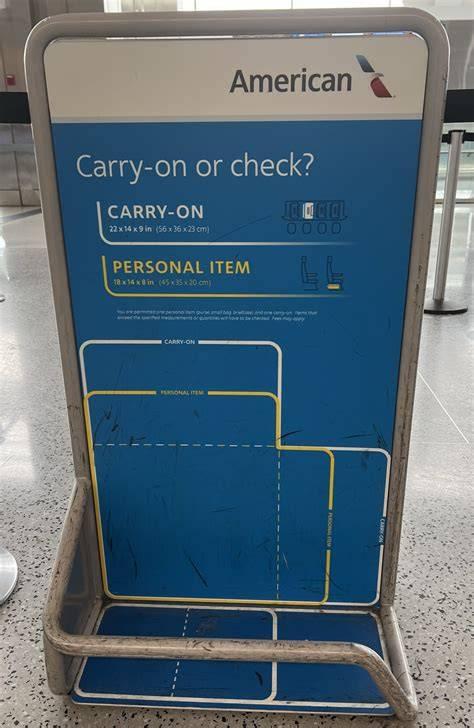
That distinction matters. A passenger who heard that American Airlines is now “allowing bigger carry-ons” could easily arrive at the airport with the wrong expectation. The published dimensions remain essentially the same: a standard carry-on cannot exceed 22 x 14 x 9 inches, including handles and wheels, while a personal item must fit within 18 x 14 x 8 inches and be capable of fitting beneath the seat ahead. American’s current published policy still says that carry-on luggage must fit the airport sizer.
The real change is more subtle and more operationally focused. American has been trying to reduce congestion during boarding by making the gate experience less dependent on passengers stopping to wrestle their luggage into a metal measuring frame. For travelers, that can mean fewer awkward confrontations and a smoother path toward the aircraft. For the airline, it is an attempt to remove one of the small but recurring bottlenecks that can turn a crowded boarding process into a race against the clock.
What Changed With American Airlines Carry-On Bags
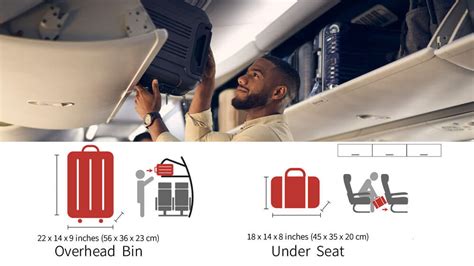
The biggest misunderstanding surrounding the policy is the idea that American Airlines has increased its carry-on size allowance. That is not what the change represents. American continues to publish a maximum carry-on size of 22 x 14 x 9 inches, including wheels and handles, and a personal-item limit of 18 x 14 x 8 inches.
What has changed is how the airline approaches enforcement at the gate. Under the previous process, passengers could be directed toward a physical sizer when an agent questioned whether a suitcase met the published dimensions. That created a very visible test. A bag either fit into the metal frame or it did not, leaving relatively little room for judgment.
The newer approach places greater emphasis on visual assessment and employee discretion at the boarding area. Instead of turning every questionable suitcase into a formal measuring exercise, agents and crew can assess whether a bag appears suitable for the aircraft’s overhead compartment. The objective is not to abandon the rules but to make enforcement less disruptive when a bag is only marginally outside the published dimensions.
This is particularly significant because boarding areas are among the most time-sensitive environments in commercial aviation. A passenger waiting to test a suitcase occupies space near the podium or jet bridge, while other passengers wait behind them. One bag check may take only a few seconds, but repeated hundreds of times across a busy operation, those seconds become meaningful.
The Carry-On Size Limit Has Not Disappeared
Travelers should still pack according to the official dimensions rather than relying on a more relaxed interpretation at the gate. American’s current carry-on page states that passengers can bring one carry-on bag plus one personal item, provided the items meet the relevant requirements.
The standard carry-on limit is 22 x 14 x 9 inches (56 x 36 x 23 cm), including the wheels and handles. The personal item limit is 18 x 14 x 8 inches (45 x 35 x 20 cm) and is intended to fit beneath the seat.
That means a traveler should not interpret the removal or reduced use of gate sizers as permission to bring a 24-inch roller bag into the cabin. The airline retains the authority to determine whether luggage can safely and practically be carried onboard. American’s conditions of carriage also state that the airline reserves the right to decide whether carry-on items are suitable and whether sufficient overhead-bin space exists.
There is another important point: aircraft and airport restrictions can differ. Smaller aircraft can have less overhead storage, and American Eagle regional flights can operate under different practical baggage procedures. Consequently, meeting the standard dimensions does not always guarantee that a bag will remain in the cabin.
Why American Airlines Is Moving Away From Gate Sizers
The reasoning behind the change is closely connected to boarding efficiency. Gate areas are already crowded with passengers, families, bags, wheelchairs, airport equipment and employees trying to coordinate a departure. Introducing a physical luggage test directly into that environment can create a bottleneck.
A passenger with an uncertain suitcase may need to stop, open the bag, reposition it, remove an item or attempt several angles before discovering whether it fits. If the bag fails, the conversation then shifts toward checking it, paying the applicable fee, removing valuables and tagging the luggage. Meanwhile, boarding continues around them.
For American Airlines, the potential benefit of eliminating that ritual is straightforward: keep passengers moving. Faster boarding can contribute to more efficient aircraft turns, fewer gate delays and a more predictable departure process.
American has also made other boarding adjustments with the same broad objective. In 2025, the airline announced changes designed to make boarding more orderly, including additional boarding time on domestic mainline flights and updated boarding groups. American specifically connected the changes with better management of overhead-bin space and fewer carry-ons being checked at the departure gate.
The carry-on change therefore makes more sense when viewed as part of a wider effort to improve the boarding operation rather than as an isolated baggage-policy experiment.
What Happens If Your Carry-On Is Too Large?
A relaxed gate-side assessment does not eliminate the possibility of a forced check. If a carry-on is clearly too large, cannot fit where it needs to go, or cannot be accommodated because of aircraft restrictions, the passenger can still be required to check it.
American’s current conditions of carriage explicitly state that bags may need to be checked at the gate when overhead bins are full or when aircraft or airport restrictions apply.
The financial consequences have also changed since the reference policy was first discussed. American’s current checked-bag policy says that, for many U.S. and nearby international markets, the first checked bag is $50 when paid at the airport or $45 when paid online, while the second is $60 at the airport or $55 online. Basic Economy tickets can carry an additional $5 charge for those first and second bags.
This is an important update because older discussions of the policy cited a $40 first-bag fee. Travelers reading older articles should not automatically assume that figure remains current.
If a carry-on is checked at the gate, passengers should immediately remove essential belongings. American specifically advises travelers to keep fragile or valuable items such as medication, keys and computers with them. Spare batteries and electronic cigarettes also have restrictions and should not simply be left inside a bag that is being transferred to the aircraft hold.
American Eagle Flights Are Different
Regional flights operated by American Eagle deserve special attention because overhead-bin space can be considerably more limited. American says that qualifying regional flights may use a valet-bag procedure, in which the carry-on is tagged at the gate and returned to the passenger on the jet bridge after arrival.
This is different from a normal checked bag that disappears into the airport baggage system and is collected from the carousel. The valet process is designed to solve a physical-space problem rather than simply punish passengers for exceeding a dimension.
There is also an aircraft-specific exception. American states that Embraer ERJ-175 aircraft allow carry-on bags and do not offer valet service under this particular procedure.
Travelers connecting between American’s mainline aircraft and regional services should therefore avoid assuming that the same boarding experience will apply throughout the itinerary.
Is American Airlines Being More Lenient?
In practical terms, the answer can be yes at the margin, but that should not be confused with a formal increase in the allowance.
The value of employee discretion is greatest when a suitcase is borderline. A soft-sided bag might compress slightly, while a rigid suitcase with the same nominal dimensions has virtually no flexibility. A passenger may also have a bag that appears large because of its wheels or handles but remains close to the published limit.
A rigid measuring device treats every bag in exactly the same way. Human assessment can account for context. That flexibility is arguably the central purpose of the change.
American’s conditions of carriage reinforce this discretion by stating that the airline retains authority over whether carry-on items are suitable and whether overhead-bin capacity is available.
Still, travelers should not deliberately exploit that discretion. A bag that is visibly oversized remains a risky choice. The safest strategy is to buy luggage that comfortably fits within the published dimensions rather than choosing a larger suitcase and hoping an agent will overlook it.
Basic Economy Passengers Still Have Carry-On Rights
Another misconception is that the change somehow affects whether Basic Economy passengers can bring a standard carry-on. American’s current Basic Economy information says that passengers can bring one personal item and one large carry-on within the applicable dimensions, although checked baggage is generally not included free of charge.
The personal item remains limited to 18 x 14 x 8 inches, while the large carry-on remains limited to 22 x 14 x 9 inches. The fare category therefore does not transform the physical dimensions of the cabin baggage.
There are, however, important exceptions involving frequent-flyer status, eligible credit cards, routes and ticket dates. American’s current Basic Economy rules have also changed in other respects, including the treatment of AAdvantage miles and Loyalty Points for tickets purchased after December 27, 2025.
That broader evolution of the fare product is worth remembering. Carry-on rules are only one part of the baggage equation, and the cost of checking a suitcase can depend heavily on the fare, destination and traveler benefits.
Free Bags Can Change the Economics
Passengers with qualifying AAdvantage status or eligible American Airlines credit cards may have baggage benefits that reduce or eliminate the cost of checking luggage. American’s Basic Economy information specifically notes that status members and eligible premium credit-card holders can receive the applicable baggage allowance when it is more favorable than the standard fare allowance.
That can make a gate check less painful for an eligible traveler than it would be for someone paying the standard airport fee.
Nevertheless, there is a practical reason to avoid an unexpected gate check even when it is free. Checked luggage can contain items a passenger needs during the flight, and the process can add inconvenience after arrival. On a mainline flight, a gate-checked bag may ultimately appear at the baggage carousel rather than being immediately available outside the aircraft.
The best approach is therefore to treat the carry-on allowance as a genuine planning limit rather than a challenge to see how much luggage can be squeezed into the cabin.
What Travelers Should Do Before Boarding
The smartest response to American’s revised enforcement approach is remarkably simple: measure the bag before leaving home. Do not wait until the gate to discover that a new suitcase is several inches too large.
It is particularly important to measure with wheels and handles included because American’s published dimensions explicitly cover them.
Travelers should also check the itinerary for regional aircraft and destination-specific restrictions. American maintains separate information on baggage limitations, including seasonal restrictions for particular destinations. Those rules can change depending on the travel period and route.
For anyone traveling with electronics, medication or documents, keeping those items in the personal item is sensible. If the larger carry-on unexpectedly has to be checked, the most important belongings will still be accessible beneath the seat.
What This Policy Means for the Passenger Experience
The most interesting part of American Airlines’ carry-on change is that it is less about luggage than about human interaction.
A strict sizer can make a passenger feel as though they are being judged by a machine. If the bag fails by a small amount, the resulting argument can feel disproportionate to the actual problem. The passenger is worried about money, inconvenience and embarrassment, while the employee is trying to keep boarding moving.
Giving gate agents greater discretion can reduce those confrontations. It does not guarantee that every traveler will receive a favorable decision, but it creates an opportunity for employees to resolve borderline situations without turning every case into a rigid pass-or-fail exercise.
That could be particularly valuable for American, an airline whose customer experience has frequently been scrutinized alongside its operational performance. A smoother boarding interaction will not fix delays, cancellations, seating complaints or baggage-handling problems. But it can remove one highly visible source of friction from the travel experience.
The Latest American Airlines Carry-On Policy in 2026
As of 2026, the central message is clear: American Airlines has not officially enlarged the standard carry-on allowance. The published maximum remains 22 x 14 x 9 inches, while the personal-item limit remains 18 x 14 x 8 inches.
The meaningful change is the way the airline manages borderline luggage and boarding-area enforcement. Physical gate sizers are being deemphasized in favor of a process that gives employees more discretion, while American continues to reserve the right to require a bag to be checked when it is too large, when overhead space is unavailable or when aircraft restrictions apply.
For travelers, that is potentially good news—but only if it is understood correctly. Pack within the published limits, expect some discretion at the gate, and never depend on that discretion.
The policy is ultimately an operational compromise. American wants passengers to board quickly, agents want fewer confrontations, and travelers want a predictable experience without surprise fees or last-minute luggage checks. Removing a metal sizer from the gate does not solve every baggage problem, but it can make one of the most stressful moments of boarding considerably less mechanical.
And that may be the real significance of the change. American Airlines is not saying that size no longer matters. It is saying that how the airline handles size matters too.