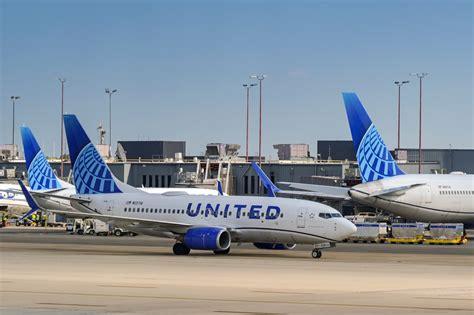
The battle over gate allocation at Chicago O’Hare International Airport (ORD) has intensified as American Airlines shifts its legal strategy in its ongoing dispute with United Airlines and the City of Chicago. After withdrawing its federal lawsuit, American has now refiled the case in the Cook County Chancery Court, aiming to block what it sees as premature and unfair preferential gate assignments to its main rival.
The High-Stakes Power Struggle at Chicago O’Hare
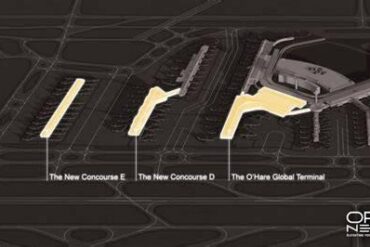
At the heart of the dispute lies O’Hare’s multi-billion-dollar expansion plan, known as “O’Hare 21”. This massive infrastructure project aims to modernize and expand one of the world’s busiest airports, including building the O’Hare Global Terminal, expanding Terminal 5, and most contentiously, enhancing Terminal 3, which is American’s primary base of operations at the airport.
The issue stems from a 2018 agreement between American Airlines, United Airlines, and the City of Chicago that temporarily paused the reassignment of preferential gates—a critical airport resource that enables an airline to control its scheduling and operations. This pause was to remain in place until three new gates in American’s Terminal 3 were completed, with a further timeline laid out for future reassessments.

American argues that the City of Chicago violated this agreement by beginning to reassign gates in favor of United before the terms had fully matured. According to American’s filings, the final of the three Terminal 3 gates was only completed on March 14, 2025, meaning the next gate redetermination shouldn’t go into effect until October 1, 2025, based on 2024 flight data. This timeline, American claims, disadvantages them because they couldn’t fully utilize the additional gates during the 2024 operational year.
American’s Legal Claims: Alleged Breach of the 2018 Accord
American’s lawsuit hinges on the contention that Chicago has prematurely and unfairly favored United by initiating a redetermination process that reallocates gates based on incomplete and unbalanced data. The airline asserts that:
- United stands to gain approximately five gates, while American would lose around four.
- These assignments are based on a redetermination schedule that was supposed to be delayed until after all three new gates in Terminal 3 were operational.
- The gate reassignment process is being accelerated at the behest of United, to the detriment of American’s competitive footing at O’Hare.
American initially sought a temporary restraining order through the federal courts but failed to obtain it—not due to a legal ruling against the merits of the case, but due to procedural or jurisdictional limitations. Now, by refiling in Cook County Chancery Court, American appears determined to force a reconsideration at the local level.
The City’s Motivation: Retaining United’s Loyalty
While no court ruling has yet determined whether the City of Chicago acted improperly, it is not hard to understand why city officials may be inclined to favor United in this scenario. United Airlines, despite being a global carrier, has deep roots in Chicago. The company’s headquarters are located in the city, although in recent years it has increasingly looked westward.

United has significantly expanded operations in Denver, which now surpasses Chicago O’Hare as the airline’s largest hub. Additionally, Colorado offers a more business-friendly tax environment, prompting speculation that United may eventually relocate its corporate base. In this context, granting United more gates at O’Hare could be interpreted as an effort by Chicago officials to retain the airline’s economic presence in the city.
From the city’s perspective, ensuring that United remains anchored in Chicago may be worth favoring the airline in contentious airport negotiations, especially with so much capital and infrastructure invested in O’Hare’s future as an international gateway.
United’s Response: Dismissing the Lawsuit as Meritless
United Airlines has not remained silent. In public statements, the carrier has labeled American’s lawsuit as “meritless,” asserting that the city’s gate allocation strategy is both fair and consistent with airport agreements. United further filed a motion to intervene, aiming to defend its interests and prevent any legal obstruction that could delay its planned growth at O’Hare.
The airline also emphasized that the expansion project benefits all carriers, not just United, and that the ongoing legal friction is distracting from the larger goals of enhancing Chicago’s international aviation footprint.
O’Hare 21: The Expansion That Fuels the Fire
O’Hare 21 is not just a backdrop—it’s the catalyst for the current confrontation. With a projected completion timeline extending into 2034, the project represents a total reimagining of O’Hare’s terminal layout, gate structure, and passenger capacity. Key developments include:
- Terminal 3 expansion: Adding three new gates for American Airlines.
- Terminal 5 enhancement: Increasing international gate capacity.
- O’Hare Global Terminal: A new state-of-the-art international facility replacing Terminal 2, set to house customs and border protection facilities.

By reshaping the airport’s infrastructure, the project inevitably alters the balance of power between carriers. The addition of new gates, especially those tied to customs and international operations, is crucial for future profitability, and both American and United are jostling for position to capitalize on the changes.
Strategic Stakes: Why Gate Access at O’Hare Matters
Gate access at major hubs like O’Hare isn’t just a matter of convenience—it’s a strategic imperative. For airlines, having more gates means:
- Increased flight scheduling flexibility.
- Higher passenger throughput.
- Enhanced ability to operate connecting hubs.
- Strengthened market share and brand visibility.
For American Airlines, losing gates in Chicago would be a significant setback. The carrier is already trailing behind United and Delta in key profitability metrics and network expansion. With United’s home-field advantage and growing dominance in Denver, American risks further marginalization in the Midwest if its footprint at O’Hare continues to shrink.
Legal Timeline and What Comes Next
The case now moves to Cook County’s Chancery Division, where American hopes for a more favorable ruling—or at least a pause in the gate reassignment process while legal arguments are fully considered. It remains unclear whether the court will issue a preliminary injunction or rule on the merits before the critical date of October 1, 2025, when gate reassignments are scheduled to take effect.
Meanwhile, construction continues across the airport. Terminal additions, roadway improvements, and new infrastructure are being built, even as the two largest U.S. carriers at ORD are locked in a bitter turf war. Legal experts suggest that unless a negotiated settlement is reached, the battle could stretch out for months, potentially delaying aspects of O’Hare 21 or altering its operational roll-out.
The Bigger Picture: Aviation Politics and Economic Geography
This lawsuit isn’t just about gates—it reflects the broader politics of aviation infrastructure in America. Major airports are deeply entangled in local economies, employment patterns, and geopolitical influence. Cities like Chicago must balance multiple interests: retaining corporate headquarters, maximizing passenger flow, ensuring fair competition, and maintaining their status as aviation hubs.
United’s threat to move headquarters, combined with Denver’s rise as its top hub, gives it leverage. American’s recourse, then, is through legal action—hoping to slow down what it sees as an uneven playing field and push for adherence to agreed terms.
Ultimately, the question is whether O’Hare can be a fair field for all major carriers or whether the hometown airline gets preferential treatment.
Conclusion: A Legal Tug-of-War With High Operational Stakes
As the American Airlines vs. United Airlines legal battle unfolds, its outcome could shape the operational dynamics of O’Hare for decades. For American, protecting its gate access at one of the busiest and most competitive airports in the world is not just about equity—it’s about survival in a market where strategic footholds dictate long-term profitability.
The Cook County courts now hold the key to determining whether Chicago’s gate allocations reflect fair governance or strategic favoritism. As infrastructure reshapes the airport, the legal frameworks surrounding it will determine who gets to grow—and who is left waiting at the terminal.