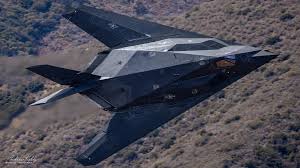
Stealth has never been a single invention or a magic coating sprayed onto an airplane like science fiction invisibility paint. It is an evolving philosophy of design, materials science, electromagnetic theory, software, and operational doctrine. The United States did not simply stumble into stealth aviation; it methodically engineered it across decades of classified programs, brutal testing, and strategic necessity. From angular Cold War experiments to flying supercomputers commanding drone swarms, American stealth jets reflect how airpower quietly reshaped modern warfare.
The concept of stealth revolves primarily around radar cross-section, or RCS, a measure of how visible an object appears to radar systems. Smaller RCS values mean an aircraft blends into background noise, becoming harder to track, target, and engage. But radar is only part of the story. Infrared signatures, acoustic output, electronic emissions, and even maintenance discipline all contribute to whether a jet truly disappears into contested airspace. What follows is not a simple ranking, but a deep look into the most elusive manned military jets ever fielded by the United States, each representing a decisive leap forward in how wars are fought before the enemy knows one has begun.
Stealth aircraft are often misunderstood as fragile or narrowly specialized. In reality, they are among the most survivable platforms ever built, precisely because they rewrite the engagement timeline. Detection is delayed, response windows shrink, and adversary decision-making collapses under uncertainty. That strategic disruption is the true weapon, and it is why stealth jets remain among the most guarded assets in the American arsenal.
Lockheed F-117 Nighthawk: The Aircraft That Changed Warfare
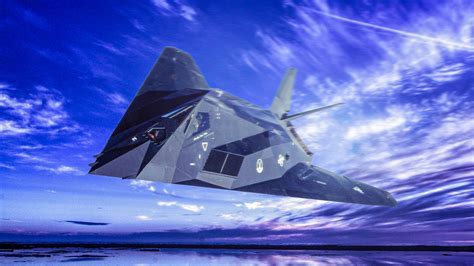
The Lockheed F-117 Nighthawk occupies a singular place in aviation history, not because it was fast or maneuverable, but because it proved stealth worked in combat. Developed in absolute secrecy by Lockheed’s Skunk Works, the F-117 was engineered at a time when computing power was so limited that designers had to approximate radar reflections using flat, faceted surfaces. The result looked alien, almost absurd, yet it rewrote the rules of air defense overnight.
Designed primarily to penetrate dense Soviet-style air defense networks, the F-117 was optimized for precision strike rather than air combat. Its angular geometry scattered radar waves away from their source, while radar-absorbent materials further dampened returns. With an estimated frontal RCS between 0.001 and 0.01 square meters, the jet appeared on radar as something closer to background clutter than a combat aircraft.
Combat validated the theory. During Operation Desert Storm, F-117s flew directly over the most heavily defended targets in Iraq, striking command bunkers and infrastructure with near impunity. Not a single Nighthawk was lost to enemy fire during the campaign. Even decades later, its stealth performance remains formidable, particularly when viewed head-on, a testament to how far ahead of its time the design truly was.
The F-117’s continued limited service underscores an important truth: stealth is not obsolete just because technology ages. Properly employed, even first-generation stealth can still embarrass modern air defenses built around flawed assumptions.
Lockheed F-22 Raptor: Air Dominance Perfected
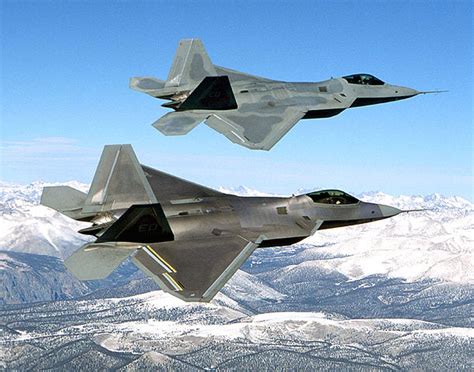
If the F-117 proved stealth was possible, the Lockheed F-22 Raptor proved it could dominate the skies. Conceived during the Cold War to counter next-generation Soviet fighters, the F-22 became something far more ambitious: an air superiority platform so advanced it forced analysts to invent the concept of “fifth-generation” fighters just to describe the gap it created.
The Raptor combines extreme stealth with supercruise capability, thrust-vectoring agility, and sensor fusion that gives pilots an almost unfair awareness of the battlespace. Its estimated frontal RCS, often cited as 0.0001 to 0.0005 square meters, is smaller than many birds, making detection at long range exceptionally difficult. Unlike earlier stealth aircraft, the F-22 achieves this without sacrificing speed or maneuverability, allowing it to dictate when and how engagements occur.
Operational exercises routinely demonstrate the Raptor’s lopsided effectiveness. In simulated combat, F-22s often achieve kill ratios so extreme they border on the absurd. Losses, when they occur, are notable precisely because they are rare. This is not a fragile aircraft sneaking past defenses; it is a predator that arrives unseen, strikes decisively, and leaves before the enemy realizes a fight occurred.
Despite production ending early due to cost and shifting priorities, the F-22 remains unmatched in pure air dominance. Upgrades, including improved stealth coatings, sensors, and compatibility with Collaborative Combat Aircraft, ensure it will remain lethal well into the 2040s.
Lockheed Martin F-35 Lightning II: Stealth as a System
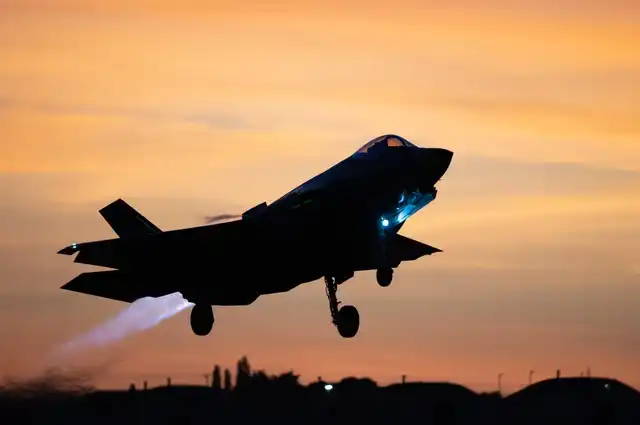
The F-35 Lightning II represents a different philosophy of stealth, one less focused on singular dominance and more on networked warfare. Designed as a multirole platform, the F-35 exists in three distinct variants, each tailored for conventional runways, short takeoff and vertical landing, or carrier operations. Despite these differences, all share a core stealth architecture optimized for penetrating contested airspace.
With an estimated frontal RCS between 0.001 and 0.005 square meters, the F-35 is less stealthy than the F-22 in pure radar terms. However, that metric alone misses the point. The Lightning II’s true strength lies in its sensor fusion, electronic warfare capabilities, and ability to act as an airborne intelligence node. It does not merely avoid detection; it maps, disrupts, and dismantles enemy defenses in real time.
In international evaluations, the F-35 consistently outperforms competitors by a wide margin. Its ability to integrate radar, infrared, electronic support measures, and offboard data into a single coherent picture gives pilots unprecedented situational awareness. This transforms not only how missions are flown, but how entire air campaigns are planned.
The aircraft continues to mature through software-driven upgrades, meaning its stealth effectiveness is not static. As adversary sensors evolve, so too does the F-35’s ability to confuse, deceive, and survive. It is stealth not as a feature, but as a constantly evolving capability embedded within a broader combat ecosystem.
Northrop Grumman B-21 Raider: The Silent Core of Deterrence
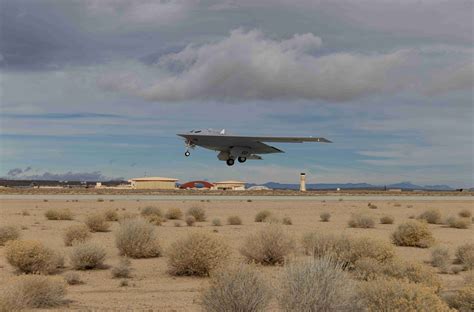
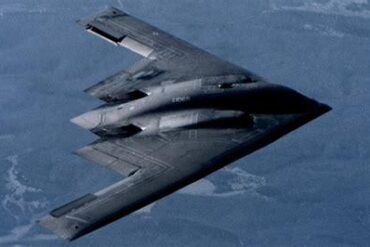
The B-21 Raider shifts the stealth conversation from fighters to strategic dominance. While often compared to the B-2 Spirit, the Raider is not merely a replacement; it is a fundamental reimagining of what a stealth bomber can be in the age of networked warfare. Designed to penetrate the most advanced air defense systems on Earth, the B-21 is expected to operate deep inside denied environments with minimal support.
Exact performance details remain classified, but estimates place its radar cross-section at less than or equal to 0.00001 square meters, potentially two orders of magnitude lower than earlier stealth bombers. Its smooth, blended design minimizes radar, infrared, and acoustic signatures while maximizing payload flexibility and mission adaptability.
More importantly, the B-21 is built as a system-of-systems platform. It is expected to command drones, coordinate with fighters, and act as a flying command center rather than a solitary bomber. This blurring of roles hints at a future where distinctions between bomber and fighter dissolve, replaced by stealthy nodes in a distributed combat web.
As the backbone of future nuclear and conventional deterrence, the B-21’s stealth is not about surprise attacks, but about certainty. It ensures that no adversary can confidently believe their defenses are impenetrable, a psychological advantage as powerful as any weapon it carries.
Boeing F-47: The Next Evolution of Invisibility
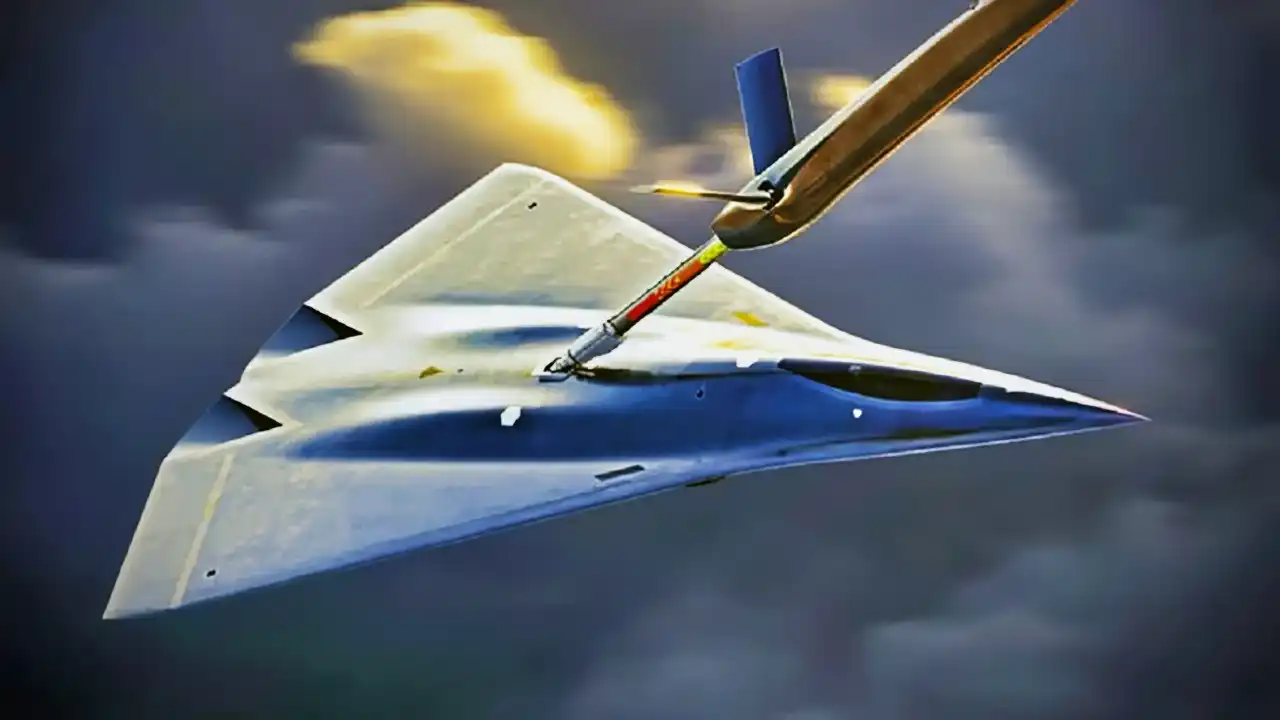
At the cutting edge of American stealth aviation sits the Boeing F-47, the manned centerpiece of the Next Generation Air Dominance program. Unlike previous fighters, the F-47 is not designed as a standalone aircraft but as the command node of a manned-unmanned team, orchestrating Collaborative Combat Aircraft in highly contested airspace.
Public details are scarce by design. What is known suggests a platform optimized for extreme stealth, adaptive sensors, and seamless integration with autonomous systems. Speculative estimates place its frontal RCS between 0.00001 and 0.00005 square meters, rivaling or surpassing even the F-22. If accurate, this would render the aircraft detectable only at very short ranges, even by the most advanced radars.
The F-47’s importance lies less in dogfighting and more in decision dominance. By fusing vast amounts of data and delegating tasks to loyal wingman drones, it compresses the enemy’s observe–orient–decide–act loop to the point of failure. Engagements may be decided before an adversary realizes a human pilot is present at all.
In this sense, the F-47 represents the logical endpoint of stealth evolution: not just hiding aircraft, but hiding intent, timing, and command structures within a fog of uncertainty the enemy cannot penetrate.
Stealth, in the American context, has never been about invisibility alone. It is about control of perception, manipulation of information, and the strategic paralysis of opponents who realize too late that the sky above them was never empty.