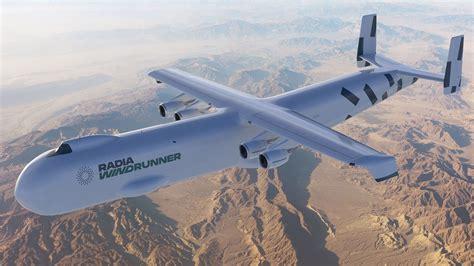
The world is at a turning point. As we shift urgently toward sustainable energy, infrastructure must evolve to support this transformation. One of the boldest technological responses to this global challenge is the WindRunner, a revolutionary aircraft being developed by Radia. Designed not for passengers, but for purpose, WindRunner will soon become the largest aircraft ever constructed — not in pursuit of speed or luxury, but to enable the mass deployment of next-generation onshore wind turbines to previously unreachable corners of the world.
The Vision Behind WindRunner: Radia’s Energy Mission
Founded in 2016 in Boulder, Colorado, Radia is not your typical aerospace firm. Spearheaded by CEO and aerospace engineer Mark Lundstrom, a graduate of the Massachusetts Institute of Technology, Radia was built on a vision to merge aerospace innovation with energy decarbonization. Unlike traditional aircraft manufacturers, Radia is fully committed to the energy sector, aiming to solve the logistical challenges involved in transporting massive wind turbines to remote locations.

Onshore wind energy is poised to become one of the primary pillars of renewable electricity production, forecast to contribute up to 41% of global energy by 2050 according to the IEA and BloombergNEF. However, transporting the latest ultra-efficient, ultra-large turbine blades — some stretching over 230 feet (70 meters) — remains a significant barrier. Most existing transportation relies on a complex and expensive mix of road and rail, severely limiting the locations where such turbines can be deployed.
Radia’s solution is as radical as it is elegant: bypass the road entirely. By designing aerial logistics systems capable of carrying oversized wind turbine components, Radia aims to unlock vast new territories for renewable energy deployment — particularly in regions previously deemed inaccessible.
Introducing WindRunner: An Aircraft Without Precedent
WindRunner is unlike any aircraft the world has seen. Built specifically to haul gigantic wind turbine blades and components, its size and design serve one goal: efficient, reliable, and direct cargo transport to remote wind farm sites.
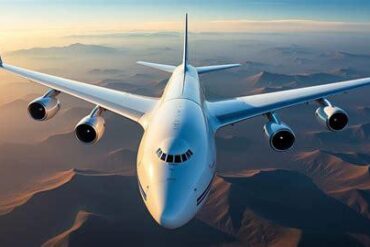
At 356 feet (108 meters) in length, with a wingspan of 261 feet (80 meters) and a maximum cargo height of 24 feet (7.3 meters), WindRunner dwarfs every existing freighter. It will be capable of carrying payloads up to 344 feet (105 meters) in length and 160,000 lbs (72,575 kg) in weight. For comparison, the iconic Boeing 747-400F freighter has just one-twelfth the cargo volume of WindRunner.
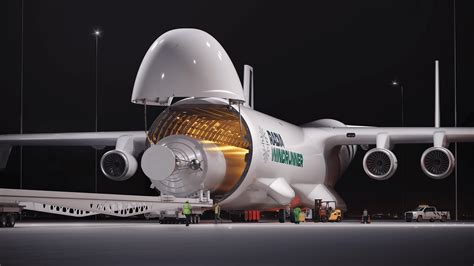
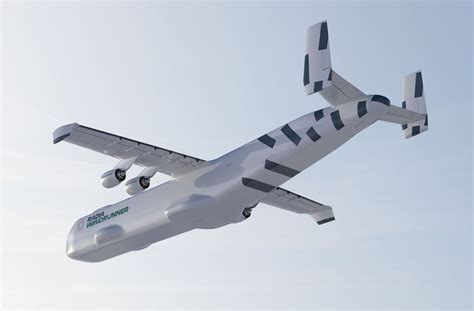
The design features a monocoque fuselage, a raised flight deck, and an enormous cargo bay accessible through a forward-hinged nose cargo door — echoing the design of the Boeing 747 freighter but on a colossal scale. The four-engine layout is mounted under a high wing with drooped wingtips, while the tail configuration includes a twin vertical stabilizer mounted on a single horizontal stabilizer — optimizing control for heavy-lift operations.
Operational Strategy: Beyond Runways and Roads
What makes WindRunner extraordinary is not just its size, but its operational flexibility. Unlike typical superfreighters, which require vast infrastructure, WindRunner is engineered to operate from unprepared or semi-prepared landing strips. This capability means it can land much closer to turbine installation sites, eliminating the need for final-mile transport via road.
Despite its bulk, WindRunner requires just 6,000 feet (1,800 meters) of runway, far less than comparable aircraft like the Antonov An-225 or Airbus Beluga XL. Its mission range of 1,200 miles (2,000 kilometers) and cruise ceiling of 41,000 feet (12,500 meters) at Mach 0.6 ensures it can fly point-to-point from turbine factories to isolated deployment zones efficiently.
This operational footprint will increase available land for large onshore wind installations by a factor of three, dramatically shifting the global wind power landscape. By airlifting blades directly, WindRunner will cut construction timelines, reduce costs, and enable rapid deployment of renewable infrastructure in developing nations, mountainous regions, and inland plains.
Technical Superiority: Breaking Every Aviation Record
Once WindRunner receives full certification, it will unseat every existing aircraft in terms of sheer volume and scale. With a cargo bay volume of 272,000 cubic feet (8,200 cubic meters), WindRunner will offer over six times the capacity of the Antonov An-124, and more than three times that of the Airbus Beluga XL.
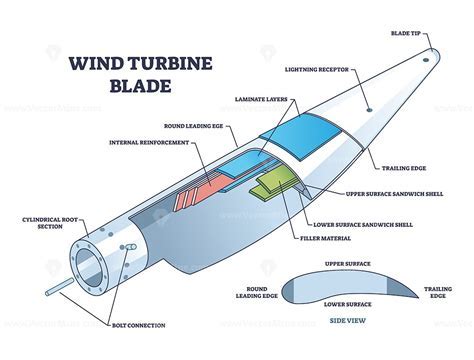
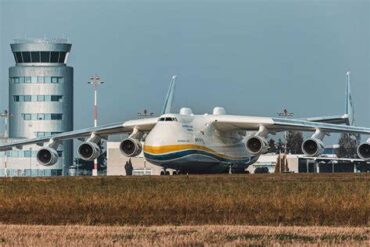
This aircraft will also surpass the destroyed Antonov An-225 ‘Mriya’, previously the world’s largest aircraft. Mriya had a maximum payload of around 250,000 kg, but WindRunner’s purpose-built interior dimensions for turbine blades and clean energy components allow it to deliver ultra-long payloads that even Mriya could not accommodate due to fuselage constraints.
GigaWind and the Renewable Expansion
WindRunner isn’t an isolated concept. It is part of Radia’s broader initiative called GigaWind, a strategic plan to partner with wind turbine manufacturers and developers to build a new generation of wind farms optimized around WindRunner’s capabilities.
Rather than merely delivering components, Radia plans to redefine how and where onshore wind farms are built. By transporting ultra-large turbines to locations previously deemed inaccessible, Radia aims to increase the cost-efficiency and output of new installations. This opens the door to wider geographic distribution of wind energy infrastructure, enabling nationwide grids to benefit from renewables on a much larger scale.
Already, Radia is working with partners such as LS Power, Good Growth Capital, and ConocoPhillips, having raised nearly $100 million in funding. The company is building relationships with energy giants and aerospace contractors alike to ensure WindRunner’s development remains on schedule.
Collaborative Aerospace Engineering: Building WindRunner
To bring WindRunner to life, Radia is working with a suite of top-tier aerospace collaborators:
- Aernnova is leading the wing and engine pylon design.
- Leonardo, a global aerospace leader, is tasked with the fuselage development.
- AFuzion provides regulatory safety consulting, helping guide FAA certification.
Rachel Kelley, Radia’s VP of Aircraft Development — formerly Boeing’s Director of Engineering for Air Force One — is spearheading the technical side. She emphasized that existing aerospace technologies are being used wherever possible to streamline production and speed up regulatory approval. WindRunner will integrate proven engines, avionics, and materials, reducing risk and ensuring robust performance.
Kelley believes that the onshore wind market, potentially worth over $10 trillion by 2050, will require “dozens” of WindRunner aircraft. The team also includes a former FAA certification officer, ensuring early and frequent engagement with the regulator throughout the aircraft’s development cycle.
A Decade-Defining Innovation for Climate and Aerospace
WindRunner is more than just an aircraft — it is a climate enabler, an aerospace marvel, and an economic catalyst. Its mission is aligned with the global imperative to decarbonize, electrify, and decentralize power generation. As climate change accelerates and renewable energy becomes not just ideal but essential, the logistics of infrastructure deployment will determine whether nations can meet their goals.
With its anticipated entry into service by the end of this decade, WindRunner could unlock new economies of scale for wind energy, allowing onshore wind to reach parity with offshore installations in terms of performance and reliability. Furthermore, it will establish new benchmarks in aviation, proving that the aerospace sector can play a critical role in planetary-scale sustainability.
Conclusion: WindRunner’s Lasting Impact
As we look ahead to a future increasingly dependent on clean energy, logistics and access remain the defining bottlenecks. Radia’s WindRunner proposes a radical leap forward — not in theory, but in engineering reality. It is a solution shaped by necessity, refined by aerospace expertise, and backed by the promise of renewable transformation.
From gigantic turbine blades to remote desert and mountain deployment sites, WindRunner will reshape not only how we move cargo but also how we define possibility. As the first aircraft built for the climate era, WindRunner is poised to become not just the largest plane ever built, but also the most consequential.