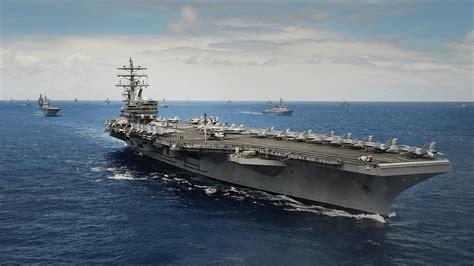
For more than a century, aircraft carriers have been the centerpiece of naval power projection, serving as floating airbases capable of launching and recovering a variety of aircraft. From the pioneering days of the HMS Furious in 1917 to the modern supercarriers of today, these colossal vessels have hosted countless aircraft types — fighters, helicopters, drones, and fixed-wing support planes. Yet, in the long history of naval aviation, one aircraft holds an unmatched record: the largest plane to ever land on an aircraft carrier — the Lockheed Martin C-130 Hercules.
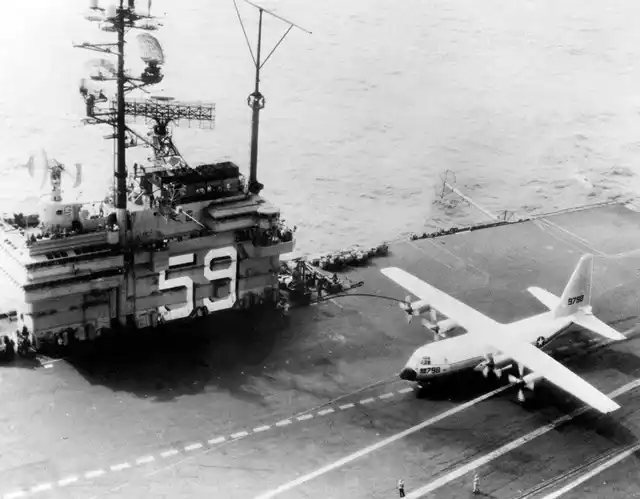
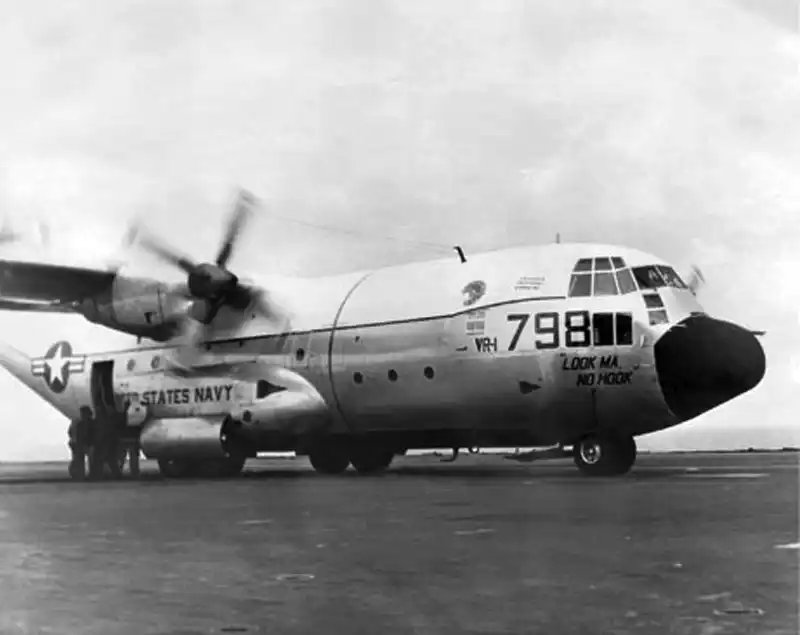
This remarkable feat of aviation occurred in 1963, when a KC-130F, a variant of the Hercules designed for aerial refueling and tactical airlift, successfully landed and took off from the deck of the USS Forrestal (CVA-59). The tests, conducted over multiple days, showcased not just the limits of carrier operations but also the Herculean capabilities of the C-130 — a transport aircraft that dwarfed the size and weight of any plane typically seen on a carrier.
Why the C-130 Hercules Was So Special
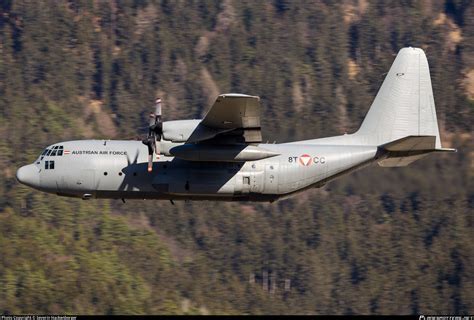
The C-130 Hercules, first introduced in 1954, has long been a cornerstone of military transport operations worldwide. Built by Lockheed Martin, the Hercules is a four-engine turboprop aircraft designed for tactical airlift, logistical resupply, and special operations. By 2025, more than 2,500 units have been produced for use by the United States and allied forces, proving its enduring value.
What made the C-130 stand out among aircraft attempting carrier operations was its sheer size and weight. At full load, the KC-130F variant used in these tests tipped the scales at 121,000 pounds, carrying up to 31,000 pounds of cargo. To put this into perspective, a fully loaded F-4 Phantom II — one of the most formidable carrier-based fighters of the era — weighed about 58,000 pounds, making the C-130 more than twice as heavy.
The Challenges of Landing a Giant on a Floating Airfield
Aircraft carriers are designed with catapults and arresting gear systems to help fighter jets take off and land on their short decks. However, the C-130 had neither. For the 1963 tests, the KC-130F had to rely solely on its braking power and reverse thrust to stop on the USS Forrestal’s 1,050-foot flight deck — barely half of the 2,000 feet typically required for its land operations.
In essence, the C-130 had to do what many deemed nearly impossible: land a massive transport plane on a moving runway at sea without the benefit of traditional carrier support systems. After the first successful touchdown, the crew proudly painted the now-famous slogan on the fuselage: “LOOK MA, NO HOOK.”
The USS Forrestal: A Platform for the Impossible
The USS Forrestal (CVA-59) was the first of the Forrestal-class supercarriers, commissioned in 1955 and boasting a flight deck over 1,000 feet long. While this made it one of the largest carriers in the world at the time, it was still not designed to handle an aircraft of the C-130’s size.
During the trials, the deck crew cleared all obstacles, providing maximum landing space for the Hercules. Over several days in October and November 1963, the KC-130F performed 21 successful takeoffs and landings, each time at varying weights, simulating different operational scenarios. These included both light-load and heavy-load configurations to test the aircraft’s performance envelope.
Performance During the Trials
The trials were nothing short of spectacular. Below is a summary of key performance data from the KC-130F during its USS Forrestal carrier operations:
| Parameter | Value |
|---|---|
| Aircraft Variant | KC-130F |
| Maximum Landing Weight | 121,000 lbs |
| Maximum Payload Carried | 31,000 lbs |
| Typical Runway Requirement | ~2,000 ft |
| Carrier Deck Length | 1,050 ft |
| Number of Landings | 21 |
| Number of Takeoffs | 21 |
| Catapult/Arresting Used | None (self-powered) |
Why Was This Test Conducted?
The trials were motivated by a simple but critical need: resupplying carriers more efficiently. While smaller carrier onboard delivery (COD) aircraft, such as the Grumman C-1 Trader, were adequate for transporting personnel and light cargo, they could not carry the bulk loads required for sustained operations at sea. The C-130 offered unmatched cargo capacity, meaning fewer trips would be needed to deliver essential supplies.
If successful, it would have enabled aircraft carriers to be resupplied directly from long-range bases without requiring additional port stops or transfer from smaller supply ships — an enormous logistical advantage during extended deployments.
Why Was It Never Put Into Regular Service?
Despite the technical success of the trials, the concept was ultimately deemed impractical for routine use. The C-130 was simply too large for standard carrier operations. Landing such a massive aircraft on a flight deck required near-perfect conditions, an extensively cleared deck, and intense crew coordination. This limited its operational feasibility during real-world combat scenarios, where carriers need to remain ready for immediate fighter operations.
Instead, the Navy opted to continue using smaller, purpose-built COD aircraft, which provided a balance of cargo capacity, maneuverability, and safety for routine operations. The Hercules, however, continued its legendary service as a versatile transport plane worldwide.
The Legacy of the KC-130F Carrier Landings
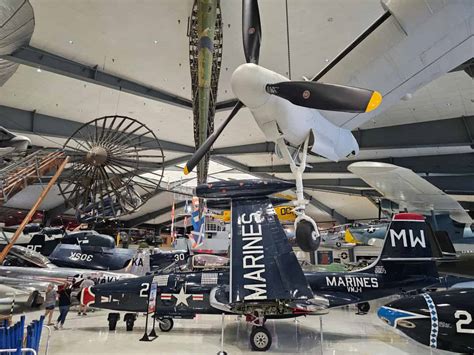
The KC-130F that participated in these trials wasn’t just any test plane — it became a symbol of innovation and daring within naval aviation history. After completing its service life, the aircraft was retired and placed on display at the National Naval Aviation Museum at Naval Air Station Pensacola, Florida, where it remains a testament to the boldness of Cold War-era experimentation.
Why This Achievement Still Matters
Even decades later, the successful landing of the largest plane ever to land on an aircraft carrier remains a benchmark of engineering and pilot skill. It expanded the understanding of what could be accomplished with short takeoff and landing (STOL) aircraft, influenced the development of later naval transport solutions, and highlighted the adaptability of the C-130 platform — a design so enduring that it remains in service in 2025.
Conclusion
The Lockheed Martin C-130 Hercules was never designed to operate from aircraft carriers, yet in 1963, it achieved what many believed to be impossible: landing and taking off from the USS Forrestal without the assistance of catapults or arresting gear. This feat was not just a testament to the aircraft’s robust engineering but also a milestone in the history of naval aviation. While it never became a standard practice, the trials showcased the boundless possibilities of carrier operations and secured the Hercules’ place in aviation history as the largest plane ever to land on an aircraft carrier.
FAQs
What is the largest plane to ever land on an aircraft carrier?
The Lockheed Martin C-130 Hercules (KC-130F variant) holds the record as the largest and heaviest aircraft ever to land on an aircraft carrier, specifically the USS Forrestal (CVA-59) in 1963.
How many times did the C-130 land on a carrier?
During the trials, the KC-130F performed 21 successful landings and 21 takeoffs on the USS Forrestal without using catapults or arresting gear.
Why didn’t the Navy use the C-130 regularly for carrier deliveries?
Despite its impressive performance, the C-130 was too large and impractical for routine carrier operations. It required a fully cleared deck and perfect conditions, making it unsuitable for the dynamic environment of active naval deployments.