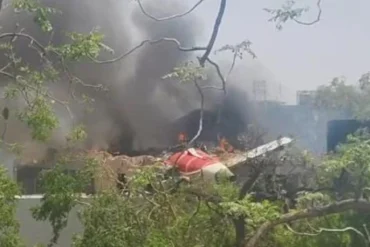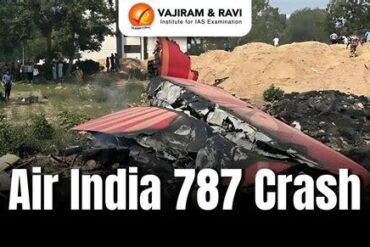
On a quiet Thursday morning, Air India Flight AI171, a Boeing 787-8 Dreamliner en route from Ahmedabad to London Gatwick, plummeted from the skies just seconds after takeoff, killing 241 of the 242 souls on board. This catastrophic event has ignited a storm of speculation and technical analysis. But amidst the fog of unverified assumptions, Captain Ehsan Khalid, a veteran Indian Air Force pilot and aviation expert, offered a chillingly precise breakdown of what might have gone wrong.
A Flight That Lasted Just 32 Seconds
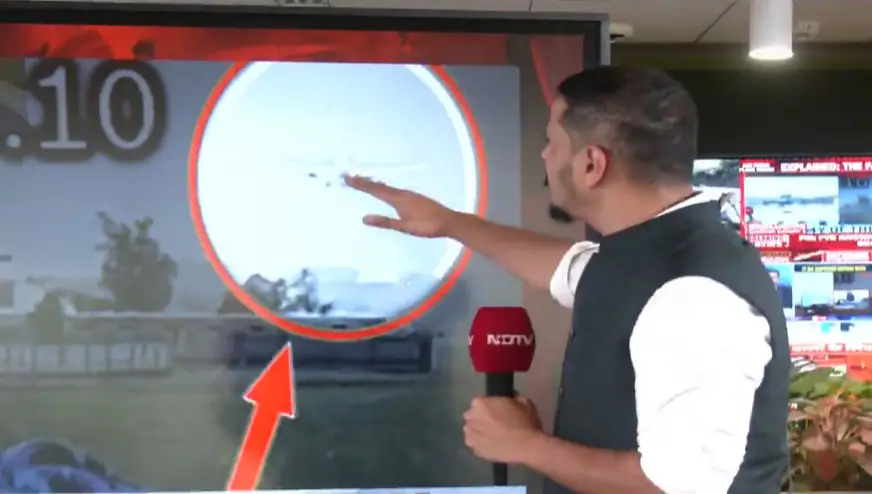
The flight lasted a mere 32 seconds from rotation to impact—an incomprehensibly short window for any commercial aircraft to encounter and recover from an emergency. In a world where air disasters often unfold over agonizing minutes, the abruptness of this crash has become one of its most haunting characteristics. According to Captain Khalid, the aircraft barely achieved an altitude of 200 to 250 feet, despite erroneous early reports suggesting 625 to 825 feet.
This height is critical because it marks the very edge of what is known as the “ground effect”—a cushion of air that assists lift just after takeoff. “Once you leave the ground effect, you’re on your own,” said Khalid. “If there’s a loss of power, or airspeed drops, the aircraft doesn’t have the aerodynamic support it did closer to the ground.”
The Persistent Landing Gear: A Key Red Flag
One of the most glaring anomalies observed in crash videos is that the landing gear remained extended throughout the flight. In commercial aviation, the landing gear is almost always retracted immediately after positive climb is established. Khalid confirms this, explaining that pilots retract the gear to reduce drag and ensure a smooth climb—unless they are in wind shear or committed to a landing.
“The fact that it stayed down is a red flag. It suggests that something interrupted standard procedure,” Khalid said. Possible explanations include system malfunction or an emergency so urgent that the pilot had no time or need to raise the gear.
The Role of Flaps and Flight Automation
Another hotly debated aspect of this disaster is the flap configuration at the time of takeoff. Flaps are critical aerodynamic devices that augment lift at lower speeds, particularly during takeoff and landing. Early still images prompted speculation that the flaps might have been retracted too early or improperly set.
Khalid, however, decisively rejects this theory. “Modern aircraft like the Boeing 787 have auto-retraction mechanisms for flaps,” he said. “The aircraft is smart. If flaps aren’t set correctly, the system screams ‘WRONG CONFIGURATION’ repeatedly. You simply can’t take off without correcting it.”
Indeed, unless there was a loss of sensor input, electrical failure, or flight computer malfunction, a flap error seems highly improbable. And yet, a catastrophic loss of lift did occur.
Was It a Bird Strike or Sensor Failure?
While speculation abounds, Khalid proposes one of the most technically probable scenarios: a bird strike or sensor failure shortly after liftoff. Ahmedabad’s airspace, like many urban airfields in India, is teeming with bird activity. A bird ingestion into one or both engines could trigger not just a loss of thrust, but also disable critical sensors responsible for airspeed and angle-of-attack data.
“The aircraft could have suffered a cascading failure,” said Khalid. “One event—such as a bird strike—could result in a loss of power, inaccurate airspeed readings, or even electrical short circuits.”
This theory gains weight from the fact that the pilots issued a “Mayday” distress call, indicating visual or sensory confirmation that the aircraft was experiencing serious mechanical or aerodynamic distress.
Control Inputs Prove Pilot Was Fighting for Control
Conspiracy theories around control surface jams have circulated, but Khalid debunks this with evidence visible in the crash videos. “You can clearly see the aircraft still pitching up during the descent,” he said. “That means the elevators were responding. The pilot was actively flying the plane.”
This small but critical detail means the aircraft wasn’t completely out of the pilot’s hands. They were still fighting to save the flight, even as lift continued to degrade.
Automation Vs. Catastrophic Failure
The Boeing 787 Dreamliner is one of the most technologically advanced aircraft in the world, boasting multiple redundancy systems. So how did such a failure get past the defenses?
“Redundancy isn’t immunity,” Khalid reminds us. “Even the most sophisticated systems can be brought down by a cascade of small but deadly failures.” In this case, a probable bird strike might have disrupted the airspeed indicators, caused a false reading, which in turn could have confused the flight computer or led the pilots to make incorrect pitch or throttle decisions.
Moreover, the landing gear and flap anomalies could be automated responses to faulty inputs—signals that misled the aircraft’s software into believing it was still landing or hadn’t completed takeoff procedures.
The Black Box: The Final Truth Awaits
While expert analysis provides some clarity, the Flight Data Recorder (FDR) and Cockpit Voice Recorder (CVR)—together known as the black boxes—will offer the definitive answers. These devices capture every second of cockpit conversation, control input, engine performance data, and airspeed.
Khalid is clear on this: “Until we analyze the black boxes, we cannot confirm the root cause. But based on current visual and flight behavior, loss of lift due to low airspeed or sensor malfunction remains the leading hypothesis.”
The Human Factor: A Crew Pushed Beyond the Edge
Aviation disasters often uncover not just mechanical faults but moments of human bravery and limitation. “The crew issued a Mayday. They pitched up, trying to stay aloft. They kept the aircraft level as long as they could,” Khalid said. In those final seconds, the pilots weren’t panicking. They were actively flying, actively problem-solving, in an environment where nothing was working as expected.
The fact that only one person survived this tragedy makes it even more emotionally devastating. But from an investigative standpoint, that lone survivor may hold vital information—especially if they recall sensory cues, warnings, or sudden movements in the aircraft.
What This Means for Indian Aviation
The crash of AI171 has once again cast a harsh spotlight on aviation safety protocols in India. While the Boeing 787 Dreamliner has a sterling global record with over 30 million flight hours, no system is impervious when ground conditions—like bird strikes—become unpredictable variables.
“This wasn’t a systems failure in the classic sense,” Khalid emphasizes. “It was a confluence of external interference, sensor confusion, and perhaps minor mechanical irregularities that turned catastrophic within seconds.”
Conclusion: An Anatomy Still Unfolding
The crash of Air India Flight AI171 is not just an aviation tragedy but a complex case study in the fragile relationship between man, machine, and nature. While experts like Captain Ehsan Khalid provide critical forensic insight, the true sequence of failures—technical and human—will only become fully clear once data analysis concludes.
Until then, this disaster serves as a grim reminder of how even the most advanced aircraft can be humbled by the chaotic variables of real-world flying.