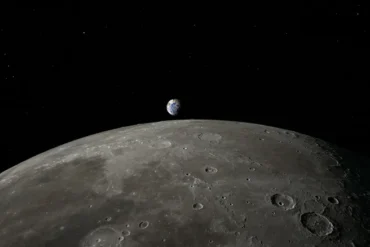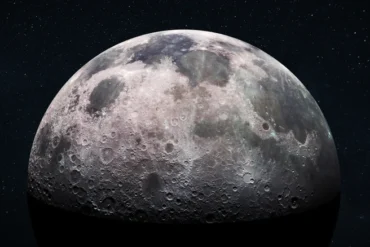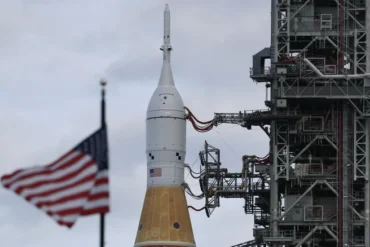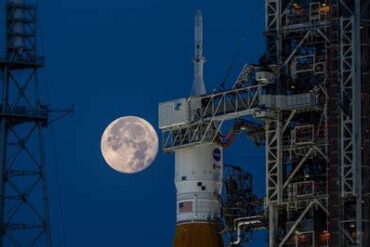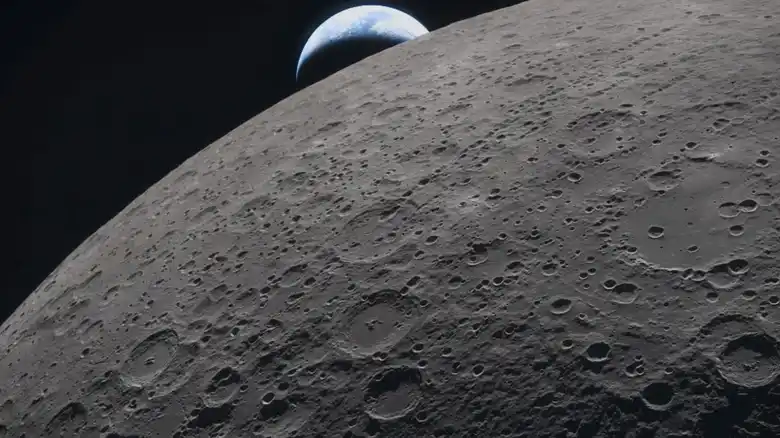
The Artemis II mission has quietly rewritten one of humanity’s most enduring assumptions: that the Moon is a lifeless, monochrome world. What astronauts aboard NASA’s Orion spacecraft encountered during their 10-day journey was something far more complex—a subtle yet unmistakable spectrum of colors shimmering across the lunar surface, particularly on the far side rarely seen by human eyes.
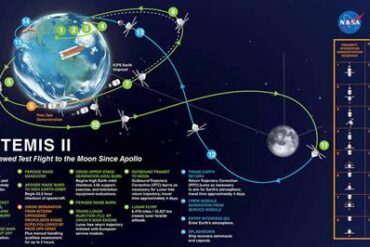
Launched atop the powerful Space Launch System (SLS), Artemis II was designed as a proving ground for future lunar missions. Its objectives were straightforward: orbit the Moon, gather imagery, conduct scientific observations, and return safely. Yet the mission delivered something far beyond expectations. Astronauts reported visible color variations, not just through high-resolution imaging systems, but with the naked eye—an observation that challenges decades of visual and scientific interpretation.
These colors are not flamboyant or theatrical. They do not transform the Moon into a cosmic painting. Instead, they exist as muted blues, faint oranges, and dusty purples, woven into the regolith like a hidden code waiting to be deciphered.
Why the Moon’s Colors Matter More Than Ever
The discovery of color diversity on the lunar surface is far more than an aesthetic revelation—it is a scientific breakthrough. According to NASA officials, these variations likely point to different mineral compositions and chemical processes occurring across the Moon’s terrain. Regions tinged with blue may indicate titanium-rich basalt, while warmer hues could suggest oxidized iron deposits.
This matters because composition defines capability. If the lunar surface contains accessible minerals, it transforms the Moon from a barren satellite into a resource-rich environment. Combined with emerging technologies capable of extracting oxygen from lunar soil, the implications are enormous. The Moon could become not just a destination, but a self-sustaining outpost.
The far side, long hidden from Earth due to tidal locking, is now emerging as a scientific treasure trove. Artemis II’s imagery provides the clearest evidence yet that this region may hold untapped potential for future exploration and habitation.
A Geological Record Written in Color and Craters
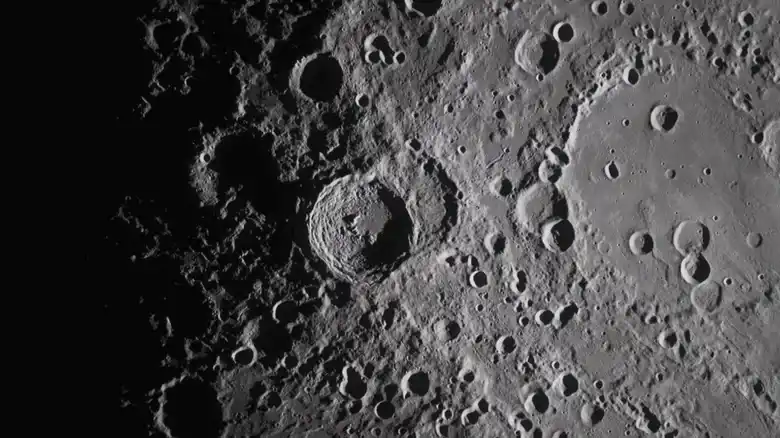
Beyond the visual intrigue, Artemis II has delivered a high-resolution geological archive of the Moon’s surface. What appears to be a chaotic landscape of craters and scars is, to trained scientists, a detailed timeline of cosmic history.
The images reveal fractured terrains, ancient lava flows, and overlapping impact craters, each layer telling a story of violent collisions and volcanic activity spanning billions of years. The newly observed color gradients enhance this understanding, helping scientists distinguish between older and newer formations with greater precision.
Rather than relying solely on shape and depth, researchers can now integrate color-based mineral mapping into their analyses. This allows for a more nuanced reconstruction of the Moon’s evolution, offering clues about its thermal history and internal composition.
Mapping the Future: From Exploration to Colonization
Artemis II is not an isolated mission—it is a strategic stepping stone toward a sustained human presence beyond Earth. The detailed imagery captured during this flight is already influencing decisions about where future missions may land, build, and expand.
NASA’s long-term vision includes establishing a permanent lunar base, potentially on the far side. The presence of diverse minerals and the possibility of in-situ resource utilization make certain regions particularly attractive. These areas could support habitats, energy systems, and life-support infrastructure, reducing dependence on Earth.
Even more compelling is the Moon’s role as a gateway to Mars. With lower gravity and abundant resources, lunar bases could serve as staging points for deeper space missions. Spacecraft could refuel, resupply, and launch from the Moon with far greater efficiency than from Earth’s surface.
A Subtle Shift With Profound Implications
What Artemis II has revealed is not a dramatic transformation of the Moon’s appearance, but a profound shift in how it is understood. The familiar gray sphere in the night sky now carries hidden complexity—an intricate blend of chemistry, history, and opportunity.
In uncovering the Moon’s quiet spectrum of color, NASA has opened the door to a new era of exploration—one where every shade tells a story, and every discovery brings humanity closer to becoming a multi-world species.