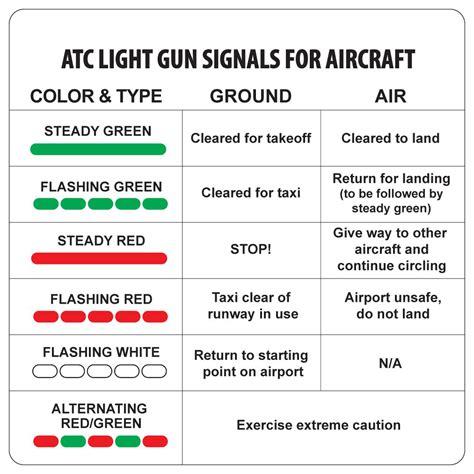
Air traffic communication depends heavily on clear and reliable channels. However, ATC light gun signals provide an indispensable backup when radio communications are unavailable. Whether due to a radio malfunction, absence of installed radios, or even a complete tower failure, light gun signals offer visual directives that ensure aircraft and ground operations can continue safely.
Understanding these signals is crucial for pilots, ground crews, and vehicle operators. We must approach these communications with complete clarity, given the serious implications of any misinterpretation.

What Are ATC Light Gun Signals?
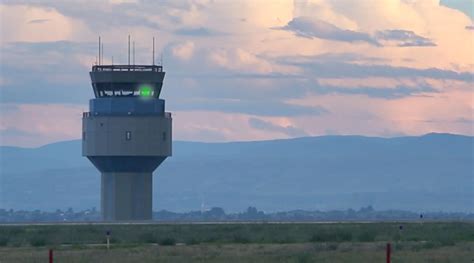
ATC light gun signals are high-intensity beams of light, transmitted either by handheld directional lamps or tower-mounted beacons, used to communicate essential instructions. Their visibility over long distances allows air traffic controllers to maintain communication with aircraft and ground vehicles, especially when other systems fail.
These signals employ three primary colors—red, green, and white—each carrying distinct instructions based on whether the recipient is airborne or on the ground. Signals can be steady or flashing, providing additional layers of meaning.
Color and Meaning: In the Air and On the Ground
Understanding the subtle differences between steady and flashing signals for each color is critical.
Steady Red Light Gun Signal
When airborne pilots observe a steady red light, they must give way to other aircraft and continue circling. This indication warns that landing would be unsafe, possibly due to runway obstructions, incoming traffic, or changing weather conditions.
On the ground, a steady red light mandates that all aircraft and vehicles must stop immediately. This directive emphasizes the presence of hazards or the necessity of maintaining order during ground operations.
Flashing Red Light Gun Signal
In the air, a flashing red warns that it is unsafe to land. Reasons may vary from debris or animals on the runway to emergencies that compromise safe arrival.
Aircraft and vehicles on the ground receiving a flashing red must taxi clear of active runways or move away from the taxiways, ensuring clear paths for other aircraft.
Steady Green Light Gun Signal
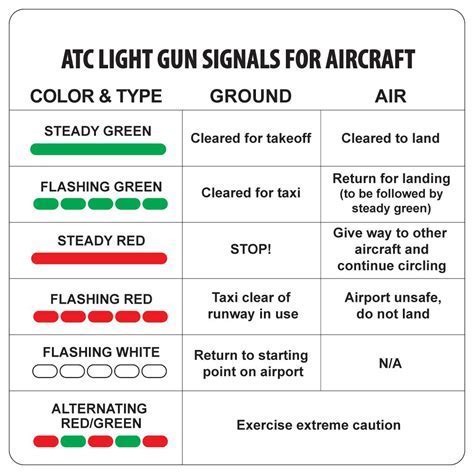
A steady green directed at an airborne aircraft means clearance to land. Nevertheless, pilots must continue to exercise vigilance, monitoring traffic and runway conditions.
On the ground, the same steady green clears aircraft for takeoff and authorizes vehicles and personnel to proceed.
Flashing Green Light Gun Signal
A flashing green signal directed at an airborne pilot instructs them to return to the airfield for landing. It is not an immediate landing clearance but an invitation to rejoin the traffic pattern in anticipation of a further command.
For aircraft on the ground, flashing green clears them to taxi. However, ground vehicles and personnel do not act upon a flashing green.
Flashing White Light Gun Signal
Under FAA regulations, a flashing white light carries no meaning for airborne aircraft. However, ICAO standards specify that a flashing white prompts aircraft to land at the airfield and then proceed to the apron—although it does not constitute final landing clearance.
On the ground, a flashing white signal instructs vehicles and personnel to return to their starting points.
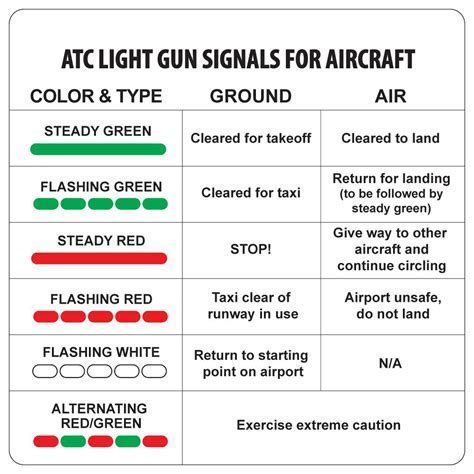
Alternating Red and Green Light Gun Signal
Alternating red and green flashes represent a general warning signal. Pilots, vehicles, and personnel must exercise extreme caution. This alert may suggest converging traffic, mechanical failures, or sudden obstructions within the operating environment. It is crucial to await further instructions following this warning.
Summary Table of ATC Light Gun Signal Meanings
| Color and Signal | Aircraft in the Air | Aircraft on the Ground | Vehicles and Personnel |
|---|---|---|---|
| Steady Red | Give way, continue circling | STOP | STOP |
| Flashing Red | Do not land | Taxi clear of active runway | Move away from runway or taxiway |
| Steady Green | Safe to land | Cleared for takeoff | Cleared to proceed |
| Flashing Green | Return for landing | Cleared for taxi | Not applicable |
| Flashing White | (FAA: No meaning) (ICAO: Proceed to apron) | Return to starting point | Return to starting point |
| Alternating Red/Green | Exercise extreme caution | Exercise extreme caution | Exercise extreme caution |
How Pilots Acknowledge Light Gun Signals
Acknowledging a light gun signal is an essential part of non-verbal aviation communication. During the day, pilots typically acknowledge receipt of a signal by rocking the aircraft’s wings or moving the ailerons and rudder. This motion visibly demonstrates awareness and compliance.
At night, where visual recognition needs enhancement, pilots can flash their landing lights or navigation lights to confirm receipt. Effective acknowledgment not only satisfies ATC procedural requirements but also enhances mutual understanding and operational safety.
Operational Considerations and Best Practices
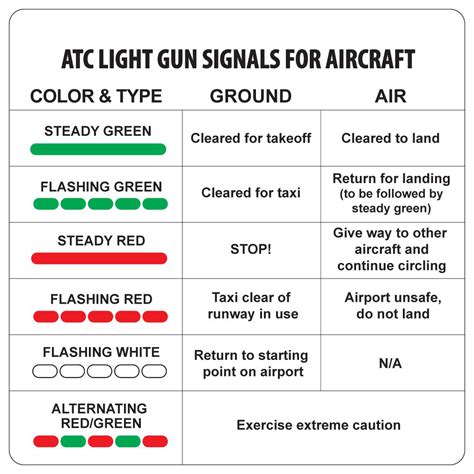
When interpreting ATC light gun signals, we must consider a few critical points to ensure comprehensive safety:
- Maintain continuous vigilance even after receiving clearance to land or taxi. Other aircraft may still pose threats.
- Do not assume clearance beyond the specific instruction given. For instance, a steady green light is permission to land but not to taxi after landing without further clearance.
- Prepare for subsequent signals. An initial flashing green may be followed by a steady green once clearance to land is granted.
- Understand jurisdictional differences such as ICAO interpretations for flashing white lights compared to FAA standards.
- Exercise extreme caution when receiving alternating red and green signals. Await further specific instructions while maintaining situational awareness.
The pilot remains the ultimate authority over the aircraft. Even when instructions are visually communicated, responsibility for the safety of the aircraft, its occupants, and surrounding traffic lies with the pilot in command.
The Importance of Regular Training and Simulation
Incorporating light gun signal recognition into regular training is essential for pilots of all experience levels. Flight schools and recurrent training programs should simulate radio failures and require students to identify and react correctly to light gun signals.
Moreover, familiarity with both FAA and ICAO signal differences prepares pilots for international operations, where procedural variations could present significant challenges.
Conclusion: Mastering ATC Light Gun Signals Is Non-Negotiable
As pilots, ground crews, and aviation professionals, we must treat light gun signals as vital elements of the aviation safety framework. In situations where technology fails or becomes unreliable, visual signaling remains one of the few methods available to maintain operational control.
A thorough understanding, immediate recognition, and correct response to these signals can prevent accidents, streamline ground operations, and preserve the safety of all involved. Mastery of ATC light gun signals should not be an afterthought but an integral part of every aviation training and operational protocol.