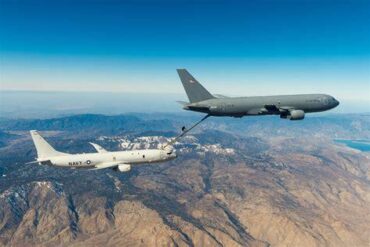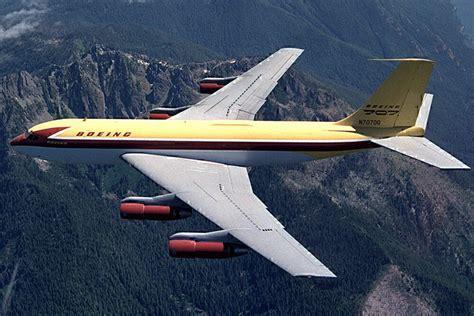
The story of modern aerial refueling begins not with a tanker, but with a bold prototype that blurred the line between military necessity and commercial ambition. The Boeing 367-80, famously known as the “Dash 80,” was never intended to serve as a frontline aircraft. Yet, it quietly became the technological backbone of a capability that still defines American air superiority today.
In the tense early years of the Cold War, range and endurance were no longer luxuries—they were strategic imperatives. The United States Air Force needed a platform capable of extending the reach of its bombers and fighters across continents. Boeing, sensing both military and commercial opportunity, unveiled the Dash 80 in 1954, a sleek jet-powered aircraft that looked decades ahead of its time.
What made the Dash 80 extraordinary was not just its appearance, but its adaptability. Boeing designed it with a dual-purpose vision: to impress airline executives and military planners alike. That gamble paid off. While the commercial world would eventually embrace it as the foundation of the Boeing 707, the military saw something even more valuable—a future tanker.
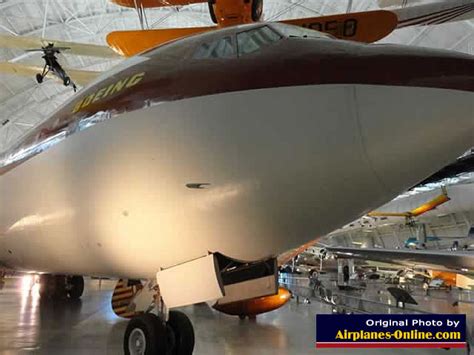
From Prototype to Powerhouse: The Birth of the KC-135 Stratotanker
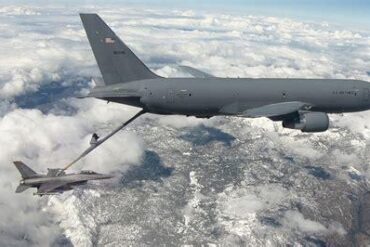
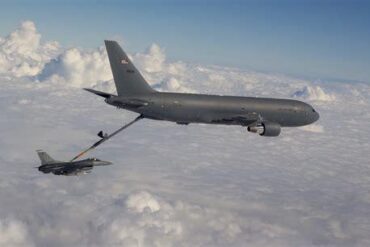
The Air Force moved quickly. In the same year the Dash 80 debuted, it ordered 29 aircraft based on the design, which would evolve into the legendary KC-135 Stratotanker. This was not a simple conversion. The military required structural modifications, including a wider fuselage to accommodate both fuel transfer systems and cargo versatility.
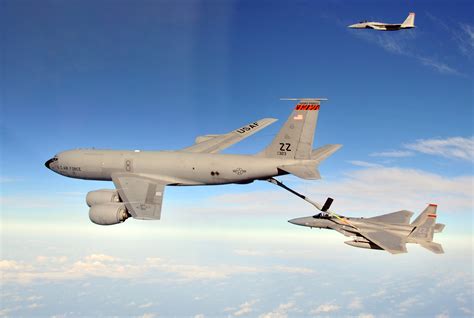
The result was a platform that could do more than refuel aircraft midair—it could adapt to changing mission demands. Over time, 732 KC-135s were produced, forming the backbone of U.S. aerial refueling operations for generations. Even today, more than six decades later, the Stratotanker remains in active service, a testament to the durability of the original design.
Engineering Evolution: Power, Performance, and Precision
While the Dash 80 laid the foundation, the modern KC-135 is a vastly more capable machine. Early versions generated around 40,000 pounds of thrust, but today’s upgraded Stratotankers boast an impressive 86,536 pounds, thanks to advanced engines shared with commercial platforms like the Boeing 737.
This evolution is not limited to raw power. The aircraft’s avionics have undergone a complete transformation, bringing 21st-century digital systems into a mid-20th-century airframe. Navigation, communication, and mission coordination have all been refined to meet modern combat and support requirements.
What truly sets the KC-135 apart, however, is its flexibility. Beyond refueling, it often serves as a command-and-control node or even a reconnaissance platform, extending its relevance far beyond its original mission profile.
The Tex Johnston Moment That Sealed Its Legacy
No discussion of the Dash 80 is complete without mentioning one of aviation’s most daring demonstrations. In 1955, Boeing test pilot Tex Johnston performed a barrel roll in the prototype during a demonstration flight. While seemingly reckless, the maneuver was a calculated display of confidence in the aircraft’s structural integrity.
The message was clear: this was not just a prototype—it was a revolution in the sky. The demonstration captured the imagination of both military officials and commercial buyers, accelerating adoption and solidifying Boeing’s reputation as an industry leader.
A Legacy Still Flying Today
More than 70 years after its first flight, the influence of the Dash 80 continues to ripple through aviation. The KC-135 Stratotanker, born from that prototype, remains a cornerstone of U.S. military logistics, enabling global reach without reliance on forward bases.
Its DNA also lives on in commercial aviation, through the Boeing 707 and subsequent generations of jetliners. This dual legacy—military endurance and commercial transformation—cements the Dash 80 as one of the most consequential aircraft ever built.
In an era defined by rapid technological change, it is remarkable that a single prototype could shape decades of innovation. Yet the Dash 80 did exactly that, proving that visionary engineering, when paired with strategic foresight, can redefine not just aircraft—but the very concept of air power itself.