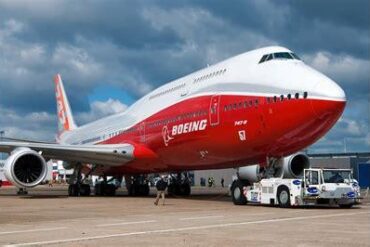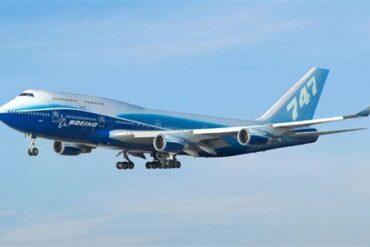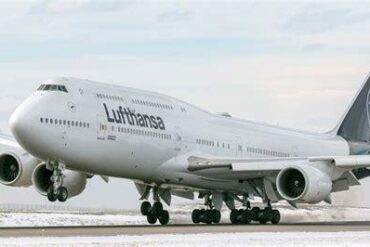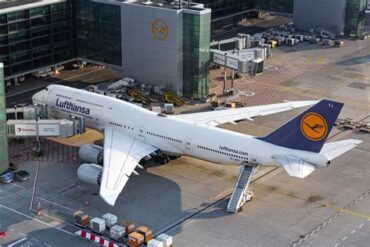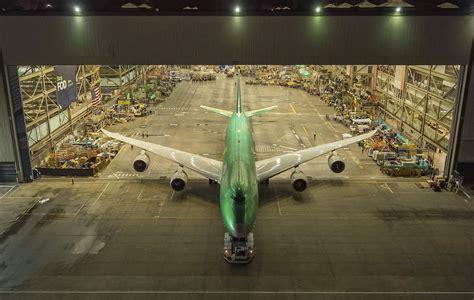
The Boeing 747 once symbolized the absolute peak of global air travel. For decades, the “Queen of the Skies” dominated long-haul routes, carried heads of state, and projected prestige for every airline that painted its tail on the aircraft’s towering vertical stabilizer. Yet the final passenger version of the jumbo jet, the Boeing 747-8 Intercontinental, arrived at precisely the wrong moment in aviation history. Airlines were pivoting toward smaller twin-engine aircraft with lower operating costs, and the age of giant four-engine passenger jets was already fading fast.
Today, only three airlines still operate passenger Boeing 747-8s. At the same time, an unlikely buyer has emerged with intense interest in nearly every surviving example: the United States Air Force.
The irony is impossible to miss. Commercial airlines largely rejected the 747-8i because it was too large, too expensive, and too inefficient compared to modern twinjets. But those same characteristics now make it uniquely valuable for highly specialized military missions that demand enormous internal space, redundant systems, and four-engine reliability.
The aircraft that struggled to survive in commercial aviation may ultimately find its lasting legacy in military service.
The US military wants them all.
The reason has little to do with nostalgia.
It has everything to do with national security.
After Boeing officially closed the 747 production line in 2023, the global fleet instantly became a finite resource. Spare parts, replacement airframes, and long-term sustainment planning suddenly became critical concerns for the Pentagon. As a result, the USAF has quietly started securing used Boeing 747-8 aircraft before they disappear from the market entirely.
The remaining passenger operators now hold some of the most strategically valuable civilian aircraft in the world.
The Boeing 747-8i Was Designed For A Market That Vanished
When Boeing launched the 747-8 program in 2005, the company believed there was still room for very large passenger aircraft sitting just below the Airbus A380 in capacity. The strategy seemed logical on paper. Airports were congested, international traffic was growing rapidly, and premium long-haul demand appeared unstoppable.
Boeing modernized the iconic 747 with new General Electric GEnx engines, upgraded avionics, aerodynamic wing improvements, and a stretched fuselage. The aircraft borrowed technology developed for the Boeing 787 Dreamliner while maintaining the unmistakable silhouette of the jumbo jet.
The result was the Boeing 747-8 Intercontinental, or 747-8i.
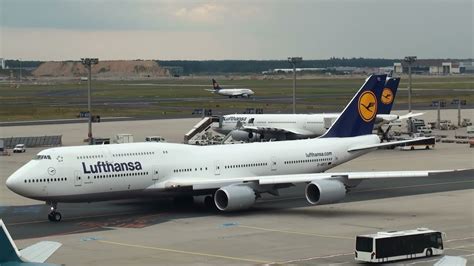
Lufthansa became the launch customer and the program’s biggest believer. The German airline envisioned the aircraft as a premium-heavy flagship capable of serving major business destinations year-round without the overwhelming capacity of the Airbus A380.
That vision made sense for Lufthansa’s network.
It did not make sense for most other airlines.
The aviation market shifted dramatically during the 2000s. Airlines increasingly prioritized frequency over sheer size. Instead of operating a single giant aircraft between two hubs, carriers preferred multiple daily flights using smaller, more efficient twinjets like the Boeing 777-300ER and later the Airbus A350.
The 747-8i found itself trapped in an uncomfortable middle ground.
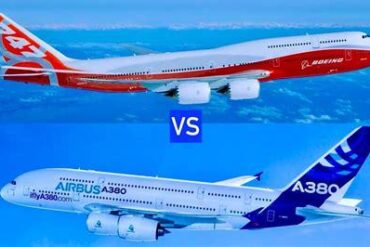
Compared to the Airbus A380, it carried significantly fewer passengers. Compared to the Boeing 777-300ER, it burned too much fuel. Airlines could not justify the economics.
Boeing marketed the aircraft as offering roughly 25% fewer seats than the A380, but real-world airline configurations told a harsher story. Most operators installed premium-heavy cabins, reducing total seating capacity dramatically. In practice, the 747-8i often carried around 40% fewer passengers than the A380 while consuming only modestly less fuel overall.
That destroyed its competitiveness.
The 777-300ER became the true killer of the passenger jumbo market. It delivered exceptional range, strong cargo capability, and far lower operating costs while using only two engines. Under modern ETOPS regulations, airlines no longer needed four engines for ultra-long-haul routes.
The economics were brutal.
Only 36 passenger 747-8s were ever ordered.
That number alone tells the story.
Only Three Airlines Still Fly Passenger Boeing 747-8s
The global passenger fleet of Boeing 747-8is has shrunk into an extraordinarily exclusive club.
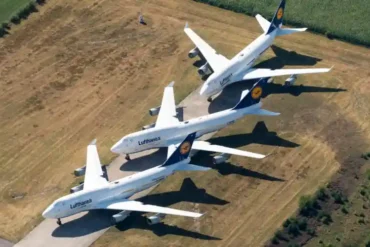
Only Lufthansa, Korean Air, and Air China still operate the type.
Even among those carriers, the fleet numbers are small.
- Lufthansa: 19 aircraft
- Korean Air: 5 active aircraft
- Air China: 7 aircraft
That is the entire remaining passenger 747-8i world fleet in active airline service.
Lufthansa remains the aircraft’s strongest advocate. The airline continues using the 747-8i on major intercontinental routes where premium demand justifies the aircraft’s unique layout and cargo capabilities. Frankfurt Airport has effectively become one of the last great sanctuaries of scheduled passenger jumbo-jet flying.
Korean Air’s fleet has already begun shrinking as the airline modernizes around newer twinjets. Meanwhile, Air China’s operation has always carried political undertones alongside commercial considerations, reflecting China’s broader strategic relationship with Boeing and the symbolic value of flagship aircraft.
But every retirement now matters in ways airlines never expected.
Because the United States Air Force is watching closely.
Why The US Air Force Selected The Boeing 747-8
In the commercial world, the 747-8i became an economic disappointment.
In military aviation, it became nearly irreplaceable.
The USAF required a massive aircraft with exceptional endurance, enormous internal volume, long-range capability, and four-engine redundancy. Very few aircraft on Earth could meet those requirements.
The Airbus A380 theoretically qualified, but Airbus never seriously pursued the Air Force One contract after concluding that producing just two aircraft in the United States would be economically impractical.
That left Boeing as the only realistic option.
The USAF officially selected the Boeing 747-8i platform for the VC-25B presidential transport program, which will eventually replace the aging VC-25A fleet currently used as Air Force One.
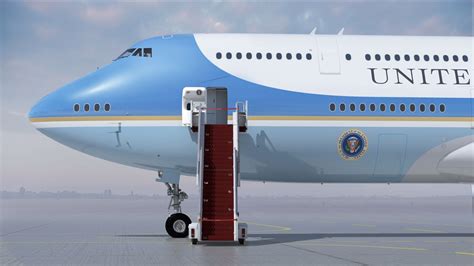
The existing VC-25As entered service in 1990 and 1991. Despite their iconic status, they are based on the Boeing 747-200B platform from the early 1970s. Maintenance costs have skyrocketed, reliability has declined, and sourcing components has become increasingly difficult.
The replacement aircraft needed to serve not merely as transportation but as a fully functional airborne White House.
Inside the VC-25 platform are systems far beyond ordinary aviation standards. The aircraft contain secure communications suites, hardened defensive systems, medical facilities, conference rooms, office space, sleeping quarters, and extensive classified technologies designed to ensure continuity of government under virtually any circumstance.
This is not simply a luxury airplane.
It is a flying national command center.
And for that mission, the 747-8 remains uniquely suited.
The Pentagon Is Now Hunting For Spare Boeing 747-8s
The closure of the 747 production line fundamentally changed the long-term equation for the USAF.
Once Boeing stopped building the aircraft, every existing 747-8 instantly became strategically valuable. Future spare parts availability could no longer be guaranteed indefinitely. The military understood that sustaining highly specialized fleets like the VC-25B and E-4C would require donor aircraft for decades to come.
So the Pentagon began buying them.
One of the most surprising deals involved Lufthansa agreeing to sell two of its prized 747-8 aircraft to the USAF for approximately $400 million total. The transaction stunned many aviation observers because Lufthansa had long appeared deeply committed to keeping the aircraft in passenger service.
The Air Force, however, saw something more valuable than airline operations.
It saw inventory.
The acquired aircraft will reportedly serve primarily as training and spare-parts platforms rather than frontline operational jets. In military planning, long-term sustainment is everything. Owning donor aircraft ensures access to critical components long after commercial supply chains disappear.
This strategy mirrors how many military fleets survive decades beyond their civilian counterparts.
The difference here is the scale of the investment.
The USAF is effectively building a strategic reserve of Boeing 747-8 airframes before the remaining examples become impossible to acquire.
The E-4C “Doomsday Plane” Program Is Expanding Demand
The Air Force One replacement program is only part of the story.
The Pentagon also needs replacements for the Boeing E-4B Nightwatch fleet, better known as the “Doomsday planes.”
These aircraft serve as survivable airborne command centers during nuclear war or catastrophic national emergencies. One E-4B is almost always operational and capable of supporting top military leadership during a crisis.
The current E-4Bs are ancient.
Some date back to the 1970s.
By the time their successors fully enter service, portions of the existing fleet could approach 60 years of age.
That replacement effort led directly to another wave of Boeing 747-8 acquisitions.
Sierra Nevada Corporation, selected to develop the new E-4C fleet, acquired five former Korean Air 747-8 aircraft for conversion into next-generation airborne operations centers.
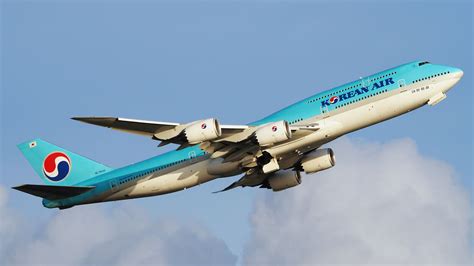
These aircraft are expected to undergo extensive modification programs stretching well into the 2030s. While many technical details remain classified, the E-4C will almost certainly incorporate advanced communications, electromagnetic hardening, survivability upgrades, and command-and-control capabilities far beyond anything visible to the public.
Unlike Air Force One, which prioritizes presidential transport and government continuity, the E-4 mission centers on wartime command operations.
Function outweighs comfort.
The aircraft are designed to remain operational during scenarios that would cripple conventional infrastructure.
And once again, the Boeing 747-8 proved uniquely qualified.
The aircraft’s massive internal volume allows for extensive mission systems, crew workstations, redundant equipment, and future upgrades that smaller aircraft simply cannot accommodate efficiently.
The USAF reportedly wants between six and eight E-4C aircraft eventually.
That means additional 747-8 acquisitions may still occur.
The Strange Story Of Trump’s Boeing 747-8 “Bridge” Aircraft
The already unusual Boeing 747-8 story took another unexpected turn with the emergence of the so-called VC-25B “Bridge” aircraft.
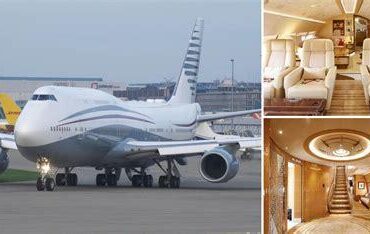
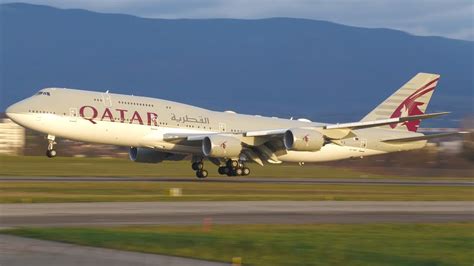
Frustrated by delays in the official VC-25B program, President Donald Trump pushed for a faster interim solution involving a Boeing 747-8 business jet originally delivered to Qatar.
The aircraft, registered as N7478D, was slated for rapid conversion into a temporary presidential transport platform.
The proposal immediately sparked controversy.
Questions emerged surrounding legal issues, ethics concerns, conversion practicality, and operational limitations. Unlike purpose-built VC-25 aircraft, the former Qatari jet began life as a luxury private aircraft rather than a hardened military platform.
Still, the project advanced.
L3Harris received the contract to modify the aircraft for presidential use, targeting operational readiness as early as summer 2026.
Speed became the defining priority.
To accelerate deployment, reports suggested certain traditional VC-25 features and systems might be omitted or simplified. That could restrict the aircraft’s operational flexibility compared to fully equipped Air Force One aircraft.
Yet the urgency reflected a deeper reality.
The existing VC-25As are aging rapidly, and delays in the VC-25B program have created mounting political and operational pressure.
Even imperfect interim solutions began looking attractive.
The Bridge aircraft may ultimately serve only temporarily, but its existence further demonstrates the extraordinary strategic importance now attached to every remaining Boeing 747-8.
The Boeing 747-8 May Outlive Its Commercial Failure
Commercial aviation judged the Boeing 747-8i harshly.
The aircraft sold poorly, arrived too late, and failed to establish a sustainable airline market. In pure business terms, it was overshadowed by the efficiency revolution led by twin-engine widebodies.
But aviation history often grants aircraft a second life in unexpected ways.
The Boeing 747 itself has repeatedly evolved beyond its original purpose. It served as a freighter, airborne observatory, shuttle carrier, military laser platform, command center, and presidential aircraft. Few airplanes in history have demonstrated similar adaptability.
Now the final passenger variant appears poised for another transformation.
As airlines gradually retire their remaining fleets, the Pentagon may become the largest long-term operator of Boeing 747-8 aircraft anywhere in the world.
That possibility would have seemed absurd fifteen years ago.
Yet it increasingly looks inevitable.
The same aircraft airlines viewed as commercially impractical now offers capabilities almost impossible to replace. Four engines, enormous internal space, exceptional range, and proven reliability still matter enormously for specialized national-security missions.
The Boeing 747-8i may never have conquered the commercial skies the way earlier jumbo jets once did.
But it may ultimately secure something even rarer.
A second career at the very center of American strategic power.