The balance of power in the long-haul aviation market has always hinged on geometry. Length determines range and payload. Wingspan influences efficiency. But cabin width—often overlooked outside industry circles—quietly shapes economics, passenger comfort, and ultimately, billion-dollar fleet decisions. Today, that dimension is at the heart of a strategic tension between two aerospace giants.
The Airbus A350 XWB—the “eXtra Wide Body”—was conceived as Europe’s answer to Boeing’s twin-aisle dominance. It is a technological marvel: carbon-fiber fuselage, advanced aerodynamics, and engines engineered for fuel efficiency in an era defined by rising costs and environmental scrutiny. Yet despite its strengths and more than 1,500 orders, the A350 faces an unexpected pressure point. The challenge does not come from a lack of efficiency or range. It comes from something simpler and more physical: the wider cabin of the Boeing 777X.
That extra width—combined with strategic design decisions—creates ripple effects across capacity, revenue, and fleet planning. For Airbus, the implications extend beyond a single model variant. They touch the very architecture of the upper widebody market.
The Strategic Brilliance Behind The Airbus A350 XWB
To understand why Airbus might be uneasy, it’s necessary to revisit why the A350 exists at all.
In the early 2000s, Boeing’s 787 Dreamliner promised to revolutionize long-haul travel. Lightweight composites, new-generation engines, and mid-size capacity created a fresh category of point-to-point flying. Airlines responded enthusiastically. The Dreamliner’s order book ballooned.
Airbus initially attempted a derivative response—modifying the A330 with updated wings and engines. Airlines were unimpressed. Major customers openly criticized the proposal as insufficient. Airbus returned to the drawing board and delivered something far more ambitious: a clean-sheet design aimed not only at matching the 787’s efficiency but surpassing it in size and capability.
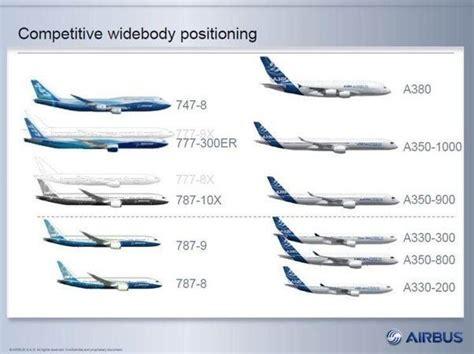
The resulting A350 was positioned cleverly. Instead of fighting the 787 directly, Airbus targeted Boeing’s most successful widebody program: the 777. The A350-900 and A350-1000 were sized to replace the 777-200ER and 777-300ER respectively, aircraft that had defined long-haul economics for decades.
It was a sharp strategic move. The 777 was aging. Airlines were looking for modern replacements. The A350 offered lower fuel burn, advanced materials, and competitive range—all in a package optimized for nine-abreast economy seating.
For years, that strategy worked.
Enter The Boeing 777X: Bigger, Wider, More Ambitious
Boeing did not allow the A350 to dominate uncontested. In 2013, it unveiled the 777X, a comprehensive reimagining of its twin-aisle workhorse.
The changes were not cosmetic. The aircraft gained:
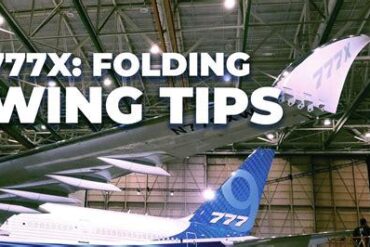
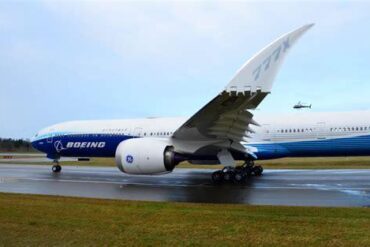
- A new composite wing with folding wingtips
- Massive GE9X engines, the most powerful commercial engines ever built
- A stretched fuselage in both variants
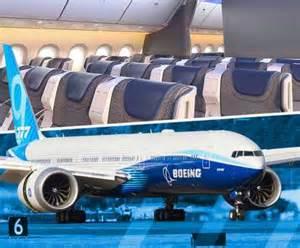
- A redesigned interior sidewall adding approximately four inches of cabin width
That last detail—four inches—may sound trivial. It is not.
The original Boeing 777 was designed for nine-abreast seating. Over time, airlines pushed it to ten-abreast to improve economics. The result was tighter seats and narrower aisles, often criticized by passengers and cabin crew alike. The 777X addresses this tension with structural refinements that increase usable cabin space without compromising the aircraft’s cross-section.
The result is a widebody optimized from the outset for ten-abreast economy seating—a configuration that fundamentally alters revenue potential.
Why Cabin Width Shapes Airline Economics
In aviation, profit margins are often measured in fractions of a percent. Adding even a handful of seats can materially change per-flight profitability.
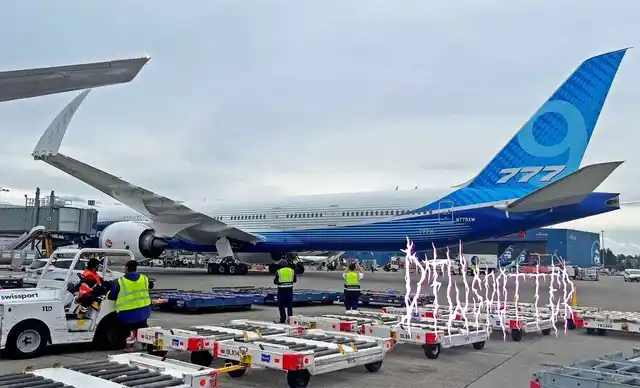
A ten-abreast layout on the 777-9 allows airlines to carry significantly more passengers than a nine-abreast A350-1000, particularly on dense long-haul routes. When multiplied across daily operations and multi-year service lives, that capacity differential becomes economically powerful.
The A350-1000 is an excellent replacement for the 777-300ER. But the 777-9 goes further. It is longer than the 747-8 and occupies a unique space as the largest twin-engine passenger aircraft currently on sale. That size enables airlines to replace aging Boeing 747s and Airbus A380s with a more efficient twin.
This matters because the very top of the widebody market—the segment once occupied by four-engine giants—has not disappeared. It has consolidated. Airlines serving mega-hubs such as Dubai, Doha, Singapore, and London still need high-capacity aircraft for slot-constrained airports.
The 777-9 fits that role more naturally than the A350-1000.
The Order Book Tells A Subtle Story
On paper, the A350 program is a success. The A350-900 alone has secured over 1,000 orders, outperforming the 777-8 and competing effectively against the 787.
The tension emerges at the larger end.
The 777-9 has accumulated more than 500 orders since launch. The A350-1000, despite entering the market earlier, trails by over 100 orders. Many airlines operate both families—but they often deploy the A350-900 in larger numbers while reserving the 777-9 as a flagship aircraft.
That distinction is revealing. The A350-1000 occupies a narrow middle ground. It is larger than the -900 but smaller than the 777-9. Airlines frequently use it as a capacity step-up within an A350 fleet, not necessarily as a dominant top-tier platform.
Meanwhile, carriers like Emirates and Singapore Airlines have embraced the 777X as a cornerstone of their future long-haul strategy—often without ordering the A350-1000 at all.
This is not a landslide victory for Boeing. But it is a meaningful signal.
The Psychological Power Of “Widest”
Aircraft marketing is not just about performance metrics. It is about perception.
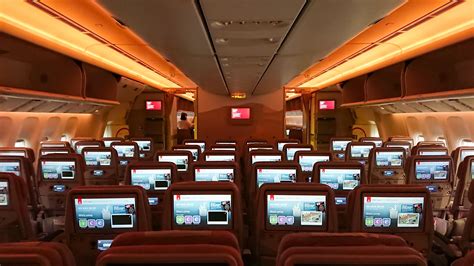
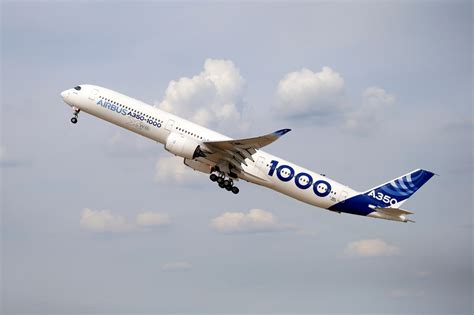
Airbus markets the A350 as the “XWB”—eXtra Wide Body. In practical terms, it is optimized for nine-abreast seating, offering slightly wider seats than a ten-abreast 777. That narrative emphasizes comfort and balance.
The 777X reframes the conversation. By engineering a cabin designed for ten-abreast from the start—and improving aisle width through thinner sidewalls—Boeing transforms what was once a compromise into a selling point.
Airlines can now argue that ten-abreast no longer automatically means cramped.
The four-inch cabin increase may not dramatically widen seats, but even incremental aisle improvements enhance service efficiency and passenger flow. In high-density operations, that operational advantage carries weight.
In other words, the 777X neutralizes a historic weakness of the 777 platform and turns cabin width into competitive leverage.
Can Airbus Stretch Its Way Out?
Industry rumors have circulated for years about a possible A350-1100, a stretched variant designed to directly challenge the 777-9. On paper, a longer A350 could narrow the capacity gap.
Yet this path carries risks.
First, stretching the fuselage does not change the cross-section. A ten-abreast A350 remains less natural than a ten-abreast 777X. Second, Boeing could theoretically respond with a “777-10,” escalating the size competition further.
There is a structural asymmetry here. Because the 777X’s cabin is inherently wider, any similarly sized Boeing variant will likely maintain a higher passenger count than an equivalent A350.
Airbus faces a philosophical choice: chase the top end aggressively, or refine efficiency and protect its strength in the mid-to-large segment where the A350-900 excels.
The New Production Standard: A Quiet Countermove
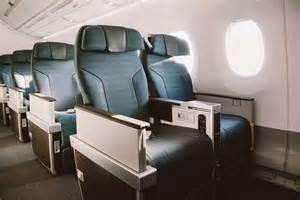
Airbus has not stood still. The A350 New Production Standard (NPS) introduces weight reductions, higher maximum takeoff weight, and an updated interior layout. Crucially, it includes thinner sidewalls enabling ten-abreast economy seating with 17-inch-wide seats.
Only a handful of airlines have adopted this configuration so far. Philippine Airlines is among the first full-service carriers to do so. Two leisure-focused airlines, Air Caraïbes and French bee, already operate ten-abreast A350s.
If ten-abreast becomes mainstream for the A350, the economics could shift dramatically. An A350-1000 configured this way would approach the per-seat cost territory of the 777-9 while retaining Airbus’s hallmark efficiency.
The uncertainty lies in market psychology. Airlines must balance revenue optimization with passenger perception. The industry remembers the backlash against tightly configured 777s. Convincing premium carriers to embrace ten-abreast A350 layouts at scale will require confidence that comfort is not compromised.
A Market Squeezed From Both Ends
The A350-1000 occupies a challenging niche. At the lower end, the A350-900 delivers outstanding efficiency and often suffices for long-haul demand. At the upper end, the 777-9 offers unmatched capacity among twin-engine aircraft.
This leaves the -1000 positioned in between—an aircraft that performs brilliantly but competes in a narrower slice of demand.
Airlines planning future fleets increasingly segment roles clearly. Smaller long-haul routes gravitate toward the A350-900 or 787. Ultra-dense trunk routes gravitate toward the 777-9. The space in between exists, but it is less expansive than either extreme.
Airbus does not face an existential crisis. The A350 remains one of the most advanced and fuel-efficient aircraft ever built. Yet the gravitational pull of the 777X at the top of the market reshapes how airlines structure their widebody portfolios.
The Broader Implications For The Widebody Market
The rivalry between the A350 and 777X reveals a deeper truth about aviation economics: size still matters.
As four-engine aircraft fade from production, airlines require efficient twins capable of carrying 350 to 400-plus passengers on intercontinental routes. The 777-9 positions itself as the heir to the 747 and A380 without the fuel penalty of four engines.
Airbus, lacking a direct A380 successor and with the A350-1000 slightly smaller, must decide whether to escalate capacity or double down on efficiency leadership.
Both philosophies have merit. The aviation industry oscillates between consolidation and fragmentation. Hub-and-spoke models favor large aircraft. Point-to-point networks favor smaller, flexible types.
The world’s widest widebody aircraft does not automatically guarantee dominance. But it shifts the strategic geometry of competition.
For Airbus, concern is not about immediate defeat. It is about ensuring that the upper boundary of the widebody market does not permanently tilt toward Boeing’s architecture.
In aerospace, inches translate into millions. Four extra inches of cabin width may seem trivial to the casual observer. In the boardrooms of Toulouse and Seattle, they are anything but.