The Boeing CH-47 Chinook has spent decades proving itself as one of the most dependable heavy-lift helicopters in military service. First introduced in the early 1960s, the twin-rotor aircraft became synonymous with troop transport, artillery movement, battlefield resupply, medical evacuation, and humanitarian missions. Its shape is unmistakable, its payload capacity respected, and its reliability battle-tested across multiple continents. Now Boeing is signaling that the next chapter for the Chinook may be far more advanced than simply carrying cargo from one point to another.
Recent concept imagery released by Boeing outlines a transformed CH-47F Chinook built for digitally connected warfare. Instead of serving only as a flying truck, the aircraft is imagined as an airborne command platform capable of launching reconnaissance drones, coordinating missions, and potentially flying without a crew onboard. If even part of this vision becomes reality, the Chinook could evolve from logistics icon into a frontline battlefield network node.
Boeing’s Chinook Drone Launch System Changes Mission Roles
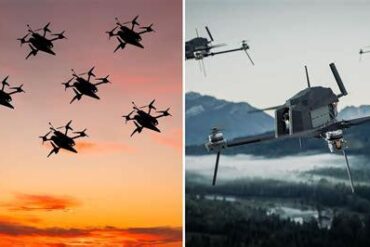
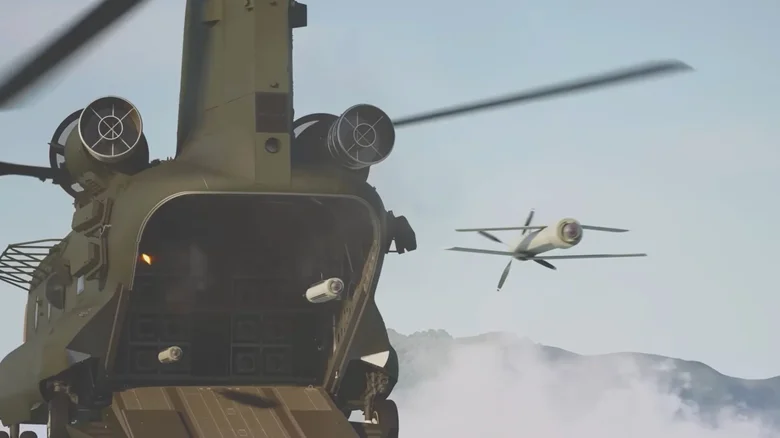
One of the most striking features in Boeing’s concept is an internal drone deployment system housed inside the Chinook’s fuselage. In the visualization, multiple unmanned aerial vehicles launch from the rear ramp area and rapidly spread outward after release. This transforms the helicopter into a mobile drone carrier that can insert sensors deep into contested areas before troops arrive.
Rather than blindly entering hostile airspace, commanders could send the Chinook forward as a reconnaissance lead aircraft. The drones would scout valleys, ridgelines, landing zones, roads, and urban corridors for enemy movement or ambush threats. Live feeds could then be relayed to pilots and ground forces in real time, dramatically improving survivability.
Because storage space would be needed for these drones, a Chinook configured for swarm control may sacrifice traditional cargo capacity. That tradeoff suggests future formations where one Chinook acts as the sensing and coordination platform while others behind it carry troops, vehicles, or supplies under safer conditions.
Why Recon Drones Matter More Than Attack Drones
Popular imagination often jumps to drone swarms as offensive weapons overwhelming targets. Boeing’s concept appears more practical and immediately useful. The unmanned systems shown resemble reconnaissance assets rather than armed loitering munitions. That matters because intelligence is often the deciding factor in helicopter survivability.
Large transport helicopters are valuable but vulnerable. They move slower than jets, create substantial acoustic signatures, and are frequently priority targets for enemy air defenses. Sending expendable drones ahead to detect anti-aircraft positions, electronic jammers, or hidden infantry teams gives crews time to reroute before entering danger zones.
This also aligns with modern military doctrine where information dominance can be more valuable than raw firepower. A helicopter that sees threats first is a helicopter more likely to complete its mission.
Autonomous Chinook Operations Could Save Lives
Perhaps even more consequential is Boeing’s proposed uncrewed mode. The concept suggests a Chinook able to autonomously navigate preselected waypoints with reduced or zero onboard crew. That idea could reshape high-risk resupply and extraction missions.
Imagine a trapped unit needing ammunition in an area saturated with enemy missiles. Instead of risking pilots, commanders could dispatch an autonomous Chinook loaded with supplies. Likewise, wounded troops could be evacuated by a remotely supervised aircraft when human crews are unavailable or conditions are too dangerous.
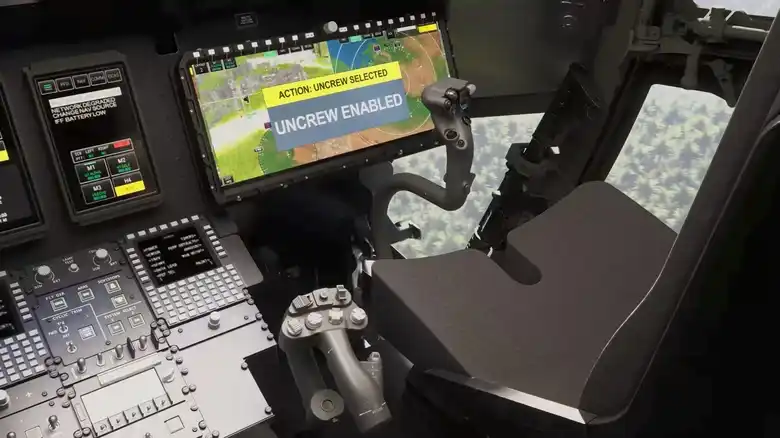
Reduced-crew capability may arrive first, with pilots overseeing advanced flight systems rather than surrendering full control. That gradual transition is more realistic and mirrors broader aviation trends toward assisted autonomy.
Challenges Boeing Must Solve Before Deployment
Concept videos are designed to inspire, but battlefield reality is ruthless. Any drone-controlling Chinook would need hardened communications links resistant to jamming, spoofing, and cyber intrusion. Recon drones must survive hostile weather, gunfire, and electronic attack. Autonomous flight software would require extraordinary reliability in terrain where seconds matter.
There is also the question of cost. Militaries already rely on the Chinook because it performs essential missions well. Upgrading fleets with launch systems, sensor networks, AI autonomy packages, and secure data architecture would require significant investment.
The Future of the Chinook Is Bigger Than Cargo
Boeing’s proposal reveals a larger truth about military aviation: legacy platforms are no longer judged only by engines and payload. They are judged by how well they connect sensors, data, autonomy, and unmanned systems into one combat ecosystem.
The Chinook has already outlived many newer aircraft through adaptability. If Boeing successfully turns it into a drone swarm controller and optionally crewless transport, the helicopter could remain relevant for decades more. What began as a battlefield workhorse may soon become one of the smartest aircraft in the sky.