The rivalry between Boeing and Lockheed Martin forms the backbone of modern American combat aviation. Both companies produce some of the most advanced military aircraft ever built, yet their philosophies about what a fighter jet should be could hardly be more different. In 2026 the contrast is particularly striking: Lockheed Martin dominates the stealth revolution, while Boeing doubles down on raw performance, payload, and adaptability.
Understanding how their fighters stack up requires looking beyond simple specifications. Aircraft design is a reflection of doctrine, economics, and technological priorities. One company builds stealthy digital war machines that act like airborne data centers. The other builds heavily armed aerial workhorses designed to bring overwhelming firepower to the fight. Together they form a layered approach to American airpower.
The result is not a simple winner-takes-all competition. Instead, Boeing and Lockheed Martin produce aircraft that often operate side-by-side in complementary roles, forming a combined ecosystem of stealth penetration, sensor networking, and high-capacity strike power.
Two Aerospace Giants With Opposite Design Philosophies
At the industrial level, Boeing and Lockheed Martin occupy very different positions inside the United States defense sector. Lockheed Martin is the undisputed leader in fighter production, largely because of the enormous Joint Strike Fighter program built around the F-35 Lightning II. The program’s lifetime cost is estimated at nearly two trillion dollars, making it the largest defense contract in history.
Boeing’s defense business is broader but less concentrated in fighters. The company builds tankers, patrol aircraft, helicopters, satellites, and strategic systems. Its fighter production is comparatively small. That difference in scale shapes how each company approaches aircraft development.
Lockheed Martin focuses heavily on stealth, sensor fusion, and networked warfare. The F-35 is essentially a flying sensor node. Its mission is not just to fire weapons but to collect and distribute battlefield data. Pilots often describe it less as a traditional jet fighter and more as an information platform with wings.
Boeing’s philosophy takes the opposite direction. Its aircraft emphasize kinetic performance: speed, altitude, range, and payload. Instead of trying to disappear from radar entirely, Boeing fighters rely on powerful radar systems, electronic warfare suites, and massive missile capacity.
In modern Air Force doctrine this idea has evolved into what strategists sometimes call the “missile truck” concept—a fighter designed to carry huge numbers of weapons while relying on stealth aircraft to identify targets.
Industrial Scale: Global Production vs Domestic Concentration
Lockheed Martin’s fighter production resembles an international industrial network. The F-35 assembly line in Fort Worth, Texas, operates almost like a sophisticated automotive factory, with aircraft moving between stations every few days. The system is optimized for volume.
Additional Final Assembly and Check-Out (FACO) facilities exist in Cameri, Italy, and Nagoya, Japan. These sites allow partner nations to assemble their own aircraft, maintain fleets locally, and participate in the supply chain.
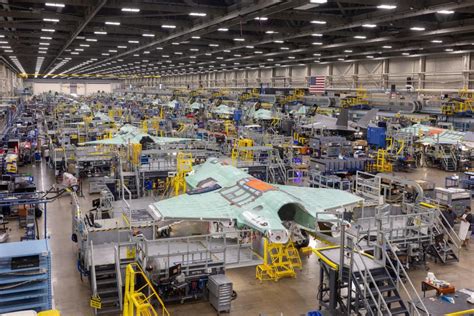
This multinational approach has advantages and risks. On one hand, it spreads production costs across many countries and guarantees long-term political support for the program. On the other hand, the supply chain becomes extremely complex. A disruption anywhere in the network—whether from geopolitics, labor disputes, or component shortages—can ripple across the entire production system.
Boeing’s fighter manufacturing looks almost quaint by comparison. Production is centered in St. Louis, Missouri, a facility with roots stretching back to the McDonnell Douglas era and the legendary F-4 Phantom. Rather than a high-volume assembly line, the operation resembles a precision workshop.
Output is dramatically lower. While Lockheed Martin produces well over a dozen fighters each month, Boeing typically delivers only a handful. This slower pace reflects the narrower market for Boeing’s aircraft, but it also allows the company to focus on highly specialized configurations.
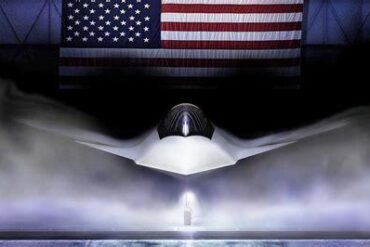
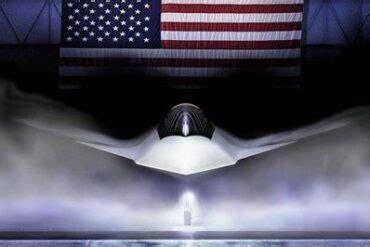
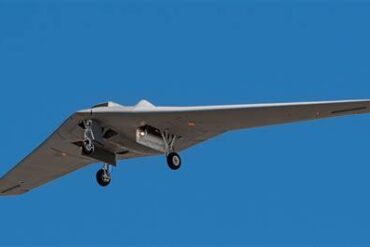
The situation may change with the development of Boeing’s F-47 Next Generation Air Dominance fighter, a sixth-generation aircraft intended to compete directly in the stealth arena. Massive new facilities are already under construction to support that future production.
The USAF High-Low Fighter Strategy
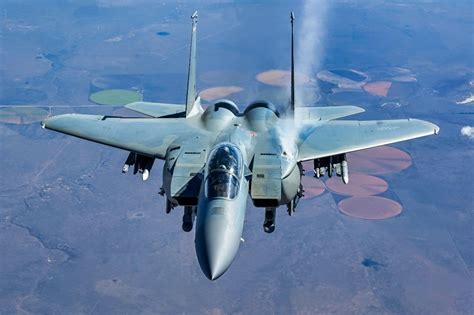
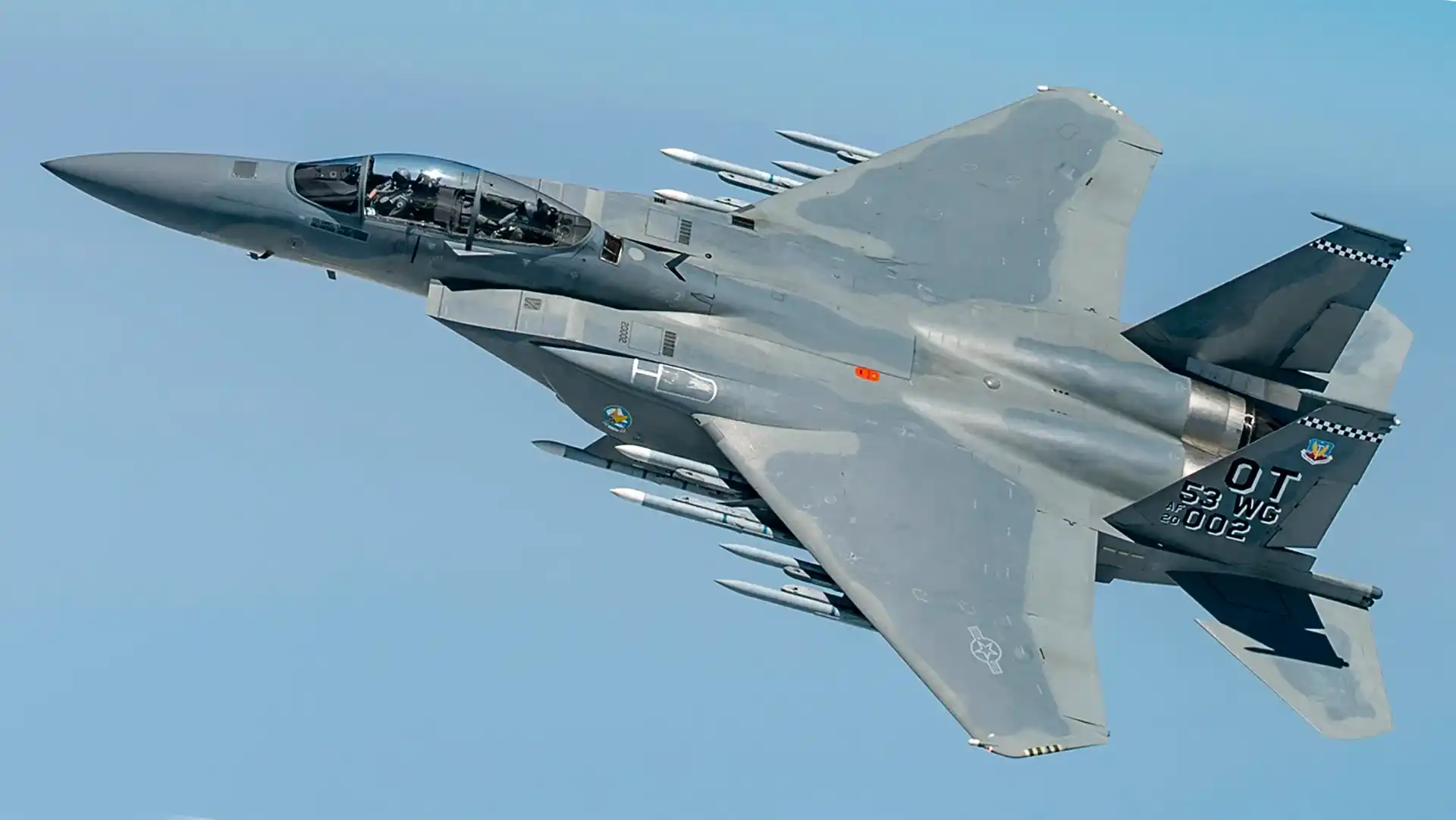
The United States Air Force currently operates a two-tier fighter structure built around the Lockheed Martin F-35A and Boeing F-15EX Eagle II. At first glance the aircraft seem to compete directly—they cost roughly the same, around $90 million per jet—but they are designed for fundamentally different missions.
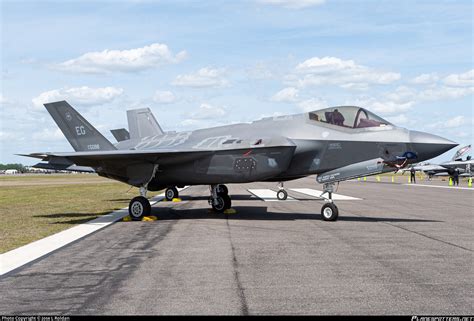
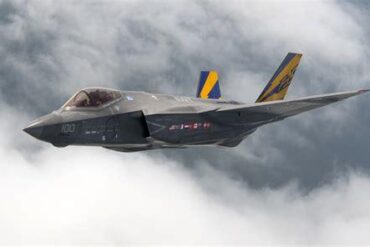
The F-35A Lightning II represents the stealth spearhead of modern air combat. It is optimized for penetrating heavily defended airspace where enemy radar systems, surface-to-air missiles, and advanced fighters would threaten conventional aircraft. Its radar signature is tiny because most weapons are carried inside internal bays.
The F-15EX Eagle II, by contrast, is enormous by fighter standards. It descends from the famous F-15 air superiority fighter first introduced in the 1970s, but the EX variant incorporates advanced avionics, digital architecture, and modern electronic warfare systems.
The performance differences illustrate their distinct roles. The F-15EX can reach Mach 2.5 and climb above 60,000 feet, while the F-35A tops out around Mach 1.6. Speed and altitude matter for missile engagement envelopes; the faster and higher aircraft can launch weapons with more energy.
Payload capacity is even more dramatic. The F-15EX can carry nearly 30,000 pounds of ordnance, making it one of the most heavily armed fighters ever built. The F-35’s internal bays limit its stealth loadout to a handful of missiles or bombs.
Yet that limitation is deliberate. In a typical mission profile the F-35 enters hostile airspace first, quietly destroying radar sites and identifying high-value targets. Once the air defenses are degraded, the F-15EX arrives with its massive weapon inventory to deliver sustained firepower.
In other words, the F-35 acts as the quarterback, while the F-15EX acts as the arsenal.
Electronics Versus Stealth: Surviving the Modern Battlefield
The central challenge for any modern fighter aircraft is survival against advanced air defense systems such as Russia’s S-400 or China’s HQ-9. These systems combine powerful radar networks with long-range missiles capable of striking targets hundreds of kilometers away.
Lockheed Martin’s answer is stealth. The F-35’s shape, materials, and internal weapon bays dramatically reduce radar reflections. In theory, this allows the aircraft to slip through detection zones long enough to destroy critical nodes in the defense network.
Boeing’s solution relies more on electronic warfare. The F-15EX carries the Eagle Passive Active Warning Survivability System (EPAWSS), an advanced suite capable of jamming enemy radar, detecting threats, and automatically deploying countermeasures.
In practical combat operations these approaches are not mutually exclusive. Stealth reduces detection probability, while electronic warfare disrupts the enemy’s ability to track and engage targets. When used together, they create overlapping layers of survivability.
Another advantage of the F-15EX is its ability to carry extremely large or experimental weapons that would never fit inside the F-35’s internal bays. Future hypersonic missiles and long-range air-to-air weapons may require exactly this kind of oversized platform.
The aircraft is therefore sometimes described as a “flying magazine”, capable of launching weapons guided by targeting data from stealth aircraft operating far ahead of it.
Naval Aviation Enters the Stealth Age
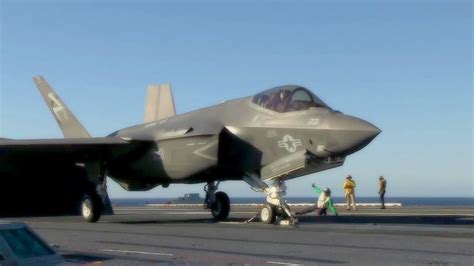
The same partnership between Boeing and Lockheed Martin exists within the United States Navy, though the aircraft involved are different. The Navy’s carrier air wings are currently transitioning from a fleet dominated by Boeing’s F/A-18 Super Hornet to a mixed force that includes the F-35C Lightning II.
The F/A-18E/F Super Hornet, especially in its modern Block III configuration, remains the backbone of naval aviation. It is rugged, versatile, and well understood by maintenance crews across the fleet. Carrier operations place extreme stress on aircraft structures, and the Super Hornet has proven remarkably resilient under those conditions.
However, stealth is increasingly important in maritime warfare. Modern naval combat involves long-range anti-ship missiles, powerful radar networks, and integrated air defenses. A fighter that can approach targets undetected provides a major tactical advantage.
The F-35C fills that role. It has the largest wingspan of any F-35 variant, allowing stable carrier landings and longer range during patrol missions. Because its weapons are carried internally, the aircraft remains aerodynamically clean, improving fuel efficiency and extending combat radius.
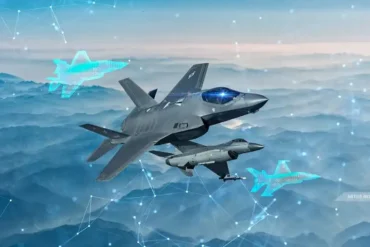
An interesting tactical twist appears when these aircraft operate together. The F-35C can detect enemy ships or aircraft with its sensors and transmit targeting data to a Super Hornet flying many miles away. The Super Hornet can then launch missiles at targets it has never seen directly.
From a systems perspective, the fighter is no longer just an airplane. It becomes a node in a distributed combat network, where information flows across multiple platforms in real time.
The End of the Harrier Era
Another area where Boeing and Lockheed Martin intersect is the transformation of Marine Corps aviation. For decades the Marines relied on the AV-8B Harrier II, a unique vertical-takeoff aircraft capable of operating from amphibious assault ships and improvised forward bases.
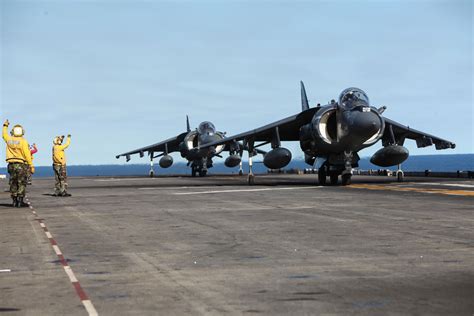
The Harrier’s design is ingenious but mechanically complex. Its Rolls-Royce Pegasus engine directs exhaust through four swiveling nozzles to produce vertical thrust. Pilots must constantly balance thrust and control inputs to maintain a stable hover. Flying the aircraft effectively requires exceptional skill.
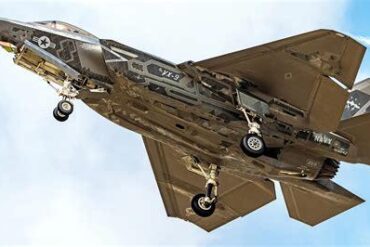
Lockheed Martin’s F-35B Lightning II represents a generational leap in this category. Instead of redirecting hot engine exhaust alone, the aircraft uses a shaft-driven lift fan mounted behind the cockpit. The engine powers the fan through a mechanical shaft, creating cooler vertical lift and far greater stability.
Even more transformative is the flight control software. Advanced automation manages many of the tiny adjustments required during vertical flight, allowing the pilot to concentrate on navigation, sensors, and weapons.
The result is a stealth fighter capable of short takeoff and vertical landing (STOVL) operations—something that would have seemed like science fiction only a few decades ago.
By June 2026, the Marine Corps plans to retire its final Harriers, completing the transition to the F-35B as its primary expeditionary strike platform.
Production Dominance and the Shadow of Skunk Works
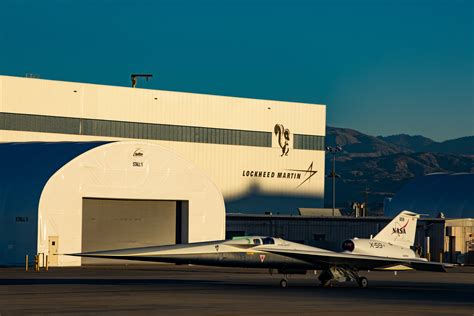
Lockheed Martin’s fighter empire owes much to the legendary Skunk Works division, the secretive engineering group responsible for revolutionary aircraft such as the U-2, SR-71 Blackbird, and F-117 Nighthawk. The same culture of experimental innovation influenced the development of the F-35.
Today the company produces fighters at a scale unmatched in the Western world. In 2025 alone, Lockheed Martin delivered 191 F-35 aircraft, setting a new production record after resolving earlier software delays tied to the Technology Refresh 3 upgrade.
That output dwarfs Boeing’s fighter production. Boeing is currently in a transitional period, juggling labor challenges, supply chain issues, and shifting defense priorities. Delivery of the F-15EX experienced delays after a lengthy labor strike in St. Louis, while production of the Super Hornet is expected to wind down within the next year.
Despite these challenges, Boeing retains an important strategic position. The F-15EX provides capabilities the F-35 cannot easily replicate, particularly in payload capacity and compatibility with large future weapons.
More importantly, Boeing’s upcoming F-47 Next Generation Air Dominance fighter could reshape the competitive landscape. Sixth-generation aircraft concepts emphasize advanced stealth, artificial intelligence integration, drone collaboration, and extremely long-range weapons.
If Boeing successfully executes that program, the balance of power between the two aerospace giants may shift again.
Two Visions of Airpower
The comparison between Boeing and Lockheed Martin fighters in 2026 ultimately reveals a deeper truth about modern warfare. Air combat is no longer dominated by a single type of aircraft. Instead, victory emerges from interconnected systems of platforms working together.
Lockheed Martin provides the stealth scouts, the aircraft that slip past radar networks and gather information from deep inside contested territory. Boeing provides the heavy hitters, the fighters that carry enormous arsenals and deliver sustained firepower once targets are identified.
This relationship resembles an ecosystem more than a rivalry. Each company builds aircraft optimized for different stages of combat: penetration, detection, coordination, and overwhelming strike.
In that sense, the future of American airpower is not Boeing versus Lockheed Martin. It is Boeing and Lockheed Martin—two design philosophies converging on the same objective: maintaining technological superiority in the skies.
And if the coming generation of fighters brings autonomous drones, hypersonic weapons, and artificial-intelligence copilots into the equation, this industrial duel is only just entering its most fascinating chapter. The machines may look like aircraft, but they are gradually evolving into something far stranger: networked war systems with wings.