The global distribution of air-power funding forms a landscape shaped by transparency gaps, shifting currencies, strategic ambiguity, and radically different defense philosophies. When exploring the world’s largest air forces by budget, the numbers do not merely describe the size of fleets—they reveal national priorities, geopolitical anxieties, and the evolving balance between conventional aviation, strategic deterrence, and high-technology warfare. While true comparability remains elusive, consistent patterns emerge when examining nations that funnel the greatest financial resources into air dominance.
Determining which air forces spend the most money begins with a structural puzzle: most countries do not break down their defense budgets with the granularity needed for precise comparison. Even advanced democracies—such as the United Kingdom—do not publicly disclose a dedicated air-force budget line. Others, including China and Russia, release figures that analysts consider incomplete, understated, or expressed in currencies that fluctuate dramatically. Budget categories vary even more dramatically. The United States Air Force, for instance, incorporates nuclear spending, long-range strategic missile programs, and space-related expenditures, while other nations count such items under entirely different ministries.
The result is a murky global accounting environment where comparisons require informed assumptions. Nevertheless, the general contours are clear: one air arm dominates, several challengers follow at great distance, and a cluster of mid-ranking powers maintains substantial aviation capabilities despite smaller economies.
The United States Air Force: A Funding Ecosystem Without Rival
The United States Air Force (USAF) enjoys an extraordinary degree of fiscal transparency compared with global peers, enabling a rare level of analytical precision. Its published annual budget sits around $188 billion, and when the United States Space Force is included—a service that still overlaps in mission space with traditional air operations—the total rises to approximately $218 billion. No other air arm comes remotely close.
This vast sum is not a simple investment in fighters, bombers, and transport aircraft. Roughly ten percent supports the American nuclear triad, including the development of the Sentinel ICBM, a next-generation intercontinental ballistic missile program that, in other countries, would fall outside the air-force budget entirely. Infrastructure, global basing rights, research laboratories, personnel systems, and strategic sustainment all contribute to the USAF’s immense financial footprint.
Within this budget, the USAF maintains the only globally oriented air-power framework in existence. Its tanker fleet—responsible for nearly three-quarters of the world’s aerial refueling capacity—provides the backbone of American power projection, enabling combat aircraft to operate far beyond the range of domestic airbases. The USAF’s fiscal scale is therefore both a cause and a consequence of its worldwide responsibilities.
America’s Other Three “Air Forces” Hidden In Plain Sight
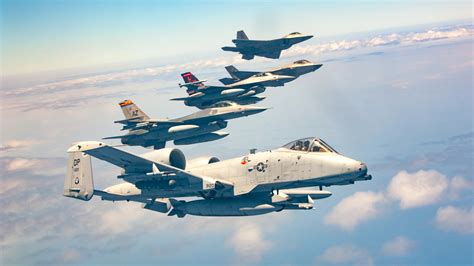
Understanding U.S. air expenditure requires acknowledging that the country effectively operates five air-power institutions: the Air Force, Navy, Marine Corps, Army, and Coast Guard. Aviation within the Navy and Marine Corps alone represents a financial block larger than the entire military budgets of most nations.
The Department of the Navy commands roughly $257 billion, of which the Navy accounts for $204 billion and the Marine Corps $53 billion. Navy aviation typically consumes 25–30% of total naval spending; Marine aviation absorbs 35–40%. When combined, these two naval air arms likely receive $65–70 billion per year. If treated as a standalone service, this would represent one of the world’s largest aviation budgets—possibly rivaled only by China.
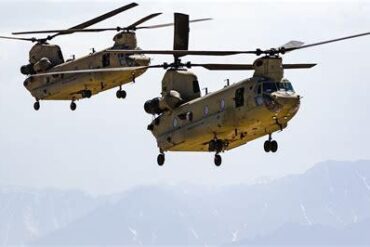
Meanwhile, the United States Army, after losing much of its aviation portfolio in 1947 to the newly formed Air Force, rebuilt around rotary-wing dominance. Today it invests an estimated $20 billion into helicopters, unmanned systems, and related support networks—an amount that surpasses the entire air-force budgets of advanced European states such as the United Kingdom and France.
China’s Air-Power Budget: The World’s Most Elusive Figure
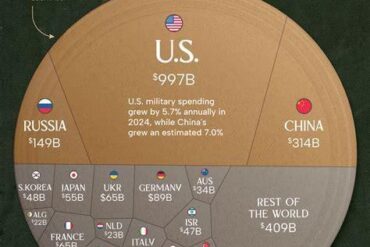
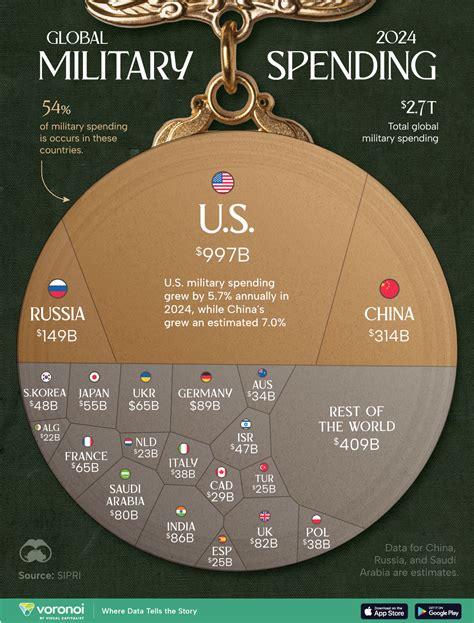
Among major powers, China presents the greatest challenge for budget transparency. The National People’s Congress reports a 2025 defense budget of $246 billion, but international institutions such as SIPRI estimate the real figure to be $318 billion or higher. Some independent analyses suggest total spending could exceed $400–470 billion, reflecting hidden programs, dual-use technologies, and off-ledger procurement.
Even more obscured is the portion allocated specifically to the People’s Liberation Army Air Force (PLAAF). Based on force structure, strategic priorities, and procurement patterns, most analysts estimate that 20–25% of overall Chinese defense spending supports air-power development. Applying this proportion to various budget estimates yields a wide set of possible outcomes:
- Official budget basis: $50–62 billion
- SIPRI estimate basis: $80 billion
- High-range independent estimates: up to $100 billion
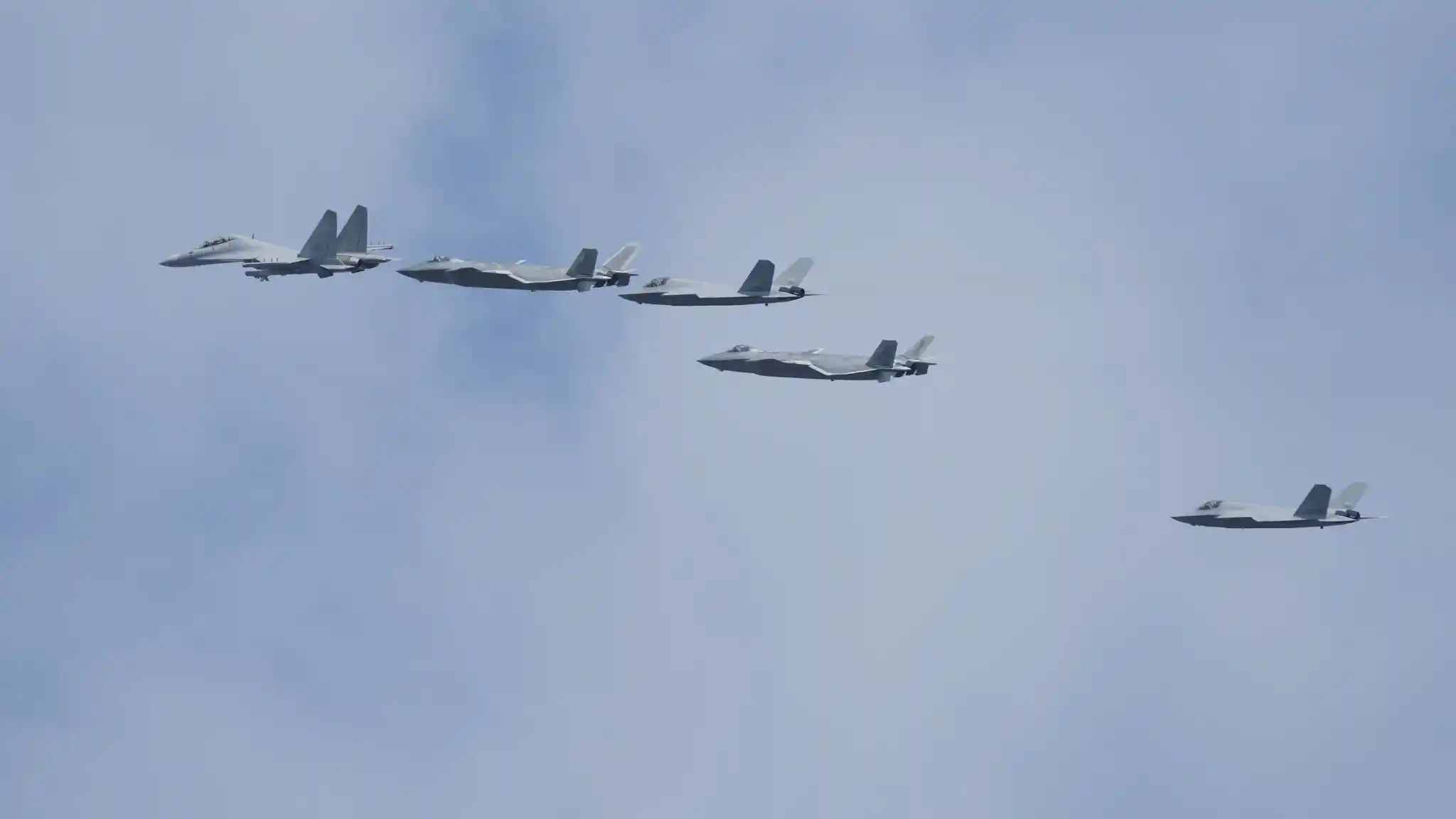
Regardless of the uncertainty, China unquestionably commands one of the world’s largest air-power budgets, rivaling U.S. naval aviation spending and vastly surpassing any other nation in the Indo-Pacific region. Its rapid modernization—visible in programs such as the J-20, J-31, and expanding tanker and AEW&C fleets—reinforces the likelihood that the PLAAF’s financial support will continue rising.
Russia’s Constrained But Still Formidable Air-Force Budget
Russia’s air-power narrative is complicated by its ongoing war in Ukraine, currency instability, and opaque financial reporting. Estimates place Russia’s total defense spending somewhere between $100 billion and $175 billion, though these figures remain contested. When a median estimate of $150 billion is used, and an allocation of 20–30% is applied to the Russian Aerospace Forces (VKS), the resulting air-force budget likely falls between $30 and $45 billion.
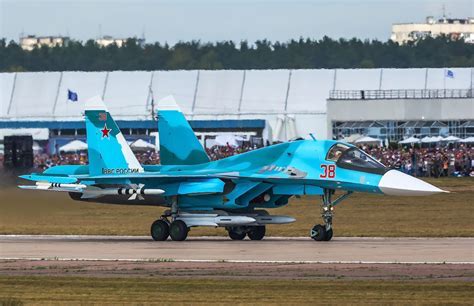
The Russian Air Force has endured significant attrition, losing modern fighters, trained pilots, and operational infrastructure. Its fleet is increasingly outdated: aircraft such as the MiG-29, Su-24, Su-25, and even early-generation Su-27 variants struggle to match the capabilities of modern Chinese or Western platforms. This technological stagnation has further highlighted Russia’s difficulties pursuing next-generation fighter programs amid wartime prioritization of ground forces.
Nevertheless, the VKS remains one of the world’s better-funded air arms. It commands extensive air-defense networks, long-range bombers, and a large tactical aviation fleet—although weakened—preserving its rank among global air-power heavyweights.
Other Major Air-Power Budgets: The Tier Just Below The Giants
Beneath the United States, China, and Russia lies a cluster of regional and trans-regional powers operating well-funded, technologically advanced air forces. Differences in accounting, currency valuation, and strategic doctrine make direct comparison challenging, but several trends emerge.
Saudi Arabia consistently appears near the top of the list. Its $78 billion defense budget allocates an estimated 25% to air power, giving the Royal Saudi Air Force a funding level of about $20 billion. This positions it alongside the U.S. Army’s aviation budget and significantly above those of most European states. Its reliance on advanced American and European platforms—including the F-15SA and Eurofighter Typhoon—makes the air force one of the most expensive per-airframe forces in existence.
India, another major aviation spender, operates a defense budget near $79 billion, with approximately 17% directed toward its air force. This produces an estimated air-power budget of $13–14 billion, though the figure may exceed $86 billion in total defense spending when procurement surges—such as Rafale acquisitions—are included.
Western Europe’s leading air forces follow closely. The UK Royal Air Force (RAF) receives around $12–18 billion, depending on SIPRI estimates. France’s Air & Space Force operates on $9–14 billion, while Germany commits roughly $8–16 billion to the Luftwaffe. Japan, South Korea, Italy, Israel, and Australia maintain similarly substantial budgets in the high single-digit to low double-digit billions.
While smaller than the behemoths of the United States and China, these budgets support advanced fighters, integrated missile defenses, and multinational operational commitments—forming a vital tier of global military aviation.
Why Budgets Don’t Predict Air-Power Capabilities
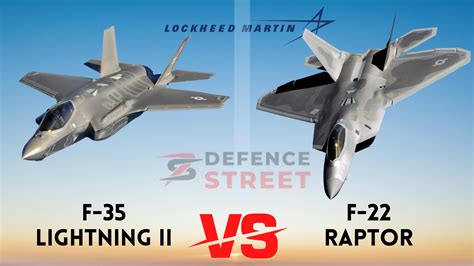
A common misconception assumes that the world’s most expensive air forces must also be the most capable or the largest by fleet size. Reality paints a more nuanced picture. For example, Pakistan operates a sizeable fighter inventory with a budget far smaller than that of the Royal Air Force. Similarly, North Korea fields one of the world’s largest numerical air forces—filled with aircraft from the 1960s and 70s—that possesses virtually no real capability in modern combat.
Air-power capability stems from many factors beyond procurement spending: sustainment infrastructure, logistics chains, pilot training hours, access to advanced munitions, and the ability to operate far from home territory. The U.S. Air Force, for example, excels in global reach because of its unparalleled tanker fleet and worldwide basing agreements—advantages that remain unmatched regardless of fleet size.
By contrast, the Russian Air Force demonstrates how a large, well-funded air arm can falter when strategic doctrine, training quality, and long-term modernization are mismatched to operational demands.
The relationship between air-force spending and capability is therefore non-linear: wealth matters, but doctrine, efficiency, and technology integration often matter more.
The Global Outlook: Air-Power Budgets In A Shifting Strategic Era
As great-power competition sharpens, air-force budgets will continue to rise across multiple regions. The United States is shifting toward next-generation stealth platforms, autonomous wingmen, hypersonic weapons, and resilient space architectures. China is expanding its long-range strike systems and rapidly increasing the sophistication of its air-power ecosystem. Regional powers—from Saudi Arabia to Japan—are doubling down on high-end fighters, early warning systems, and integrated air-missile defense to hedge against uncertainty.
The future landscape will likely widen the gap between highly advanced air powers and those with legacy fleets, even when total aircraft numbers mask the disparity. In an era defined by electronic warfare, networked sensors, and long-range precision weapons, the sophistication of investment—not simply the amount—will determine which nations dominate the skies.
The world’s largest air-force budgets thus reflect more than military arithmetic; they reveal national strategies, geopolitical ambitions, and the accelerating race for technological superiority in modern warfare.