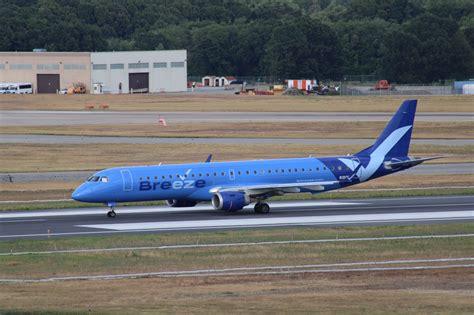
Breeze Airways has officially ended its Embraer E190 era, completing a fleet transformation that began as the airline moved from startup operations toward a larger, longer-range network. The carrier’s final scheduled E190 passenger flights took place in early September, marking the end of an aircraft chapter that helped Breeze establish itself during the post-pandemic recovery.
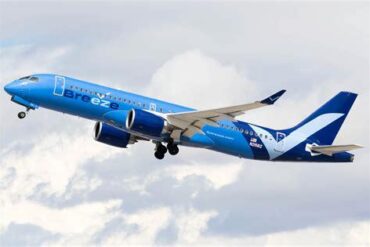
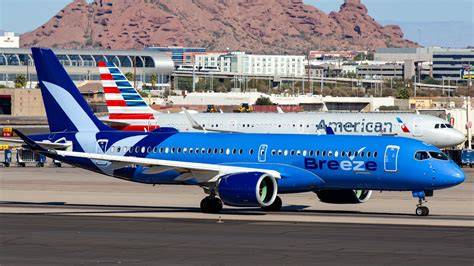
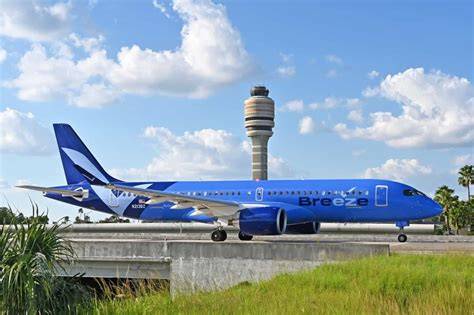
The move leaves Breeze Airways with an all-Airbus A220 fleet, consisting of 59 A220-300s. The transition is more than a simple aircraft replacement. It represents a deliberate shift toward a standardized fleet built around greater range, higher capacity, improved passenger comfort, and a more consistent operating model.
Breeze originally relied on the E190 because its size and economics suited an airline trying to launch numerous underserved routes. The aircraft gave the carrier the flexibility to connect smaller markets while demand patterns were still developing. As Breeze expanded, however, the Airbus A220-300 increasingly became the backbone of its network, eventually making the E190 unnecessary.
Breeze Airways Completes Its Final E190 Flights
The E190’s departure was surprisingly understated. According to scheduling data from Cirium, Breeze operated just eight E190 flights during the first week of September, with four flights on September 4 and another four on September 7.
The final operations followed a familiar Breeze pattern. The aircraft operated a one-stop rotation between New Orleans (MSY) and Wilmington (ILM), via Orlando (MCO). These services were marketed as BreezThru itineraries, allowing passengers to remain on the same aircraft and flight number during the intermediate stop.
The final aircraft was N120BZ, which operated as MX311 from New Orleans to Orlando before continuing to Wilmington. It subsequently returned as MX310, eventually arriving back in New Orleans at 5:55 p.m. That flight effectively closed Breeze’s scheduled commercial E190 chapter.
The aircraft’s story with Breeze did not necessarily end at the airport. After completing its final passenger duties, N120BZ was scheduled to fly toward San Jose, Costa Rica (SJO) for storage, signaling the beginning of its next operational chapter outside Breeze’s scheduled passenger network.
Why the Airbus A220 Became Breeze’s Fleet of Choice
The retirement of the E190 makes strategic sense as Breeze continues developing a network that reaches beyond the capabilities of smaller regional jets. The A220-300 offers significantly more capacity and substantially greater range while retaining the efficiency expected from a modern narrowbody aircraft.
According to the supplied aircraft data, the A220-300 has a range of approximately 3,300 nautical miles, compared with around 2,450 nautical miles for the E190. That difference gives Breeze considerably more flexibility when designing routes between markets that previously required larger aircraft or connections.
The A220 is also physically larger. Its longer fuselage and wider cabin allow Breeze to carry more passengers while providing a more spacious onboard environment. For an airline whose business model depends heavily on nonstop service between underserved cities, those additional seats and extra miles can materially change the economics of a route.
Just as importantly, the A220 gives Breeze a platform that can support the airline’s continued expansion without requiring the complexity of maintaining multiple aircraft families.
A Younger and Simpler Breeze Airways Fleet
Fleet simplification is one of the most important consequences of the E190 retirement. With the final Embraer gone, Breeze no longer needs to operate two different aircraft types across its network.
A single-type fleet can bring advantages in maintenance planning, crew training, spare parts management, scheduling, and operational flexibility. Pilots and maintenance personnel can concentrate on one aircraft family, while the airline can potentially move aircraft between routes more easily according to demand.
The result is also an exceptionally young fleet. Data cited from ch-aviation puts the average age of Breeze’s A220-300 fleet at approximately 2.7 years. That makes Breeze one of the airlines with the youngest fleets in commercial aviation.
And the transformation is not finished. Breeze still has almost 40 additional A220s to be delivered, meaning the airline’s fleet will continue expanding while remaining centered on the same aircraft family.
Every Breeze Flight Now Offers a Premium Cabin
For passengers, the most visible consequence of the transition may be inside the cabin.
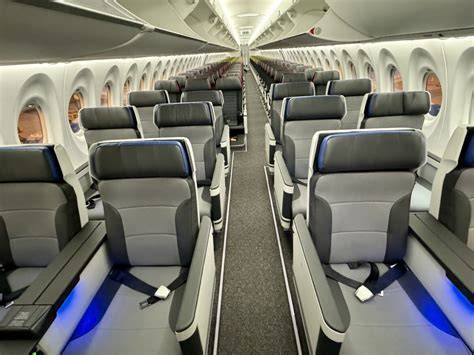
The E190 previously operated by Breeze had 108 economy seats and did not offer the airline’s dedicated premium seating product. The A220-300, by contrast, can accommodate 137 passengers, including 12 Breeze Ascent premium seats.
Breeze Ascent is arranged in a 2-2 configuration, giving premium passengers a wider seat than the 3-2 arrangement used in the aircraft’s economy cabin. The premium seats provide approximately 20.5 inches of width and 39 inches of pitch, compared with roughly 18.1 inches of width and 31–33 inches of pitch in economy.
That means the end of the E190 also marks a significant change in Breeze’s passenger proposition. Every flight can now offer premium seating, creating greater consistency across the airline’s network and giving travelers more choice when booking.
What Breeze’s All-A220 Strategy Means for Future Growth
The E190 helped Breeze get off the ground, but the A220 is increasingly defining what the airline wants to become. Its greater range and capacity are particularly useful for an airline pursuing point-to-point routes rather than building its network around a traditional mega-hub.
The retirement therefore looks less like the end of an aircraft type and more like the completion of an important phase in Breeze’s development. The airline can now plan its future around a single modern narrowbody platform, while the incoming A220s provide room for further growth.
Breeze’s E190s were important to its early identity, but their role became harder to justify as the airline matured. With the last aircraft now retired from scheduled passenger service, Breeze Airways is officially an all-A220 airline—and its next phase will be shaped almost entirely by Airbus’s modern twinjet.