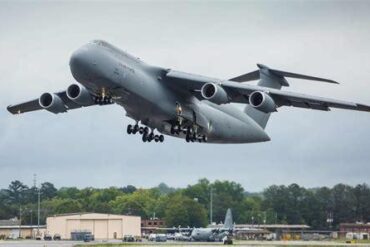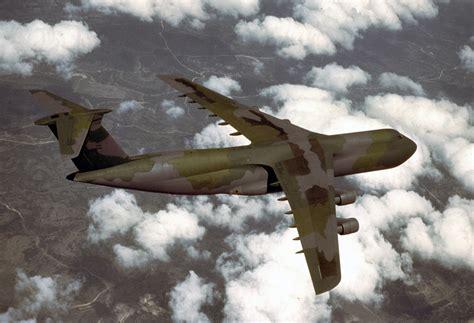
The story of the Lockheed C-5 Galaxy is not just about an aircraft—it is about a machine that quietly reshaped how a superpower projects force across the planet. Conceived in urgency, criticized for its cost, and nearly undone by its own ambition, this colossal airlifter has endured for more than half a century. Today, it remains one of the most strategically indispensable assets in the United States military arsenal.
What makes this even more remarkable is that the foundation of this capability was laid in 1968, during one of the most turbulent periods in modern military history. While technologies have evolved and threats have changed, the C-5’s core mission—moving massive military power anywhere, anytime—has only grown more relevant.
The Vietnam War Bottleneck That Changed Everything
By the mid-1960s, the United States faced a logistical dilemma in Vietnam that no amount of tactical brilliance could solve. The battlefield was vast, unpredictable, and unforgiving. American forces needed rapid reinforcement, but the ability to move heavy equipment across the Pacific Ocean simply didn’t exist at the scale required.
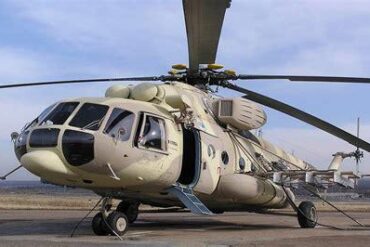
Helicopters—particularly those used in air cavalry operations—were essential for navigating Vietnam’s dense jungles and rugged terrain. But when these machines were damaged or destroyed, replacing them became a logistical nightmare. Shipping them by sea took weeks, sometimes months. In war, that kind of delay can be catastrophic.
The same problem applied to main battle tanks and armored vehicles, which were critical for holding ground during major offensives. Existing transport aircraft like the C-141 Starlifter simply could not carry such oversized cargo.
This gap exposed a harsh truth: without the ability to rapidly deploy heavy equipment, the United States risked losing its operational edge.
A ‘No Limits’ Engineering Gamble
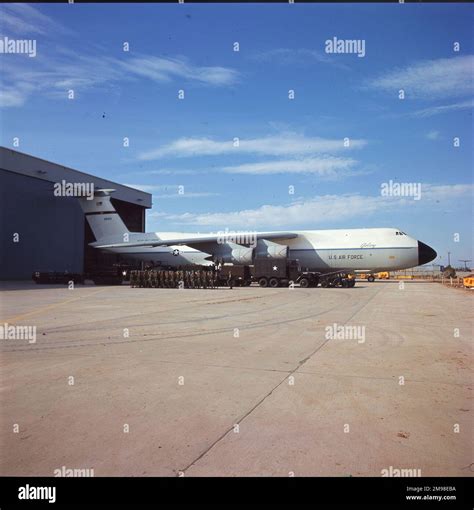
Faced with this challenge, the U.S. Department of Defense launched one of the most ambitious aviation programs in history. The requirement was straightforward in concept but extreme in execution: build an aircraft capable of transporting virtually the entire arsenal of a U.S. Army division across intercontinental distances.
Lockheed won the contract in 1965, but the expectations were staggering. The new aircraft had to:
- Carry M60 tanks, which no existing aircraft could lift
- Transport helicopters fully assembled
- Fly long-range missions without refueling
- Handle cargo volumes never before attempted in aviation
The result was the C-5 Galaxy—a machine so large and complex that it pushed the boundaries of aerospace engineering.
But ambition came at a cost. The program experienced massive overruns, becoming the first military aircraft program to exceed $1 billion over budget. Critics labeled it reckless. Media outlets questioned whether such an enormous investment was justified.
Yet, even amid controversy, one fact remained undeniable: nothing else in the world could do what the C-5 was designed to do.
The Birth of a Strategic Titan
When the first C-5A took flight on June 30, 1968, it marked more than a technical milestone—it signaled the arrival of a new era in strategic airlift capability.
The aircraft entered service in 1970 and was deployed to Vietnam almost immediately. It didn’t take long for its value to become clear. The C-5 could transport nearly 98% of the Army’s equipment, including items previously considered impossible to move by air.
Its impact was immediate and profound. Instead of waiting weeks for reinforcements, commanders could now receive critical assets in a matter of days—or even hours.
That shift alone redefined modern military logistics.
Engineering the Impossible: Size, Scale, and Sheer Power
To understand why the C-5 remains unmatched, you have to grasp its sheer scale. This aircraft isn’t just big—it’s monumental.
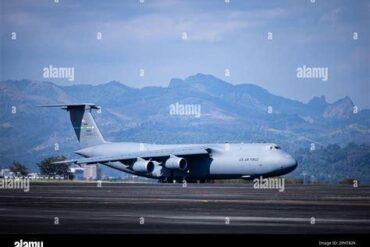
Stretching 247 feet in length, the C-5 is longer than many commercial airliners, including the Airbus A380. Its 222-foot wingspan rivals the width of a football field, and its towering 65-foot height makes it comparable to a six-story building.
Inside, the cargo bay is nothing short of cavernous:
- 143 feet long
- 13 feet high
- 19 feet wide
- Over 34,000 cubic feet of space
This allows it to carry:
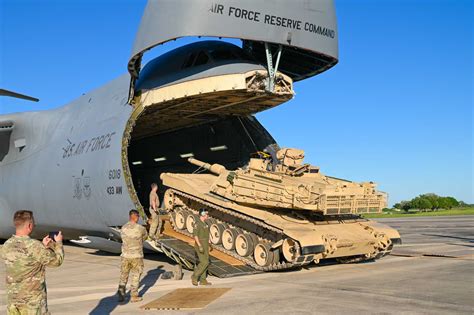
- One or even two M1A2 Abrams tanks
- Six UH-60 Black Hawk helicopters
- Multiple armored vehicles or 350 troops with equipment
Its unique front and rear loading ramps enable rapid drive-on and drive-off operations, drastically reducing turnaround time. The aircraft’s kneeling landing gear system lowers the fuselage to align with standard cargo heights, making loading even more efficient.
In short, the C-5 isn’t just a transport—it’s a flying logistics hub.
From ‘FRED’ to Super Galaxy: Overcoming Early Flaws
Despite its revolutionary capabilities, the C-5’s early years were far from smooth. Its advanced systems were notoriously unreliable, earning it the infamous nickname “FRED”—short for Freaking Ridiculous Electronic Disaster.
The irony? Even with its flaws, it was still indispensable.
Rather than abandoning the platform, the U.S. Air Force chose to refine it. Over decades, the aircraft underwent continuous upgrades, culminating in the C-5M Super Galaxy modernization program.
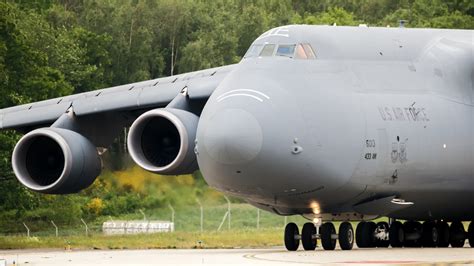
The transformation was dramatic. The most significant improvement came from replacing the original engines with General Electric CF6-80C2-L1F engines, delivering:
- 22% more thrust
- 30% shorter takeoff distance
- 58% faster climb rate
Payload capacity increased to 285,000 pounds, while reliability and mission readiness improved significantly.
Financially, the upgrade made sense too. Modernizing a C-5 cost roughly $75 million, compared to about $200 million for a new C-17 Globemaster III—an aircraft that carries only about half the C-5’s cargo volume.
The lesson was clear: when something already dominates its niche, evolution beats replacement.
Global Reach: From Warzones to Humanitarian Lifelines
What truly cements the C-5’s strategic importance is its versatility. While born out of wartime necessity, it has served in nearly every type of mission imaginable.
From Vietnam to the Middle East, from Cold War deployments to modern conflicts, the C-5 has been a constant presence. But its role extends far beyond combat.
It has delivered:
- Humanitarian aid to Rwanda during the 1994 crisis
- Equipment for peacekeeping missions in Zimbabwe
- Emergency supplies after natural disasters worldwide
This dual-use capability—warfighter and lifesaver—makes it one of the most valuable assets in the U.S. military inventory.
Why No True Replacement Exists
Given its age, one obvious question arises: why hasn’t the C-5 been replaced?
The answer lies in a combination of engineering complexity, cost, and unmatched capability.
Designing an aircraft that can:
- Carry extreme payloads
- Operate across intercontinental distances
- Maintain operational flexibility
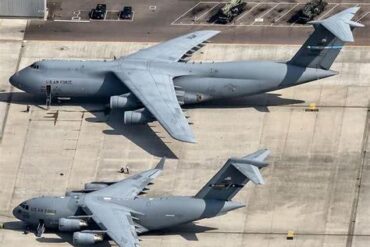
…is extraordinarily difficult. Even modern platforms like the C-17, while more agile, cannot replicate the C-5’s sheer volume and payload capacity.
In essence, the C-5 occupies a category of its own—a niche so demanding that no direct successor has yet emerged.
The Strategic Advantage of Mass Deployment
Military power isn’t just about advanced weapons—it’s about how quickly those weapons can be brought to bear.
The C-5 enables the United States to deploy entire force packages across the globe in record time. Tanks, helicopters, support vehicles, and personnel can all arrive together, ready for immediate action.
This capability creates a powerful strategic effect: deterrence through speed and scale.
An adversary isn’t just facing American forces—they’re facing the reality that those forces can appear almost anywhere, almost instantly.
Fleet Evolution and Enduring Presence
Over the decades, the C-5 fleet has evolved while maintaining its core mission. From the original C-5A models to the improved C-5B and specialized C-5C, each iteration addressed reliability and mission capability.
Today, the U.S. Air Force operates a streamlined fleet of C-5M Super Galaxies, stationed at key bases including:
- Dover Air Force Base
- Travis Air Force Base
- Lackland Air Force Base
- Westover Air Reserve Base
These aircraft continue to form the backbone of America’s strategic airlift command, ensuring readiness for both conflict and crisis.
Looking Ahead: The Future of Strategic Airlift
Even as the C-5 remains vital, the Air Force is already planning for the future. The next generation of airlifters, often referred to as Next Generation Airlift (NGAL), aims to combine the strengths of the C-5 and C-17 into a single platform.
One of the most promising concepts is the blended-wing-body (BWB) design.
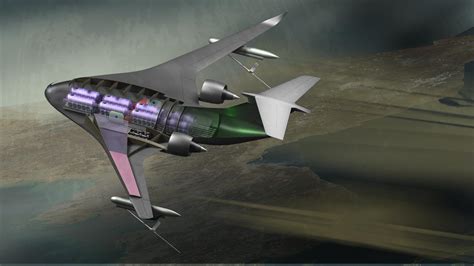
This futuristic approach integrates the wings and fuselage into a single aerodynamic structure, offering:
- Reduced radar signature
- Improved fuel efficiency
- Greater payload flexibility
Unlike the massive, highly visible C-5, future airlifters will prioritize stealth and survivability, enabling operations in contested environments where modern air defenses pose significant threats.
They are also expected to feature:
- Advanced defensive systems against missiles and drones
- Capability to operate from damaged or short runways
- Faster loading and unloading processes
Yet, even with these advancements on the horizon, replacing the C-5 will not be easy. Its combination of capacity, range, and proven reliability sets a benchmark that future designs must strive to match.
A Legacy That Refuses to Fade
More than five decades after its first flight, the C-5 Galaxy remains a symbol of engineering ambition and strategic foresight. It was born out of necessity, shaped by adversity, and refined through decades of service.
Its continued relevance in modern military operations is not an accident—it is the result of a design that solved a fundamental problem better than anything before or since.
In an era defined by rapid technological change, the C-5 stands as a reminder that sometimes, the most powerful innovations are not those that constantly evolve, but those that get it right the first time—and keep getting better.
And as long as the United States needs to move massive power across vast distances, this 1968-born giant will remain exactly what it has always been: indispensable.