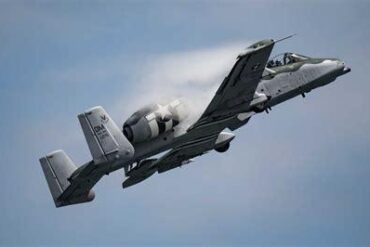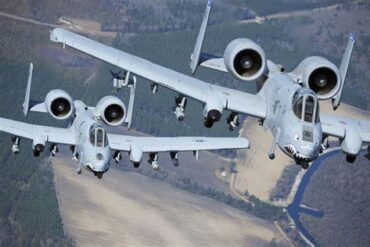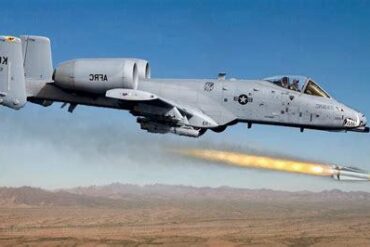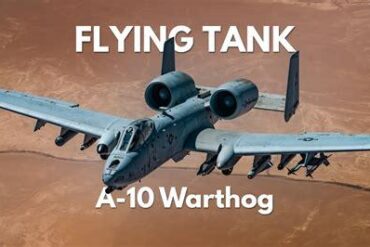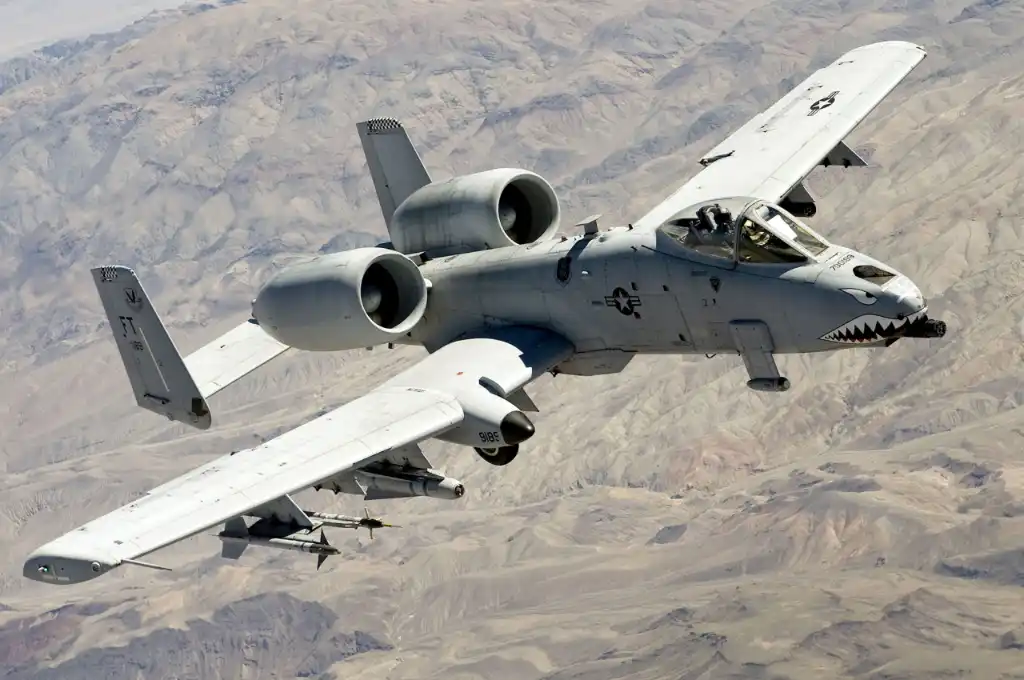
The enduring question of whether an A-10 Warthog can destroy a tank sparks intense debate across military forums, defense circles, and aviation history communities. The answer is far more decisive than many expect. The A-10C Thunderbolt II—universally recognized as the Warthog—was engineered from the ground up to devastate armored vehicles, and tanks sit squarely at the center of that mission profile. This aircraft represents a rare moment in modern military aviation where a machine was designed around a gun rather than fitting a gun onto a machine. The result is a platform capable of punching through hardened armor and leaving behind a trail of wrecked steel, even in environments thick with countermeasures and battlefield chaos.
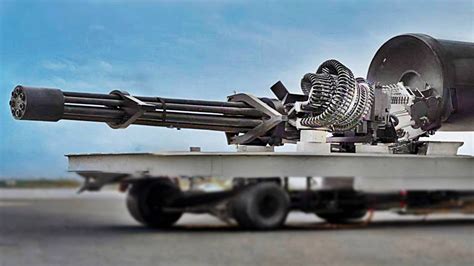
When the United States Air Force launched the A-X program in the late Cold War era, it sought an aircraft that could loiter, take hits, fly low, strike with surgical precision, and deliver overwhelming firepower. What followed was the A-10: a twin-engine, titanium-armored, close-air-support specialist whose center of gravity—both literally and strategically—is the 30mm GAU-8/A Avenger. This weapon remains one of the most powerful airborne cannons ever deployed. Built by General Electric and integrated directly into the airframe, the Avenger fires armor-piercing depleted-uranium rounds at a rate capable of shredding even modern tank armor.
As the Warthog entered service in 1977, its combat record quickly revealed how effectively its design principles translated into real battlefield lethality. The aircraft’s slow speed by modern jet standards isn’t a limitation—it is a tactical advantage. Pilots can stabilize firing angles, bring the cannon to bear with deliberate accuracy, and deliver bursts that transform enemy armor into flaming ruin.
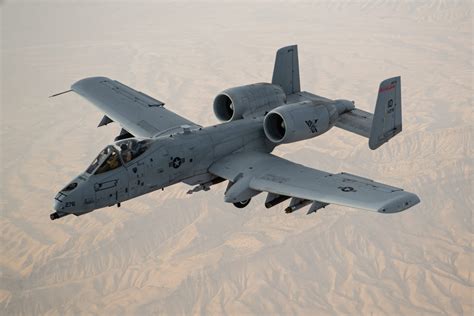
The A-10’s Origin as a Purpose-Built Tank Destroyer
The Warthog’s lineage traces back to lessons learned from the Douglas A-1 Skyraider, an aircraft renowned for its reliability and close-support effectiveness. But the A-10 needed to exceed the Skyraider’s capabilities in survivability, weaponry, and accuracy against modern Soviet armor. Engineers responded with an airframe wrapped around the GAU-8/A, creating a gun that makes up roughly 16% of the aircraft’s empty weight. The drum typically carries 1,174 rounds of 30mm ammunition, though it can be expanded to 1,350 rounds, giving pilots an astonishing number of opportunities to aim, fire, and destroy.
During Operation Desert Storm, the A-10 validated these design principles on a historic scale. Smithsonian Magazine reported more than 900 destroyed Iraqi tanks, many falling victim to the Avenger cannon. Maverick missiles, cluster munitions, and laser-guided bombs expanded the Warthog’s toolkit even further, allowing the aircraft to engage at longer ranges or strike hardened positions when cannon passes were less favorable.
The Avenger fires so accurately that 80% of its rounds land within a 40-foot circle at 4,000 feet. That level of precision, combined with kinetic energy and depleted uranium, allows the shells to enter armor plating, create internal spalling, and ignite ammunition stores. Inside a tank, this becomes catastrophic.
How the Avenger Cannon Destroys a Tank
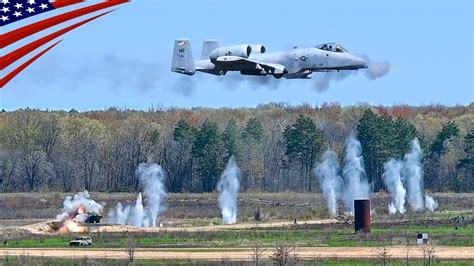
The process appears deceptively simple from the outside. A pilot lines up a target from a shallow dive, monitors reticles that account for speed, altitude, and ballistic drop, and once stabilized, fires a burst lasting just a fraction of a second. In that moment, the Avenger unleashes a storm of 30mm rounds that hit the target with extreme kinetic force.
The depleted uranium round—denser than steel—penetrates armor, liquefying portions of it and sending molten fragments into the crew compartment. Task & Purpose observed that the round effectively turns tank armor into “white-hot shrapnel.” Even modern vehicles equipped with Explosive Reactive Armor (ERA) have proven vulnerable. In 2022, tests by the USAF 422nd and 59th Test and Evaluation Squadrons demonstrated the Warthog could still inflict lethal damage against armored vehicles protected by contemporary systems.
Forward air controllers guide pilots toward ideal attack vectors, while the A-10’s unmatched ability to loiter and re-attack ensures tanks cannot easily hide. Even partial silhouettes become viable targets when the pilot applies a well-timed burst of the Avenger.
Technical Performance and Operational Strength
The A-10’s tank-killing reputation isn’t myth; it’s backed by numbers. During the Gulf War alone, mission capable rates exceeded 95%, and the aircraft launched 90% of all AGM-65 Maverick missiles used in theater. Its low-altitude survivability comes from redundant flight controls, titanium armor protecting the cockpit, and engines spaced widely to minimize the risk of a single hit disabling both.
Tank destruction depends on factors such as attack angle, ammunition type, weather clarity, and surface-to-air missile threats. Yet even in imperfect conditions, the Warthog consistently achieves effects other aircraft cannot replicate. Fast-moving multirole fighters may carry precision munitions capable of destroying tanks, but they lack the ability to repeatedly strafe, adjust aim between passes, or linger in contested zones at low altitude with the same degree of survivability.
Attack helicopters, while potent with Hellfire missiles, operate closer to ground threats and are more vulnerable to small-arms fire and MANPADS. Drones excel in reconnaissance and precision strikes, yet they cannot deliver the sustained kinetic output of the Avenger cannon, nor can they adapt dynamically to rapidly shifting battlefield conditions with a human pilot’s intuition.
Modern Threats and the Future of Tank Busting
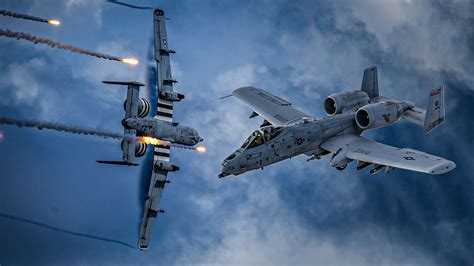
The battlefield has evolved, and so have the threats facing the A-10. Advanced surface-to-air missiles, dense urban environments, and newer armor technologies complicate classic tank-busting runs. Pilots must evaluate attack vectors to minimize exposure, coordinate with ground forces, and rely on detailed mission planning to overcome defensive layers.
Still, the Warthog remains lethal. Even in peer-adversary simulations, its ability to provide close-air-support in austere environments stands out. The Weapons School at Nellis Air Force Base continually sharpens pilot tactics, ensuring graduates achieve surgical precision under intense pressure.
Where the A-10 thrives is in semi-permissive environments—battlespaces where the enemy may have defenses, but not enough to prevent repeated A-10 ingress. Its resilience, maneuverability, and devastating gunfire offer unmatched reliability. When a ground commander calls for armor neutralization up close, no platform delivers that effect like the Warthog.
Conclusion: Can the A-10 Destroy a Tank?
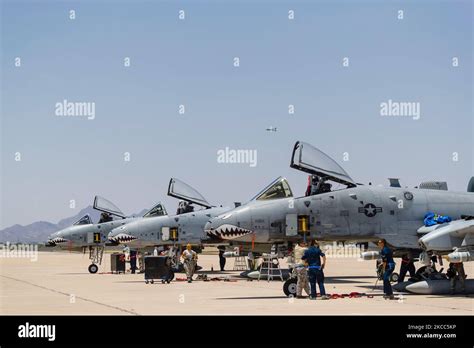
Absolutely. The A-10 Warthog was engineered for the sole purpose of dismantling armored warfare. Its record—from the Gulf War to Iraq, Afghanistan, and extensive modern testing—makes clear that tanks cannot withstand the Avenger’s punishing impact when the aircraft is given room to maneuver. Stealth fighters may strike from afar and drones may hover invisibly, but the Warthog is the platform ground troops trust to remove tanks from the battlefield with ruthless precision.
The combination of 30mm depleted-uranium rounds, low-speed accuracy, high survivability, multiple attack options, and decades of real-world results cements the A-10 as one of history’s most formidable tank killers. Even as militaries evolve, its place in the close-air-support domain remains unmatched.