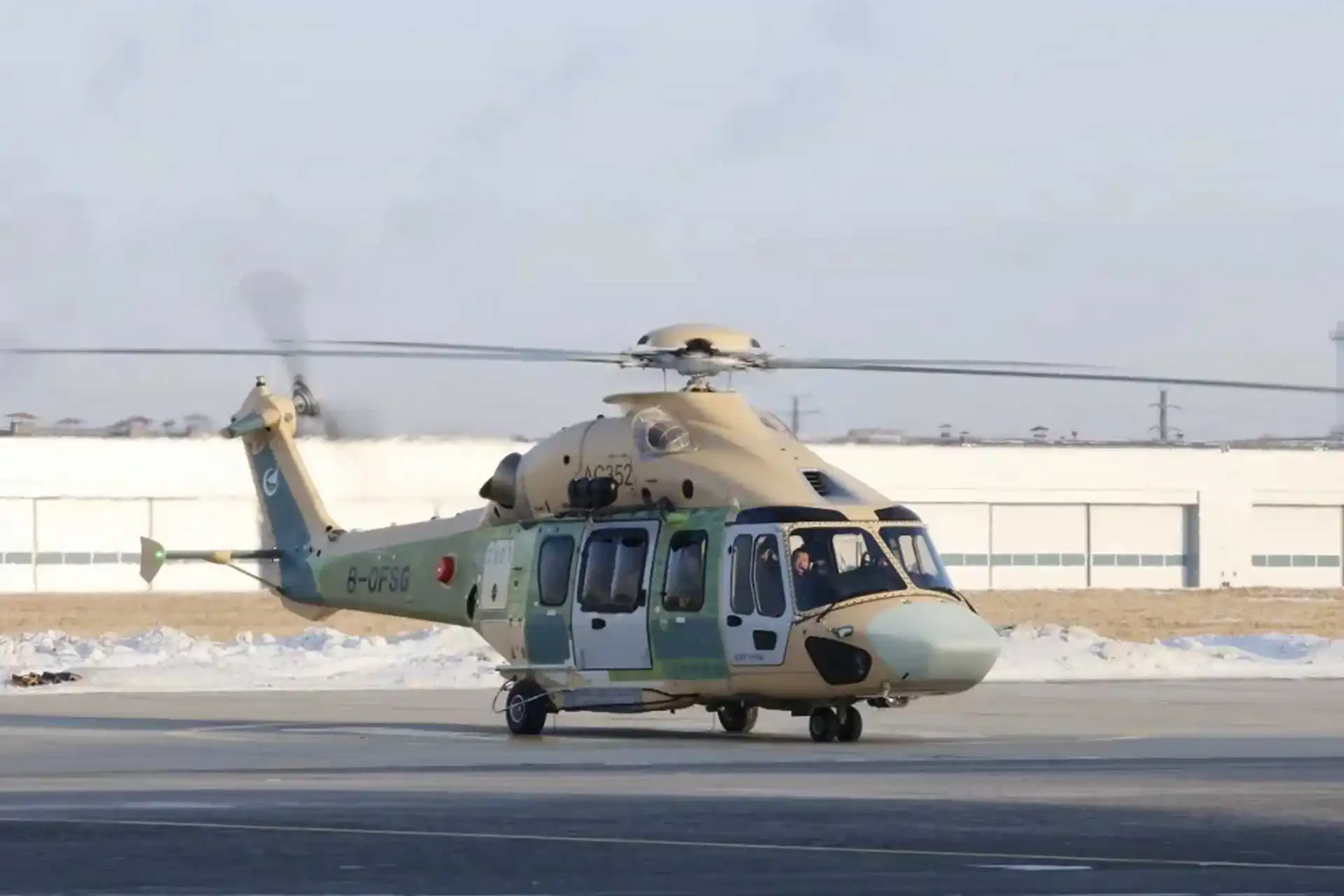
China has restarted flight testing of its AC352 multipurpose helicopter, signaling renewed momentum for a program positioned at the heart of the country’s civil aviation and emergency response ambitions. The return to the air on January 20, 2026, in Harbin marked more than a symbolic milestone. It confirmed that a prolonged pause in airborne development has ended and that the helicopter is now entering a decisive adjustment and verification phase focused on search and rescue operations. Conducted during a national aviation emergency-rescue equipment meeting, the flights highlighted a dedicated SAR configuration designed for demanding missions where endurance, payload, and system integration matter more than raw speed.
The AC352, also known domestically as the Harbin Z-15, occupies a carefully calculated niche in China’s rotary-wing ecosystem. It bridges the operational gap between lighter helicopters that struggle with range and payload, and heavier platforms that are expensive, scarce, or prioritized for military use. By resuming flight tests with a mission-focused configuration, AVIC has signaled that the program is shifting from developmental uncertainty toward certification-driven maturity and near-term operational relevance.
The January 2026 demonstration emphasized real-world utility rather than abstract performance metrics. The helicopter flew with equipment and systems configured specifically for emergency response, reinforcing the program’s civil orientation. This focus aligns with growing domestic demand for reliable offshore transport, disaster response, and maritime rescue coverage across China’s expansive coastline and inland waterways. The restart also suggests that program adjustments made during the pause have reached a level of confidence suitable for renewed airborne validation.
The AC352’s origins stretch back two decades, rooted in a rare example of deep industrial cooperation between China and Europe. Initial discussions began in 2005 between Eurocopter and AVIC to co-develop a new medium twin-engine helicopter, then known as the EC175. A formal development contract signed later that year established an unusually balanced partnership, with equal sharing of investment, development workload, industrial responsibility, and commercial risk. This structure laid the foundation for two parallel products: the Airbus H175 for global markets and the Chinese-produced AC352 for domestic and regional use.
Introduced publicly at Heli-Expo 2008, the program’s industrial architecture split final assembly and long-term support between Harbin and Marignane, France. While the European H175 progressed more quickly, the Chinese AC352 followed a deliberately later timeline, reflecting localization goals and the integration of domestically developed systems. The first AC352 prototype appeared publicly in 2015 at the China Helicopter Expo in Tianjin, followed by a maiden flight in December 2016. From the outset, the aircraft was positioned as a civil and public-service platform, with SAR, emergency medical services, and offshore transport as its core missions.
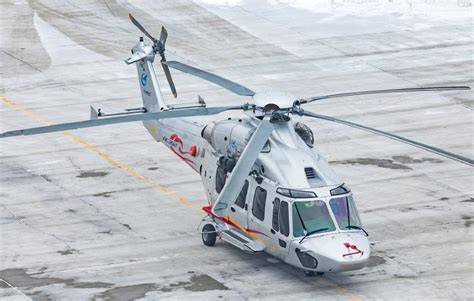
Although derived from the H175 airframe, the AC352 incorporates significant Chinese design contributions that distinguish it technically and strategically. AVIC developed the main rotor system and the flight control architecture, ensuring domestic control over critical technologies. The helicopter features a wide-body fuselage with a flat cabin floor, enabling flexible reconfiguration for passengers, stretchers, or cargo. A retractable tricycle landing gear reduces drag in cruise while preserving ground handling stability, a combination well suited to offshore platforms and confined landing zones.
At the heart of the AC352 is the WZ-16 turboshaft engine, a product of cooperation between Safran and Chinese partners CAPI and Dongan under the Aero Engine Corporation of China. Each engine delivers more than 1,240 kW of takeoff power, with maximum output approaching 1,500 kW, supporting a maximum takeoff weight of 7.5 tonnes. This power margin is central to SAR missions that demand high hover performance with heavy loads, particularly in hot-and-high or maritime environments. The helicopter’s typical operational range of around 850 kilometers and cruise speeds between 280 and 300 kilometers per hour provide the endurance needed for extended search patterns and distant recoveries.
Dimensionally, the AC352 aligns with the H175 family, featuring a 14.8-meter main rotor diameter and a fuselage length of approximately 15.7 meters. The five-bladed composite rotor, mounted on a flexible titanium rotor head, is designed for long service life and reduced vibration, improving crew endurance during lengthy missions. The airframe and rotor system are rated for around 20,000 flight hours, while major drivetrain and engine overhaul intervals extend to 5,000 hours, a lifecycle profile intended to reduce long-term operating costs for civil operators.
The cockpit reflects modern expectations for workload reduction and situational awareness. A full glass layout with four large multi-function displays is paired with a dual-duplex, four-axis automatic flight control system, supporting stable hover, precise approach profiles, and safer operations in degraded visual environments. These features are not cosmetic upgrades; they directly support SAR effectiveness by allowing pilots to manage complex missions while maintaining tight control margins near obstacles, vessels, or survivors in the water.
What truly defines the AC352’s January 2026 flight tests is its mission equipment integration. Structural and systems provisions were incorporated from the outset to support rescue hoists, emergency flotation gear, external mounts, and sensor installations without extensive airframe modification. The SAR configuration demonstrated in Harbin included an electrically powered rescue winch, a high-intensity searchlight, and dedicated rescue communications linking pilots, winch operators, and cabin crew. These systems are designed for coordinated operation during night-time and adverse-weather rescues, conditions that account for a disproportionate share of high-risk missions.
For maritime operations, the helicopter integrates maritime radio systems, satellite communications, and a Beidou positioning transmit-receive system, ensuring continuous connectivity and precise tracking offshore. A direction-finding system assists in locating distress signals, while an onboard video monitoring suite provides real-time views of cabin activity, hoist operations, and flight parameters. This level of integration places the AC352 squarely between light utility helicopters, such as the Z-9, and heavier platforms like the Z-20, offering a balance of capability, cost, and availability tailored to civil operators.
Operational modeling underscores this positioning. With a four-person crew and a 30-minute fuel reserve at cruise, the AC352 can recover up to 14 people within a 100-nautical-mile radius, or five people within a 200-nautical-mile radius. These figures translate into meaningful coverage for offshore energy installations, coastal shipping lanes, and remote inland regions. They also highlight why lighter helicopters struggle to meet modern SAR expectations, while larger aircraft often exceed practical requirements for routine civil missions.
The resumed test campaign is expected to exceed 300 flight hours, concentrating on validating mission equipment, system reliability, and handling qualities across representative operating conditions. This phase is designed to support approval of design changes by the Civil Aviation Administration of China during 2026, a prerequisite for delivery clearance and commercial entry. The focus on certification signals that the program has moved beyond exploratory development into a structured path toward service introduction.
Commercially, Citic Offshore Helicopter has been identified as the launch customer, with plans to deploy the AC352 for offshore energy support alongside emergency rescue and public service missions. With an estimated unit value of approximately $8.5 million, the helicopter is positioned competitively against imported alternatives, particularly when domestic support, localized supply chains, and regulatory alignment are taken into account. For Chinese operators, this combination offers not just cost efficiency, but strategic assurance of long-term availability and upgrade potential.
The restart of AC352 flight tests therefore carries implications beyond a single program milestone. It reflects a broader maturation of China’s civil helicopter industry, where indigenous design authority, international collaboration, and mission-driven development converge. By focusing on search and rescue as a proving ground, AVIC is demonstrating confidence that the AC352 can meet the unforgiving demands of real-world operations. As certification progresses and deliveries approach, the helicopter is poised to become a central asset in China’s expanding emergency response and offshore aviation landscape, quietly reshaping how medium-lift rotary-wing missions are flown across the country.