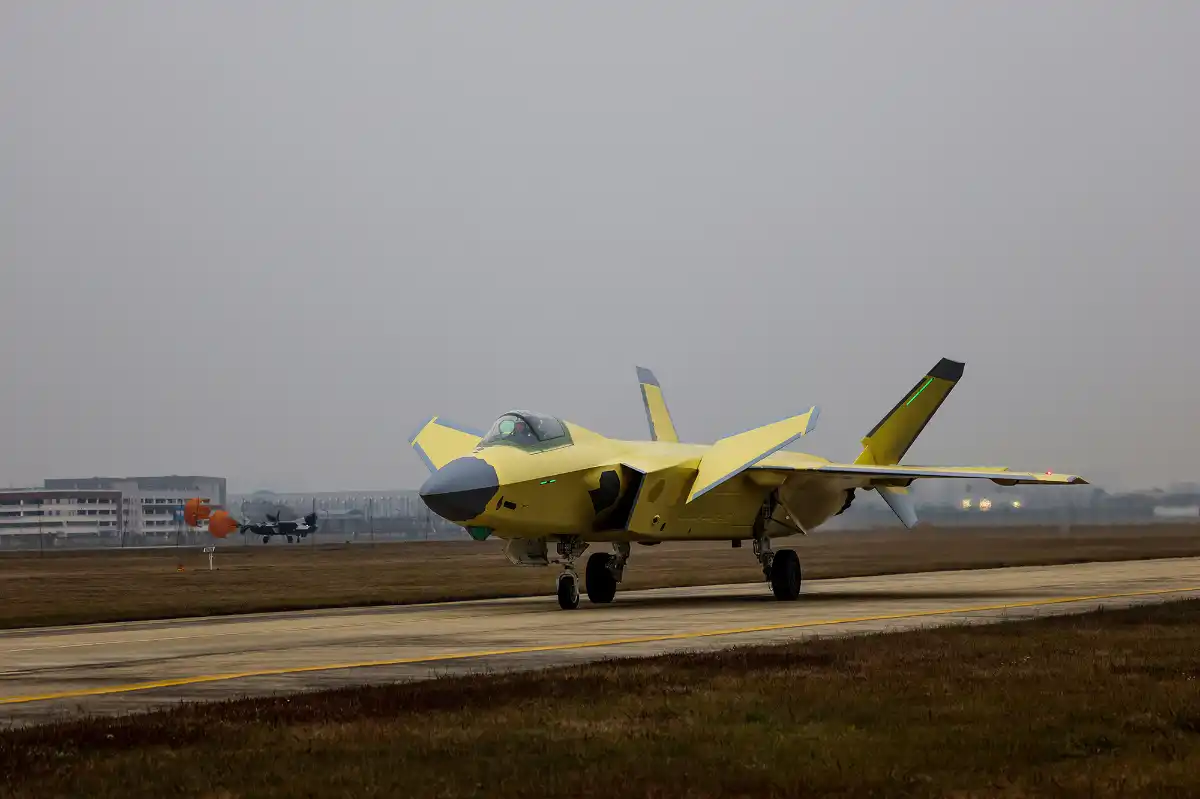
China’s push to close the performance gap with the world’s most advanced combat aircraft reached a visible milestone in January 2026, when newly released images confirmed that the J-20A stealth fighter is now flying with the long-awaited WS-15 turbofan engine. The development marks a turning point for the People’s Liberation Army Air Force, shifting the J-20 program from interim compromises toward the configuration it was originally designed to field against peer adversaries such as the U.S. Air Force’s F-22 Raptor.
The images, shared by Chengdu Aircraft Corporation, show a J-20A aircraft finished in yellow primer, a coating traditionally associated with production verification and acceptance flights rather than experimental prototypes. While the airframe itself drew attention, the real significance lay at the rear of the aircraft. The exhaust geometry visible in the photographs aligns with the WS-15’s distinctive nozzle design, not with the earlier AL-31 or WS-10 engines that powered previous operational J-20 variants.
This detail signals that the WS-15 has moved beyond limited test installations and into a phase where it is being evaluated for routine operational use. For a program that has faced decades of scrutiny over propulsion reliability, materials science, and thermal management, the implications are substantial.
The January 24, 2026 flight occurred as part of a broader test campaign spanning multiple locations and aircraft types, yet the J-20A image stood apart. It suggested scaling and validation, not experimentation. No official figures were released on how many airframes are now equipped with the WS-15, but the context strongly indicates a transition toward serial integration rather than isolated trials.
From Interim Solutions to Intended Performance
Early J-20 fighters entered service powered by Russian-supplied AL-31F engines, later supplemented by the domestic WS-10. Both options allowed the aircraft to reach initial operational capability, but neither enabled it to fully exploit its stealthy aerodynamics or internal fuel capacity. Limitations in thrust, thermal efficiency, and sustained supersonic performance constrained mission profiles, particularly those involving long-range, high-speed penetration.
The J-20A represents an evolutionary refinement of the original design. One of its most visible changes is the raised spine behind the canopy, a reshaping that smooths airflow where the cockpit meets the fuselage. This adjustment reduces drag at high speed while also creating additional internal volume. That space can be allocated to avionics, electronic warfare systems, or fuel, all of which increase the aircraft’s combat persistence.
These airframe enhancements come at a cost. Added systems and structure increase weight, raising the demand for higher and more reliable thrust. Without a more powerful engine, such refinements offer diminishing returns. The WS-15 is therefore not merely an upgrade but a prerequisite for realizing the J-20A’s design intent.
The WS-15 Engine and Its Long Road to Maturity
Development of the WS-15 began in the early 1990s, with the explicit goal of powering China’s future fifth-generation fighters. The engine is a low-bypass, afterburning turbofan optimized for high specific thrust rather than fuel economy. It measures roughly 5.05 meters in length, 1.02 meters in diameter, and has a dry mass close to 1,600 kilograms.
Its internal architecture includes an axial-flow compressor, an annular combustion chamber built from advanced nickel-based alloys, and single-stage high- and low-pressure turbines. The reported bypass ratio of around 0.25 and an overall pressure ratio in the 25–26 range place it firmly within the class of modern fifth-generation fighter engines.
Performance figures suggest an afterburning thrust rating between 161 and 180 kilonewtons, with turbine inlet temperatures approaching 1,850 Kelvin. These numbers are critical not only for raw acceleration and climb rate, but for enabling supercruise, sustained supersonic flight without engaging afterburners. For stealth aircraft, supercruise reduces infrared signature and fuel consumption while maintaining tactical speed.
Beyond thrust, the WS-15 is designed to generate significantly more electrical power than its predecessors, supporting energy-hungry sensors, data links, and electronic warfare systems. However, as with all advanced combat engines, peak output is only part of the story. Durability, maintenance intervals, and consistency across production batches will ultimately determine how transformative the WS-15 proves to be in day-to-day operations.
Measuring Against the F-22 Raptor
Any discussion of the J-20A inevitably invites comparison with the Lockheed Martin F-22 Raptor, the world’s first operational fifth-generation fighter. The F-22 is powered by two Pratt & Whitney F119 engines, each producing more than 156 kilonewtons of thrust with afterburner. The F119 is renowned not only for its power, but for its two-dimensional thrust-vectoring nozzles, which can deflect up to ±20 degrees in pitch.
This capability gives the F-22 exceptional control at high angles of attack, enhancing agility in close-range engagements and providing superior post-stall maneuverability. The F119’s bypass ratio of approximately 0.30 and overall pressure ratio near 26 reflect a mature balance between thrust, efficiency, and thermal endurance.
With two WS-15 engines potentially delivering equal or greater combined thrust, the J-20A may achieve parity with the F-22 in terms of straight-line acceleration, climb performance, and high-speed range. In missions emphasizing long-distance interception, escort, or penetration, these attributes matter more than extreme close-in agility.
However, the current WS-15 installation appears to lack thrust vectoring. This leaves the F-22 with a clear advantage in dynamic maneuvering and dogfight scenarios, even as the J-20A narrows the gap in propulsion power.
Strategic Implications for Airpower Balance
The significance of the WS-15 extends beyond individual performance metrics. By fielding a domestically produced engine capable of powering a fifth-generation fighter at its intended envelope, China reduces reliance on foreign technology and gains greater control over production tempo and upgrades.
For the People’s Liberation Army Air Force, this translates into more credible long-range operations, particularly in the vast expanses of the Western Pacific. Improved supercruise and endurance enhance the J-20A’s ability to patrol contested airspace, escort high-value assets, and challenge adversary aircraft without relying on forward basing.
At the same time, propulsion parity does not equate to overall dominance. Stealth shaping, sensor fusion, pilot training, and combat doctrine all shape real-world outcomes. The WS-15’s true impact will only become clear as the engine accumulates flight hours across multiple units and operational conditions.
A Turning Point, Not an Endpoint
The first confirmed flights of a J-20A powered by WS-15 engines represent a pivotal moment for China’s aerospace ambitions. They signal that a long-troubled propulsion program has reached a level of maturity sufficient for frontline evaluation, if not yet full confidence.
For observers, the development underscores a broader trend. The era when engine technology formed an insurmountable barrier between Western and Chinese fighter programs is narrowing. The gap has not vanished, but it is now measured in degrees rather than generations.
As production scales and operational data accumulates, the WS-15 will either validate decades of investment or reveal new challenges. Either way, its arrival ensures that the J-20A enters the next phase of its service life not as a compromised platform, but as an aircraft finally approaching the performance envelope it was always meant to reach.