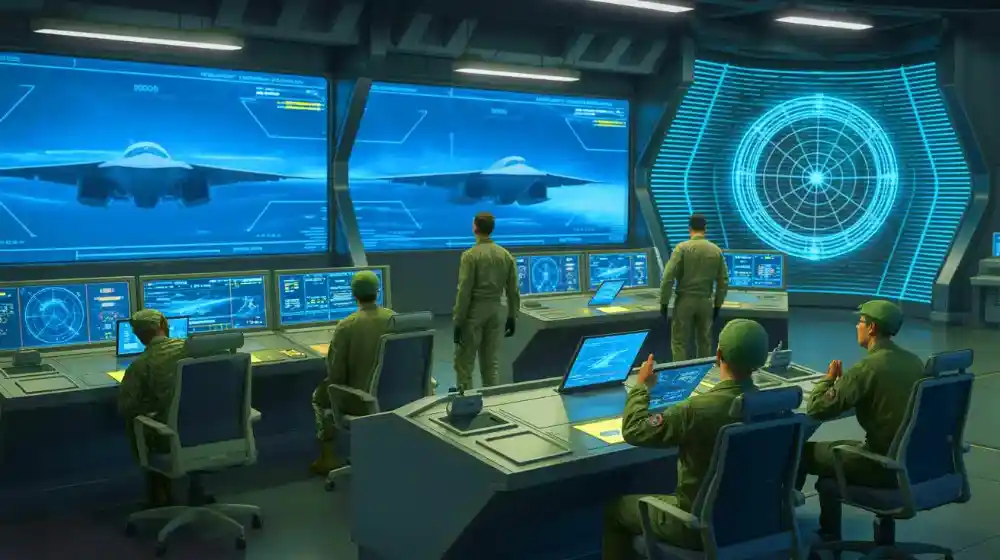
Radar technology, long a cornerstone of military and civilian surveillance, is undergoing a revolutionary transformation—ushered in by China’s aggressive pursuit of quantum radar systems. This technology promises to render current stealth aircraft obsolete, upending the balance of military power. While quantum radar remains in the experimental phase, China’s unveiling of mass-produced photon detection units in October 2025 marks a crucial leap forward in the global race to quantum superiority.
Quantum Radar: A Paradigm Shift in Detection Technology
Unlike traditional radar systems that bounce radio waves off an object to determine its size, shape, and trajectory, quantum radar leverages the bizarre properties of quantum entanglement. Through a phenomenon known as quantum sensing, it allows for highly sensitive, noise-resistant object detection, potentially even identifying aircraft cloaked in stealth technology.
At the heart of this system is the entangled photon pair. One photon is emitted toward the target (the “signal”), while its entangled partner (the “idler”) remains stored. If the signal photon bounces off an object and returns, it can be compared against the stored idler. This matching process is exquisitely precise, allowing detection of even the faintest returns.
China’s Breakthrough: The Photon Catcher
In a landmark development, researchers at the Quantum Information Engineering Technology Research Center in Anhui province announced the mass production of a component called the “photon catcher.” This ultra-sensitive device is capable of detecting a single photon—a feat critical to making quantum radar viable.
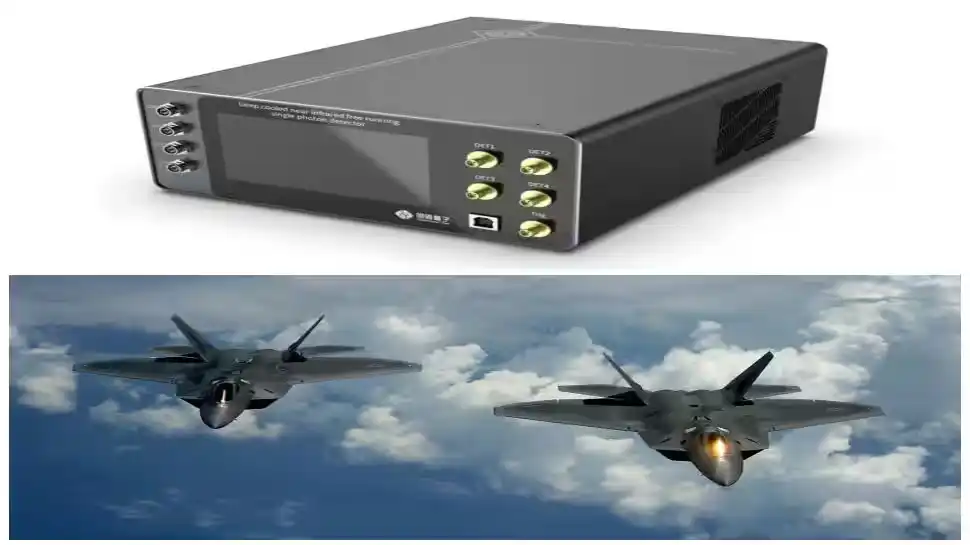
This photon catcher is not a working quantum radar itself, but it addresses a primary hurdle: separating returning signal photons from overwhelming ambient noise. By detecting individual photons, China’s system dramatically enhances radar signal clarity, allowing it to interpret weaker, more distant reflections—exactly the kind stealth aircraft are designed to evade.
While current prototypes operate only over short distances—typically just a few dozen feet—the promise of scaling this up to practical ranges is no longer science fiction. But doing so requires overcoming formidable technical challenges.
The Technical Barriers Still Standing
Despite rapid advances, quantum radar still faces fundamental limitations:
- Limited Range: Current quantum systems use microwave or infrared photons, which are easy to entangle but don’t travel far.
- Quantum Memory Storage: Storing idler photons without decoherence (loss of quantum state) remains difficult.
- Cryogenic Requirements: Many quantum devices must operate near absolute zero to function properly, which is unfeasible for most battlefield applications.
To build a field-ready quantum radar, China—or any nation—must invent durable systems that maintain coherence at higher temperatures, over longer distances, and in hostile environments.
Implications for Stealth Technology and Global Defense Strategy
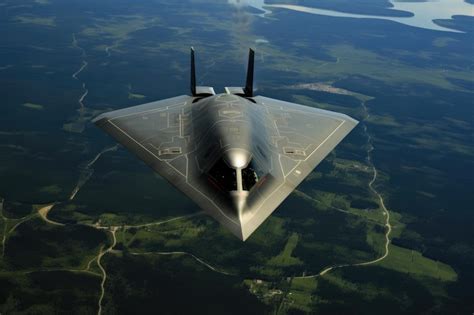
The United States has long enjoyed air superiority, largely due to its investment in stealth aircraft like the F-22 Raptor and F-35 Lightning II. These platforms exploit radar-absorbing materials and angular surfaces to deflect traditional radar waves. Quantum radar, however, targets the very foundation of stealth by using entangled light to detect even minimal interactions.
If China can successfully deploy quantum radar systems, it could render U.S. and allied stealth capabilities obsolete, forcing a fundamental reassessment of aerial warfare strategy. Military planners in the West are deeply concerned, as quantum radar would eliminate the tactical surprise afforded by stealth and change the calculus in contested airspace like the Taiwan Strait or South China Sea.
Furthermore, China’s potential lead in this technology presents a new challenge for NATO and allied militaries. The mere belief that Chinese forces can detect stealth aircraft would alter mission planning and reduce the confidence of air dominance strategies built over decades.

The Role of Propaganda and Information Control
It’s critical to recognize that China’s technological announcements often carry an undercurrent of geopolitical signaling. While the mass production of photon catchers suggests real progress, it’s unclear how close China truly is to a fully functional, field-deployable quantum radar system.
In the realm of advanced defense technology, truth and perception often blur. By publicizing its progress, China may be seeking to:
- Deter potential adversaries by creating uncertainty around their air capabilities.
- Attract scientific talent and investment into its burgeoning quantum industry.
- Claim technological leadership in quantum science to boost national prestige.
Regardless of intent, Western defense institutions must take such claims seriously, especially given the proven capabilities of China’s growing scientific infrastructure.
How Quantum Radar Could Reshape Future Conflicts
The rise of quantum radar will impact more than just aircraft detection. Its potential applications span multiple domains:
- Ballistic Missile Defense: Quantum radars could track hypersonic or low-observable missiles.
- Submarine Detection: Though more speculative, quantum sensing in acoustic or electromagnetic domains may disrupt underwater stealth.
- Space Surveillance: Quantum systems may eventually enhance satellite tracking and space object discrimination.
If China achieves early quantum radar deployment, it could gain the upper hand in multi-domain awareness—identifying and targeting adversaries in air, sea, and space with unprecedented precision.
The Race for Quantum Supremacy in Radar
China is not the only nation racing toward quantum radar. The United States, Canada, and several European countries are also investing heavily in quantum sensing technologies. However, China’s willingness to rapidly prototype and mass produce critical components, like the photon catcher, indicates a level of commitment that could result in early operational systems.
Moreover, China’s broader quantum program—spanning satellite-based quantum encryption, ultra-secure communications, and quantum computing—forms a coherent national strategy. This integration across disciplines could give it an edge in developing real-world quantum radar applications.
Conclusion: The Future Is Being Written in Photons
The era of quantum-enhanced detection is no longer theoretical. China’s push to mass produce photon-catching components represents a bold move to dominate the future of warfare by nullifying traditional stealth advantages. While technical and environmental barriers remain, the trajectory is clear: radar systems of the future will not just see objects; they will perceive them at a quantum level, in ways previously thought impossible.
As with any major technological disruption, the stakes are high. Whether China’s quantum radar becomes a functional reality or remains a strategic bluff, the global military balance may well hinge on who masters quantum detection first. And that race, undeniably, has already begun.