Quantum computing is no longer confined to the realm of theoretical physics or sci-fi speculation — it has become a top strategic priority for militaries worldwide. The U.S. Department of Defense (DoD), in partnership with elite research entities like DARPA, is aggressively investing in quantum technologies. The stakes are high: whoever wins the quantum race could redefine the global balance of power.
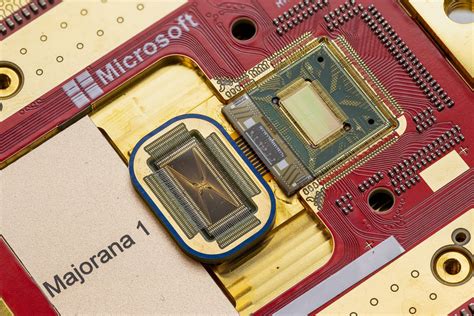
At the heart of this military push lies the promise of unparalleled computational power, unbreakable communication networks, and next-generation sensing capabilities. In 2025, Microsoft unveiled its Majorana-based quantum chip, a breakthrough that reignited urgency across defense sectors. The U.S. government has since identified three core focus areas where quantum technologies could have transformational military impact: quantum communication, quantum computing, and quantum sensing.
Quantum Computing for Strategic Dominance
Traditional supercomputers have reached impressive but ultimately limited levels of performance. Quantum computers, by contrast, process data using qubits — particles that can exist in multiple states simultaneously. This property enables exponential speedups in certain calculations, positioning quantum machines as critical tools for military advantage.
According to advisors on the Defense Science Board, quantum systems could pave the way for “more accurate lethal autonomous weapon systems.” The implication is profound: AI-powered weapons, guided by quantum-trained algorithms, may respond faster, think more clearly under uncertainty, and execute operations with unprecedented precision. This is not hypothetical — DARPA’s ongoing collaboration with Microsoft seeks to build such utility-scale quantum computers by the early 2030s.
Meanwhile, in April 2025, DARPA selected 20 companies, including IBM and HP, under its Quantum Benchmarking Initiative (QBI). The objective is crystal clear: build a fault-tolerant quantum computer before 2035. These machines must not only perform quantum operations at scale but do so with accuracy and durability — something that existing prototypes still struggle to achieve.
Quantum Sensing: The Next Battlefield Frontier
Perhaps the most revolutionary aspect of military quantum ambitions lies in quantum sensing. These ultra-sensitive instruments exploit quantum properties to detect even the most minute changes in gravity, magnetic fields, and other environmental signals. The military applications are vast and unprecedented.
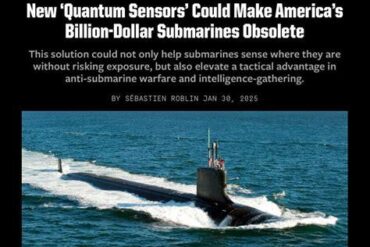
For example, quantum sensors mounted on submarines could detect enemy vessels from far greater distances, even when cloaked or silent. Ground troops could use portable quantum sensors to identify underground tunnels, IEDs, or buried threats. In the realm of electronic warfare, such sensors might scan and intercept signals with far more clarity and range than current tools permit.
However, as with any technology, the risk is symmetrical. If adversaries — such as China or Russia, both of which are investing heavily in quantum research — field these capabilities first, it could severely undermine U.S. strategic advantages. This concern was explicitly noted in the 2025 Worldwide Threat Assessment issued by the Defense Intelligence Agency (DIA).
Intelligence, Surveillance, and Reconnaissance on Steroids
Beyond kinetic applications, quantum-enhanced AI is expected to supercharge intelligence, surveillance, and reconnaissance (ISR) missions. When paired with real-time battlefield sensors, quantum systems can accelerate the analysis of vast data streams, generating actionable insights in seconds instead of hours or days.
Consider mission-scale simulations — a field where quantum computers excel at solving complex probabilistic models. This computational power would allow military strategists to simulate scenarios, predict enemy movements, and assess terrain in far greater depth. Logistics and operational planning could also be optimized, making deployment more agile and efficient.
As noted by the Advanced Technology Academic Research Center, quantum systems will even support predictive maintenance — identifying when a jet, tank, or naval system needs service before a failure occurs. This capability dramatically increases fleet readiness, reduces costs, and ensures high mission availability.
Quantum Communication and Post-Quantum Cryptography
Perhaps the most frequently discussed — and feared — military quantum application is in cryptography. Quantum computers pose a threat to modern encryption standards, particularly RSA, which currently protects everything from financial data to classified military transmissions.
Conventional wisdom held that breaking RSA encryption would take standard computers trillions of years. But quantum computers are not standard. They operate on entirely different principles, and with sufficient qubit counts, can run Shor’s algorithm, a quantum routine capable of factorizing large integers — the mathematical foundation of RSA — in feasible time.
As of 2025, even the most powerful machines max out at around 1,088 qubits, far from the estimated 20 million qubits needed to break 2048-bit RSA. Still, that threshold may fall sooner than expected. Late in 2024, Chinese researchers using a D-Wave quantum computer claimed to break a simplified 50-bit RSA system. While this falls short of real-world encryption standards, it served as a powerful proof of concept.
In response, the U.S. is rapidly transitioning toward quantum-resistant cryptographic systems. The National Institute of Standards and Technology (NIST) has already begun vetting and standardizing post-quantum algorithms to secure military communication for the next era. By 2035, the government aims to fully transition defense systems to quantum-resilient protocols.
This urgency is also rooted in what’s known as the “harvest now, decrypt later” threat model. In this scenario, foreign actors are believed to be collecting encrypted communication now, with the intention of decrypting it once quantum capabilities mature. Sensitive information transmitted today could become exposed tomorrow.
The Geopolitical Quantum Arms Race
Quantum development is not simply about technological prestige — it’s about national survival. As the battlefield becomes increasingly digital, quantum supremacy will determine the edge in warfare. This extends to cybersecurity, satellite protection, autonomous drones, and even space-based quantum networks.
The National Quantum Initiative (NQI), first signed into law in 2018, has received renewed funding and strategic direction to maintain U.S. leadership. But the pressure is mounting. China has already launched quantum communication satellites, deployed quantum-encrypted ground stations, and established major university research hubs focused solely on military-grade quantum science.
Russia, too, has redirected intelligence resources into quantum R&D. With its historical expertise in mathematics and cyber operations, Moscow is seen as a potential wildcard. Meanwhile, the European Union, United Kingdom, and Israel are all taking major steps to develop their own domestic quantum programs — both for deterrence and alliance interoperability.
Toward Quantum Battlefield Integration
Ultimately, the Pentagon’s vision is not to build quantum computers in isolation, but to integrate quantum capabilities across the entire defense ecosystem. That means linking quantum processors with AI battlefield intelligence, powering autonomous drones with quantum-enhanced decision loops, and coordinating global logistics using quantum-secured networks.
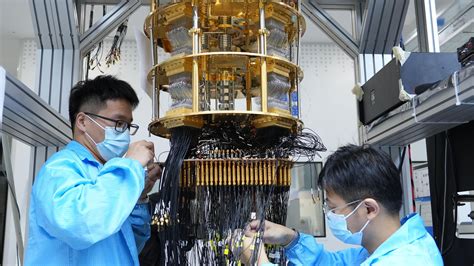
Yet challenges remain. Quantum decoherence — the tendency of qubits to lose their quantum state due to environmental noise — continues to limit real-world application. Likewise, the sheer cost of building and maintaining a stable quantum environment, often requiring temperatures near absolute zero, makes scaling an enormous undertaking.
Despite these obstacles, the momentum is unstoppable. With DARPA’s 2035 deadline and private sector breakthroughs accelerating, the next decade will see quantum systems woven into the very fabric of military operations. And while the first full-scale battlefield-ready quantum computer may still be years away, the roadmap is no longer theoretical.
The race has begun — and the consequences of losing it are unthinkable.