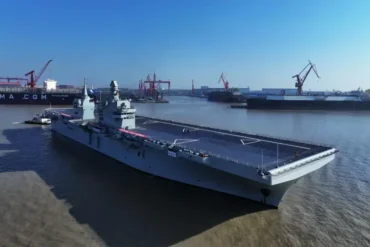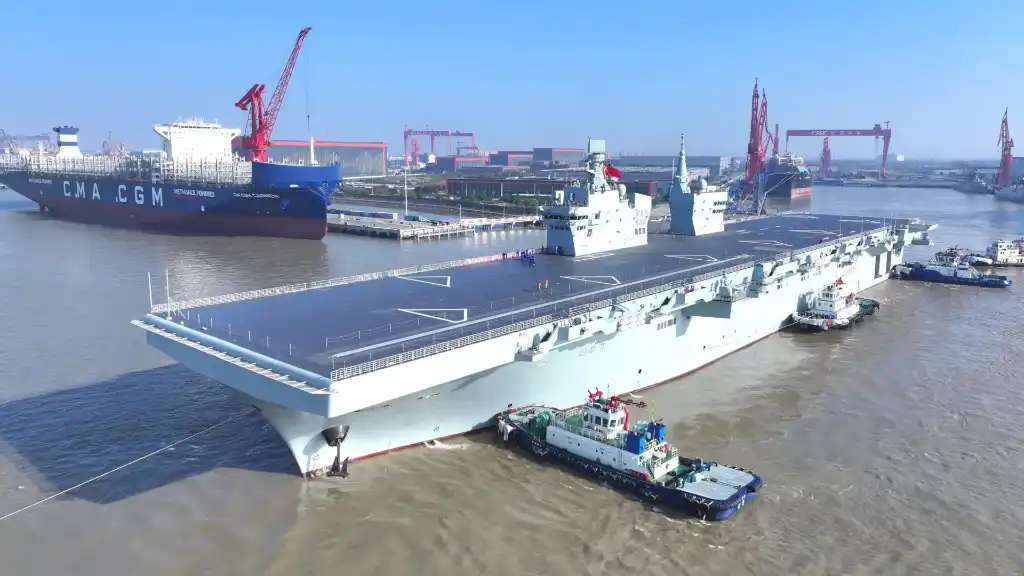
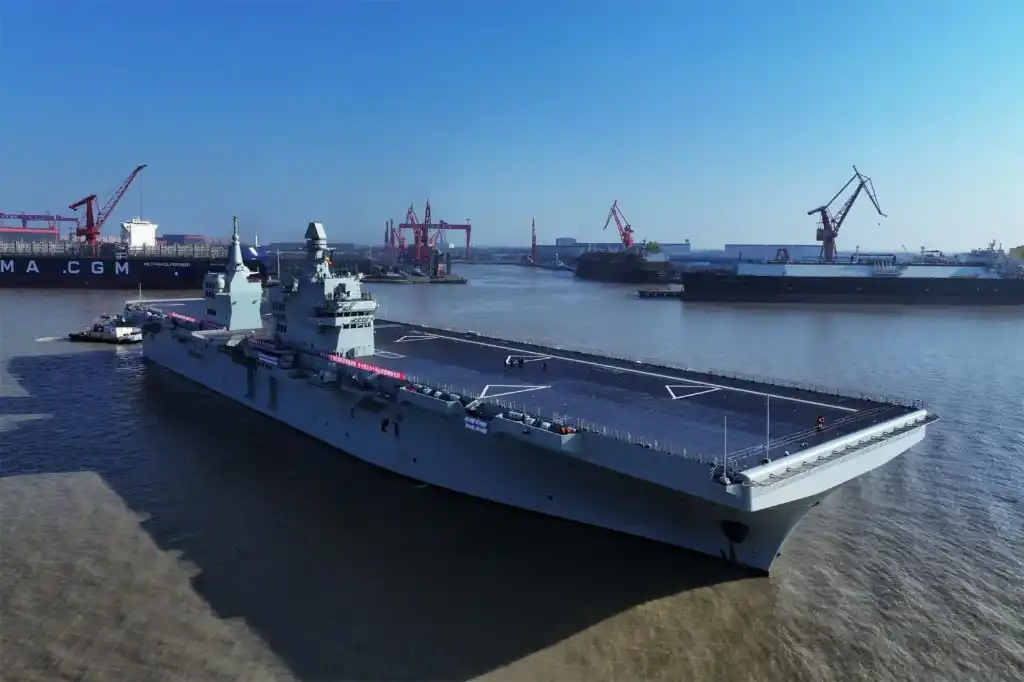
China’s unveiling of the Type 076 amphibious assault ship marks a decisive turn in naval innovation, one that reshapes expectations for what an amphibious platform can achieve. In late 2024, the world caught its first glimpse of this new vessel, but the shroud only began to lift when the Sichuan (51) departed Shanghai for sea trials on November 14, 2025. With that quiet departure came loud implications: China has built an amphibious assault ship that simply has no equal in Western navies.
The Type 076 is not an aircraft carrier in the traditional sense, yet its silhouette and its capabilities blur the boundaries between carrier and assault ship. Western LHDs, such as the U.S. Navy’s Wasp-class, operate vertical-lift jets and helicopters but lack any form of catapult launch system. The Sichuan, by contrast, introduces an electromagnetic catapult, signaling a deliberate evolution in Chinese naval doctrine. This allows the launch of aircraft that require significant takeoff acceleration, giving China a hybrid platform that redefines what an LHD can be.
The sea trials of the Sichuan revealed a vessel with formidable scale and intriguing flexibility. Stretching an estimated 827 feet and displacing 40,000 to 50,000 tons, the Type 076 stands far closer to a compact carrier than the amphibious assault ships familiar to Western fleets. Yet its mission profile remains distinctly amphibious. It is designed to move, deploy, and support 1,000 fully loaded marines, equipped with the aircraft and drones needed to establish and maintain an assault foothold.
A New Hybrid of Aviation Power at Sea
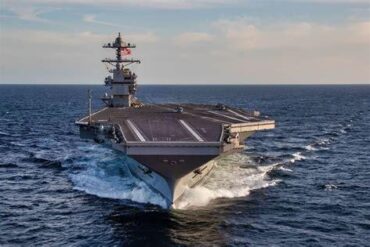
The most striking difference between the Type 076 and its Western counterparts lies in its aviation deck. The electromagnetic catapult, previously seen only on China’s Type 003 Fujian aircraft carrier and America’s USS Gerald R. Ford (CVN-78), empowers the ship to launch fixed-wing drones, stealth unmanned systems, and potentially a broader family of aircraft. This changes the tactical equation dramatically. Western LHDs can operate jets like the F-35B, but only because they take off vertically or with a short run; they cannot launch aircraft that rely on catapult energy.
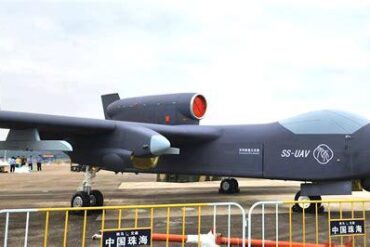
The Sichuan’s ability to send heavier, faster, and more capable aircraft into the air from an assault ship creates entirely new mission sets. It becomes not merely a transport and rotary-wing platform but a forward drone carrier, one able to seed contested airspace with fixed-wing unmanned aircraft that extend surveillance, strike, and electronic warfare ranges. China’s ongoing investment in stealth drones makes this capability even more consequential.
The Role of Type 076 in China’s Amphibious Strategy
The Type 076 arrives at a moment of heightened strategic ambition for Beijing. As the People’s Liberation Army Navy expands into a blue-water force, China has simultaneously prioritized platforms optimized for amphibious warfare. The persistent goal of asserting control over Taiwan looms behind these developments, and the Type 076 is built with this scenario in mind.
To understand the ship’s significance, one must view it as part of a layered amphibious architecture. It does not replace traditional LHDs; it enhances and multiplies their effectiveness. Its aviation capabilities enable persistent drone overwatch, electronic attack, and rapid long-range surveillance during an amphibious landing. Its troop capacity ensures it retains the core functionality of an LHD. And its integration of advanced launch systems allows it to support both manned and unmanned aviation in ways no Western amphibious platform can match.
A Technological Statement Wrapped in a Warship
The Type 076 is more than an engineering milestone; it is a strategic message. By bridging the gap between amphibious assault ships and light aircraft carriers, Beijing demonstrates a willingness to rethink naval norms. Western navies optimized their LHDs for helicopters and STOVL aircraft, locking in certain design limits. China instead chose to equip an LHD with a next-generation launch system, enabling it to act as a drone carrier, manned aircraft platform, and marine deployment ship all in one.
This hybridization reflects confidence, ambition, and a shifting maritime balance. The Sichuan’s first sea trials confirmed what analysts had suspected: China is not merely replicating existing Western designs—it is innovating beyond them. Its navy now fields an amphibious assault ship that offers fixed-wing versatility, drone specialization, and traditional landing capabilities in a single hull.
As the global naval landscape evolves, the Type 076 demonstrates how one vessel can break free from traditional classifications. China’s latest amphibious assault ship stands as a proof-of-concept for the future, where flexibility and multi-domain capability become the defining traits of maritime power projection.