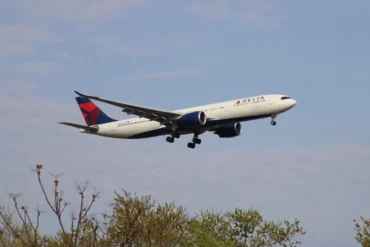
Delta Air Lines Flight DL478, en route from Hartsfield-Jackson Atlanta International Airport (ATL) to Portland International Airport (PDX), turned an ordinary transcontinental journey into a dramatic and heartwarming story when a baby girl was born just 30 minutes before landing. The midair delivery, which took place on Friday, April 24, transformed the aircraft into a makeshift delivery room, highlighting both the unpredictability of air travel and the skill and quick thinking of onboard personnel.
The events began when a flight attendant noticed a woman experiencing contractions and asked over the intercom whether any medical professionals were on board. Two emergency medical technicians, Tina Fritz and Caarin Powell, responded immediately. Fritz recounted that the woman, identified as Ashley, had contractions roughly three minutes apart. The flight crew acted with urgency and calm, assembling what medical supplies were available while improvising with blankets and even a flight attendant’s shoelace to help start an IV, ensuring both mother and baby were supported during the rapid delivery.
Remarkably, the newborn arrived within three strong pushes, appearing healthy and vigorous. Fritz swiftly cut the umbilical cord, wrapped the baby, and held her securely as the plane prepared for touchdown. Upon landing at Portland International Airport, emergency medical services were ready to receive the new family, and both mother and child were reported to be in stable condition. Passengers applauded the mother, turning the cabin into a scene of celebration and relief. Delta Airlines later issued a statement expressing gratitude to the crew and medical volunteers for their decisive actions and extended best wishes to the new family.
This incident is notable not only for its emotional resonance but also because it represents the second reported midair birth on a commercial flight bound for a U.S. airport in April 2026. Earlier in the month, a Caribbean Airlines flight from Kingston, Jamaica, to New York’s JFK Airport also reported an onboard delivery. These occurrences underscore the rare yet real circumstances airlines may encounter and the importance of onboard medical preparedness.
Understanding Airline Policies for Pregnant Travelers
Air travel during pregnancy is guided by a patchwork of airline-specific regulations rather than a universal federal mandate. The Federal Aviation Administration (FAA) provides general guidance, indicating that uncomplicated pregnancies are not disqualifying for air travel, while the Centers for Disease Control and the American College of Obstetricians and Gynecologists advise travelers to consult their airline’s policies.
Delta Airlines is among the more flexible carriers, allowing pregnant passengers to fly without restrictions or medical certificates, although travelers in their eighth month are encouraged to seek a doctor’s approval. By contrast, other airlines implement stricter policies: American Airlines requires medical documentation if the due date is within four weeks, Southwest Airlines discourages travel from week 38 onward, and United Airlines may require clearance at 36 weeks or for high-risk pregnancies. Such variation makes it essential for expectant travelers to verify policies before booking.
The recent Portland incident emphasizes how rapidly labor can progress, even when passengers and crew assume a flight is routine. Airlines typically stock basic medical kits, yet the lack of a fully equipped delivery environment necessitates improvisation, relying on the training of flight attendants and the presence of medical personnel among passengers. The collaboration between cabin crew and medical volunteers in this case reflects a high level of readiness and adaptability under pressure.
Midair Births: A Rare but Documented Phenomenon
The birth aboard Flight DL478 adds to a growing list of in-flight deliveries reported globally, illustrating that while uncommon, midair births are far from unprecedented. Recent examples include a Caribbean Airlines delivery to JFK, an Air India Express birth between Muscat and Mumbai in 2025, and several instances involving airlines such as Ryanair, Emirates, Qatar Airways, and Turkish Airlines over the past several years.
Historically, these events often involve rapid labor onset, requiring immediate response from crew and passengers with medical expertise. In many cases, airlines have honored the newborns with gifts or symbolic gestures, such as free flights, to commemorate the extraordinary circumstances of their arrivals. While these incidents are exceptional, they reinforce the importance of maintaining emergency protocols and the vital role of trained professionals in ensuring positive outcomes.

Medical Response and Cabin Coordination
The Portland delivery demonstrated a coordinated response that relied on clear communication and resourcefulness. Flight attendants acted as first responders, calling for medical help and securing essential supplies from the onboard medical kit. The EMTs adapted to the limitations of the aircraft environment, improvising with items such as passenger blankets and a shoelace for a makeshift tourniquet to facilitate IV administration. Such ingenuity is a testament to the professionalism and composure of individuals under unexpected and high-pressure circumstances.
Upon delivery, both mother and baby were closely monitored as the plane prepared for landing. The cabin crew’s ability to maintain calm among passengers, combined with medical volunteers’ expertise, ensured a seamless transition from an airborne emergency to a controlled arrival on the ground. The supportive response from fellow travelers, who applauded the birth, created a communal moment that highlighted the human dimension of air travel and the collective celebration of life in extraordinary circumstances.
Airlines and the Nuances of Pregnancy Policy
The absence of a standardized federal cutoff for flying while pregnant has led airlines to establish their own guidelines, resulting in a variety of rules across carriers. Delta’s permissive stance contrasts with airlines like Breeze Airways, which mandates physician documentation for domestic flights in the ninth month, or American Airlines, which enforces restrictions within a week of the due date. These policy differences impact travel planning and risk management for pregnant passengers, emphasizing the necessity of proactive communication with healthcare providers and airlines alike.
In-flight births such as Ashley’s on DL478 illuminate the practical implications of these policies. While Delta permits late-stage pregnancies without formal documentation, unforeseen medical events can still occur. The airline’s ability to handle such emergencies safely highlights the importance of a flexible and well-prepared crew, as well as the value of passengers with medical expertise.
The Psychological and Social Dimensions of Midair Births
Beyond the logistical and medical elements, midair births hold significant psychological and social weight. For the mother, the experience can be both exhilarating and stressful, amplified by the confined and unusual environment of an aircraft cabin. For fellow passengers, witnessing or participating in a birth at cruising altitude can evoke awe, empathy, and community spirit, as was evident when the cabin erupted in cheers following the successful delivery.
The presence of medical professionals and supportive crew members not only ensures safety but also fosters confidence among passengers, reducing anxiety during an unprecedented event. These moments, captured in anecdotes and press coverage, contribute to the human-interest appeal of aviation news, highlighting resilience, cooperation, and the extraordinary stories that emerge within the structured routines of air travel.
Historical Context of In-Flight Deliveries
Examining midair births in context reveals a fascinating record of aviation’s intersection with human life. Notable instances over the past decade demonstrate diverse circumstances and airlines, from routine domestic flights to international routes. Many incidents involve rapid labor onset, requiring immediate intervention by crew or medical professionals onboard. Airlines have adapted protocols over time to accommodate such rare occurrences, balancing safety, medical readiness, and passenger support.
The Portland incident is particularly illustrative, occurring just before landing and highlighting how timing and proximity to airports influence the management of in-flight medical emergencies. Earlier cases, such as the birth of a baby named Miracle Aisha on a Qatar Airways flight or a premature arrival on an Emirates overnight journey, underscore the unpredictable nature of labor and the essential role of preparedness and expertise among airline staff and volunteering passengers.

Aviation and Public Health Implications
Airline births, while rare, raise broader questions about health policy and public awareness. Airlines must balance permissive travel policies with the responsibility to minimize risk for passengers, particularly those in late-stage pregnancies. This balance involves maintaining fully stocked medical kits, training staff in emergency protocols, and providing clear guidance on the risks and considerations of flying during pregnancy.
From a public health perspective, awareness campaigns can educate expectant travelers on best practices, emphasizing early consultation with healthcare providers and awareness of airline-specific rules. Midair births like that on Delta Flight DL478 serve as compelling case studies for aviation safety professionals, illustrating both the challenges and triumphs of managing human health at 36,000 feet.
The Future of Emergency Preparedness in Aviation
The successful delivery on Flight DL478 underscores the importance of continuous training and preparedness in the aviation sector. Airlines increasingly recognize that rare events such as midair births, though uncommon, require robust contingency planning. Investment in medical kits, simulation exercises for crew, and protocols for identifying and supporting medical volunteers onboard are crucial elements for ensuring passenger safety and well-being.
For Delta Airlines, the incident serves as both a success story and a reminder of the unpredictability of in-flight emergencies. The collaborative efforts of EMTs, flight attendants, and passengers exemplify a model for responsive, adaptable, and humane aviation service. Each emergency encountered in-flight provides opportunities to refine procedures, enhance staff training, and improve communication strategies, reinforcing the airline’s commitment to safety and passenger care.
Conclusion: A Remarkable Arrival
The birth of a baby girl at 36,000 feet aboard Delta Flight DL478 from Atlanta to Portland is a story of courage, skill, and human resilience. It highlights the unpredictability of air travel, the critical importance of prepared and responsive crew, and the extraordinary collaboration between passengers and medical professionals. As both mother and child were safely transported to a local hospital in Portland, the narrative stands as a testament to the dedication and resourcefulness of those involved.
In a world where travel routines are often taken for granted, moments like these remind us that life can unfold in the most unexpected places—even tens of thousands of feet above the ground. The legacy of such midair births not only adds to aviation’s remarkable history but also inspires a deeper appreciation for the shared human experiences that occur in the skies. The story of this baby girl, welcomed with care, celebration, and expertise, will be remembered by passengers and crew alike as a unique milestone in aviation history.