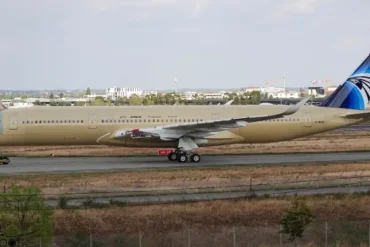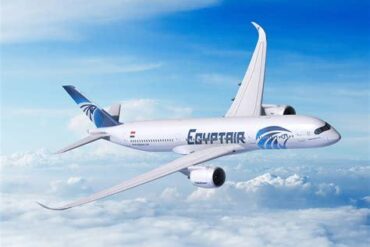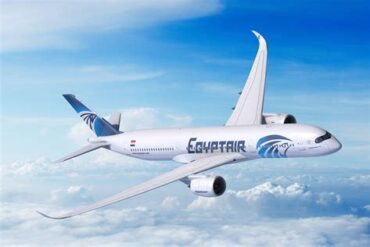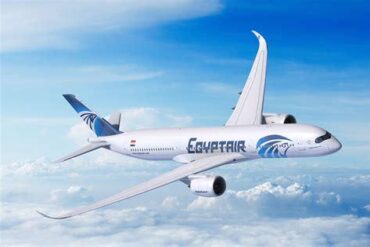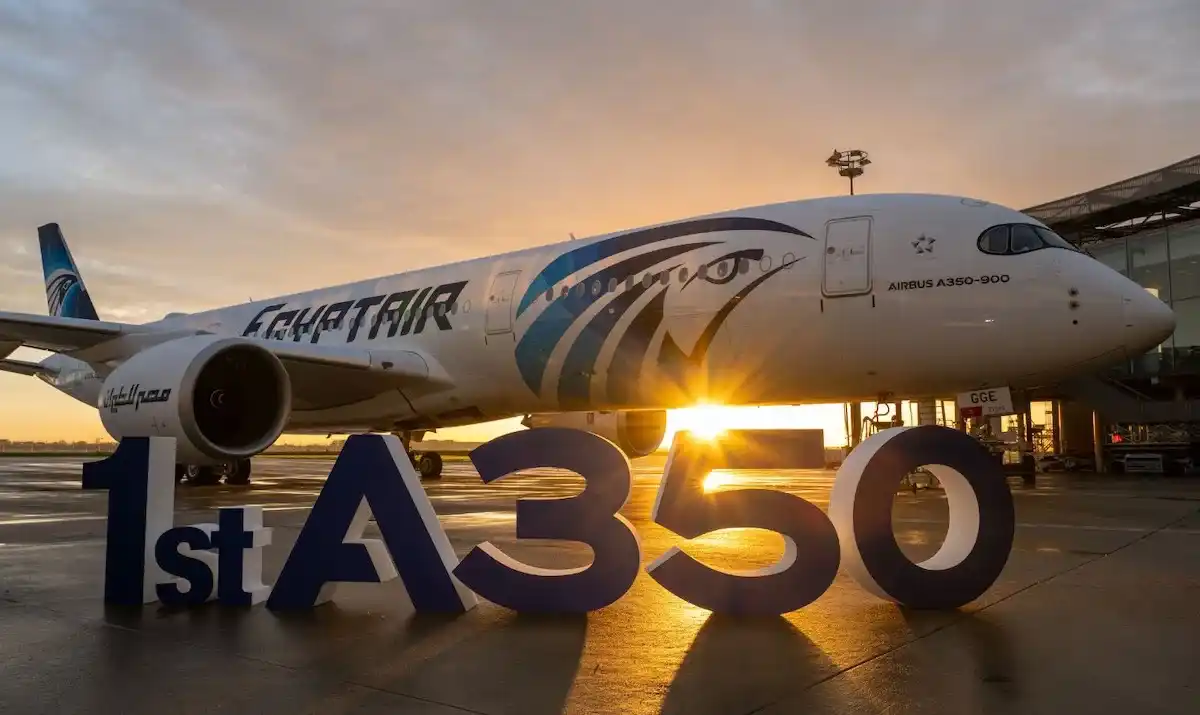
EgyptAir has formally entered a new phase of long-haul fleet modernization with the arrival of its first Airbus A350-900, marking the beginning of a 16-aircraft delivery program that will extend through 2033. The milestone follows the airline’s initial firm order for 10 jets announced at the Dubai Airshow in November 2023, later expanded to 16 aircraft in June 2025. The first aircraft, registered SU-GGE, completed its delivery flight from Toulouse to Cairo, signaling not only a fleet upgrade but a strategic recalibration of EgyptAir’s intercontinental ambitions.
The delivery schedule is deliberately staggered. After this inaugural aircraft, seven additional A350-900s are expected to join the fleet in 2026, followed by three aircraft in 2030, with the remaining six delivered by 2033. This measured rollout allows EgyptAir to align capacity growth with network expansion while gradually phasing in next-generation efficiency gains.
Airbus positions the A350 as offering 25% lower fuel burn compared to previous-generation widebody aircraft, a statistic that carries significant operational and environmental weight. For a carrier operating long-haul routes linking Cairo with Europe, North America, Asia, and the Gulf, fuel efficiency translates directly into route sustainability, competitive pricing flexibility, and lower carbon emissions per seat.
EgyptAir’s A350-900 Cabin Configuration and Passenger Experience
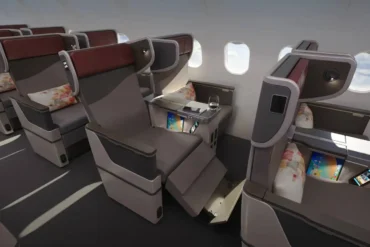
EgyptAir’s A350-900s are configured with 340 seats in a two-class layout, including 30 business class seats and 310 economy class seats. While full cabin imagery has yet to be widely released, the airline has confirmed that business class passengers will benefit from direct aisle access, a critical competitive standard in long-haul premium travel.
The airline currently operates reverse herringbone seats on its Boeing 787-9 fleet, a layout known for privacy and space efficiency. Whether EgyptAir maintains that configuration for fleet consistency or introduces a new seat platform remains a focal point for industry observers. The carrier has historically demonstrated flexibility rather than strict uniformity in cabin products, making the A350 interior reveal particularly significant for brand positioning.
The A350 platform itself supports wider cabin cross-sections, improved cabin pressure equivalent altitude, larger windows, and enhanced humidity control. These technical features translate into tangible passenger benefits on ultra-long-haul sectors: reduced fatigue, quieter cabins, and improved overall comfort.
Strategic Fleet Realignment: Growth or Replacement?
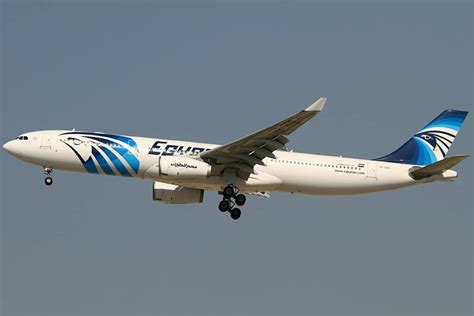
EgyptAir’s current fleet composition reflects a mixed manufacturer strategy. The narrowbody segment includes Airbus A320neo, A321neo, and Boeing 737-800 aircraft, with 737 MAX 8s on order. On the widebody side, the airline operates Airbus A330-200, A330-300, Boeing 777-300ER, and 787-9 aircraft. The introduction of the A350 adds another modern long-haul type into an already diverse widebody portfolio.
This raises a central operational question: will the A350s primarily support network expansion, or will they replace aging aircraft?
From a capacity perspective, the A350-900 closely aligns with the Boeing 777-300ER, suggesting a logical succession path. EgyptAir’s 777 fleet averages roughly 15 years in age—still viable but approaching the window where replacement planning becomes economically prudent. However, the airline’s A330 fleet averages approximately 18 years, making those aircraft the oldest widebodies currently in operation.
Replacing A330s with A350s would represent a notable capacity increase alongside a generational efficiency leap. Such a move would also standardize long-haul operations around more fuel-efficient twin-engine aircraft, aligning with global industry trends that favor lower operating costs and improved sustainability metrics.
Operational Economics and Network Expansion
The A350-900 is engineered for long-range missions exceeding 8,000 nautical miles, enabling EgyptAir to optimize existing routes and potentially launch new non-stop services. Cairo’s geographic position offers a strategic bridge between Africa, Europe, and Asia. With modern widebody aircraft, EgyptAir strengthens its ability to capture sixth-freedom traffic—passengers connecting through Cairo between regions.
Lower fuel burn per seat provides flexibility in route economics, especially on thinner long-haul markets where demand fluctuates seasonally. The A350’s composite airframe structure reduces weight while enhancing durability, decreasing long-term maintenance costs compared to older aluminum-intensive designs.
EgyptAir CEO Ahmed Adel has emphasized that the A350 acquisition supports both fleet modernization and rising long-haul demand. The aircraft also aligns with broader sustainability objectives, reinforcing Egypt’s commitment to reducing aviation emissions without compromising connectivity.
Fleet Complexity Versus Flexibility
While some global carriers pursue aggressive fleet commonality strategies to minimize training and maintenance complexity, EgyptAir maintains a diversified approach. The coexistence of Boeing 787s and Airbus A350s within the long-haul segment illustrates a dual-supplier strategy that can mitigate manufacturer-specific risks while enhancing procurement leverage.
However, this flexibility comes at the cost of increased training requirements, spare parts inventories, and operational planning complexity. Whether EgyptAir gradually consolidates around fewer widebody types or continues operating a multi-platform fleet will shape its cost structure in the coming decade.
The A350’s entry does not signal immediate retirement announcements, but its performance metrics and delivery timeline strongly suggest a phased transition. As aircraft approach the 20-year mark, maintenance-intensive heavy checks become increasingly expensive. In that context, next-generation efficiency becomes more than a marketing claim—it becomes a financial imperative.
Long-Term Outlook Through 2033
With deliveries extending through 2033, EgyptAir is committing to a decade-long modernization trajectory rather than a rapid fleet overhaul. This staggered timeline enables capital expenditure smoothing while ensuring operational continuity.
By the time the final A350 is delivered, EgyptAir’s long-haul fleet composition could look markedly different from today’s mix of A330s and 777s. The combination of Boeing 787-9 and Airbus A350-900 aircraft would position the airline with one of the region’s most modern twin-engine widebody fleets.
The arrival of SU-GGE is more than a ceremonial milestone. It represents the opening chapter of a structural transformation designed to strengthen EgyptAir’s competitiveness across intercontinental markets, improve passenger experience, and align with global sustainability standards. Through 2033, each successive delivery will quietly reshape the airline’s operational DNA—one composite wing at a time.