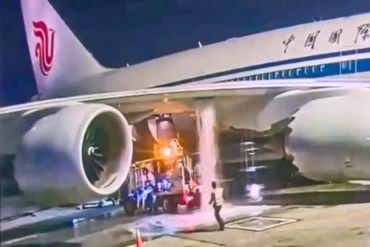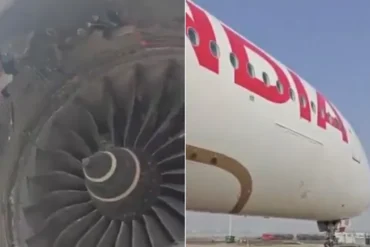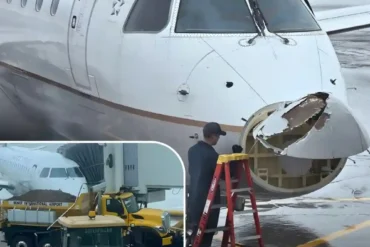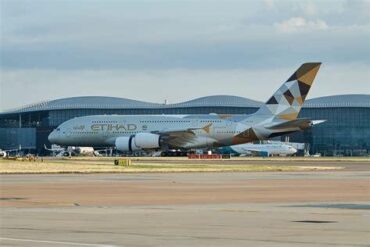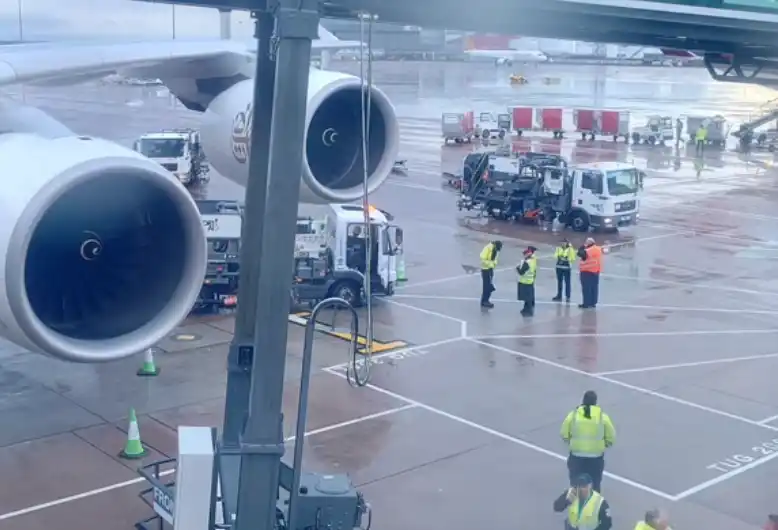
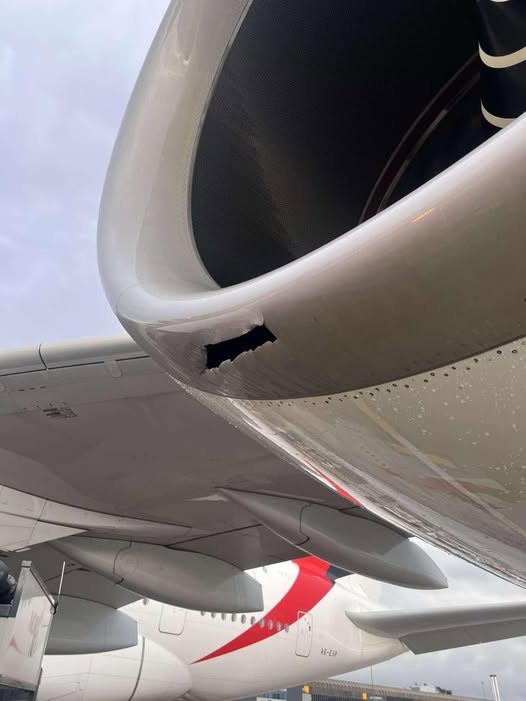
An Emirates Airbus A380 operating as flight EK18 was abruptly grounded at Manchester Airport (MAN) after a fuel truck collided with the aircraft during turnaround preparations. The superjumbo, registered A6-EVP, had just completed its inbound EK17 flight from Dubai when the incident occurred, forcing the airline to cancel the scheduled return service. The damage, concentrated on the lip section of Engine No.1’s cowling, created an immediate operational hazard and halted the aircraft’s departure window.
Witness accounts and images circulating on social media showed a clear puncture in the engine cowling, indicating a direct strike rather than a glancing impact. This type of structural breach requires intensive inspection and precise repair work before an aircraft of this size and complexity can be cleared to fly. Emirates initiated its standard post-incident procedures, mobilizing engineers to assess the damage and engage with airport authorities to determine how the fuel truck came into contact with the aircraft.
How The Collision Happened On The Apron
The collision unfolded while the A380 was parked at its stand, undergoing routine ground servicing between flights. As ground crews repositioned equipment around the aircraft, a fuel truck reportedly moved too close to the four-engine giant and struck the No.1 engine housing. While apron movements generally follow strict choreography—especially for widebody jets spanning nearly 80 meters—an operational lapse or miscommunication can trigger incidents of this nature. At the time of the collision, passengers were not boarding, which simplified immediate safety concerns but complicated the turnaround plan. Emirates quickly activated contingency protocols, delaying the aircraft’s pushback and initiating inspections that ultimately ruled out same-day dispatch.
Manchester Airport did not immediately release an operational statement, but sources familiar with apron logistics emphasized that responsibility typically rests with the ground vehicle operator unless a broader systems failure is discovered. Emirates arranged alternative flights for affected passengers, but the cancellation still carried considerable operational and financial consequences.
High Cost Of Repairing A380 Engine Damage
Repairing damage to an Airbus A380 engine cowling is neither quick nor inexpensive. The A380 has been out of production since 2021, and its component supply chain is increasingly strained. More than 12% of the global fleet has been scrapped, a necessity that inadvertently supports spare-parts availability for active operators. Even with Emirates’ extensive A380 infrastructure—currently the world’s largest fleet—the airline must often contend with limited access to structural panels and engine fairing components.
Engine cowling repairs require specialized composite work and strict conformance checks because the housing plays a crucial role in aerodynamic stability and engine airflow. If replacement cowlings are unavailable, repairs may become even more labor-intensive, driving up costs and downtime. Although Emirates completed repairs in just over two days, the financial impact of the incident extends beyond the engineering bill.
Flight Cancellation Costs And Passenger Impact
Canceling a long-haul, widebody departure almost always creates a costly ripple effect. Eurocontrol estimates that a single same-day cancellation of a widebody flight can cost up to $150,000, not including knock-on effects such as crew repositioning or rescheduled catering. In this case, the flight disruption was attributed to a ground vehicle incident—an event typically categorized as an extraordinary circumstance. Under this classification, airlines are not required to pay compensation to passengers under European aviation regulations.
However, Emirates still bore the full operational burden of accommodation, rebooking, and passenger handling. Airlines aim to avoid canceling flagship A380 rotations, especially between major hubs like Manchester and Dubai, where load factors run consistently high. Despite the setback, Emirates continued operating its broader A380 schedule from Manchester without interruption.
Inside The Aircraft: A6-EVP’s Fleet Profile
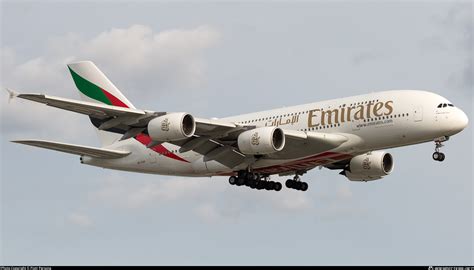
The aircraft involved, A6-EVP, stands out as one of Emirates’ youngest A380s. Delivered in May 2021, it is part of a late-generation batch fitted with Rolls-Royce Trent 900 engines, rather than the GP7200 engines powering the majority of the airline’s fleet. Having accumulated over 20,000 flight hours and 2,200 flight cycles, the aircraft remains in prime operational condition, making the timing of the incident particularly unfortunate.
Its cabin layout represents Emirates’ latest four-class configuration: 14 First Class suites, 76 Business Class seats, 56 Premium Economy seats, and 338 seats in Economy, for a total capacity of 484 passengers. This configuration is core to Emirates’ strategy of maximizing A380 deployment on premium-heavy routes.
Aircraft Returns To Service After Two Days
After more than 48 hours of assessment and structural repair, A6-EVP returned to flight operations. Tracking data from Flightradar24 shows that the aircraft departed Manchester on November 30 at 9:24 PM local time as flight EK20, landing at Dubai International Airport at 8:05 AM the following day. The quick turnaround is a testament to the airline’s extensive A380 maintenance resources, though the incident highlights the vulnerability of large aircraft during ground servicing, where even minor impacts can result in major operational consequences.
The collision ultimately becomes one more data point in the broader conversation about maintaining aging or out-of-production widebody fleets. With the A380 facing supply-chain constraints and shrinking global operator support, events like this underscore the importance of ground-handling precision—and the financial stakes when things go wrong.