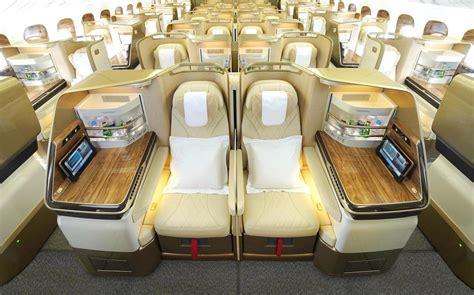
A long-haul journey with Emirates can make business class look tempting long before the aircraft leaves the gate. The airline has built a global reputation around premium cabins, and its business class product combines lie-flat seating, elevated dining, lounge access, and a noticeably more spacious environment. Yet the published price of a business class ticket can be several thousand dollars higher than economy, particularly on Emirates’ longest flights.
That price gap explains why many passengers now consider a different strategy: buying an economy ticket and upgrading later. On some flights, an upgrade can reduce the premium substantially. On others, however, the difference may be smaller than expected. Emirates does not use one universal upgrade price, and an offer can change according to the booking, route, fare type, timing, and available business class inventory.
The key point here is that an Emirates upgrade should not be treated as a guaranteed bargain. A passenger may see an attractive offer through Manage Your Booking, receive a last-minute cash proposal during check-in, or find that no cash upgrade is available at all. Travelers using Skywards Miles face another calculation because the number of miles required also depends on the fare and route. Understanding those variables is essential before deciding whether to buy business class outright or try to upgrade later.
How Emirates Determines the Cost of a Business Class Upgrade
Emirates does not publish a single fixed cash price for moving from economy to business class. Instead, the amount offered to an eligible passenger can vary according to several elements surrounding the booking and flight. Business class seat availability is one of the most important considerations because the airline has a strong incentive to protect premium inventory when demand is high.
A flight with many unsold business class seats may create more room for an upgrade offer, while a flight with limited remaining premium inventory may produce a higher price or no offer. This is particularly relevant on long-haul services where business travelers can generate strong demand. The same route can therefore produce different upgrade prices on different departure dates.
Timing matters as well. Depending on the booking and eligibility, passengers may see an upgrade opportunity after purchasing their ticket, before departure, during online check-in, or at the airport. An offer available several days before departure may not remain unchanged as the flight approaches. Conversely, a passenger should not assume that waiting until the last minute will automatically produce a cheaper deal.
The original economy fare also matters. Emirates sells multiple fare types, including Special, Saver, Flex, and Flex Plus, with differences in flexibility, benefits, and Skywards Miles earning. The fare purchased can influence eligibility for upgrades and the methods available. Consequently, two travelers sitting beside each other in economy could have very different upgrade possibilities because they bought different fares.
Emirates Dubai-Auckland: The Longest Route and Its Huge Cabin Price Gap
Emirates’ Dubai International Airport (DXB) to Auckland Airport (AKL) service is a useful example of just how large the premium can become on an ultra-long-haul flight. The flight departs Dubai at 10:05 a.m. and arrives in Auckland at 9:55 a.m. the following day, creating an exceptionally long journey across multiple time zones.
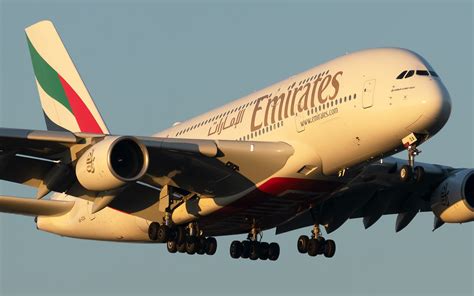
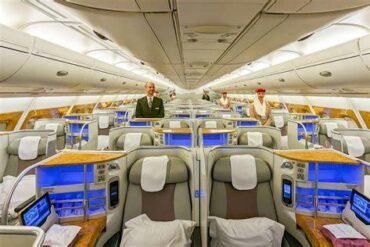
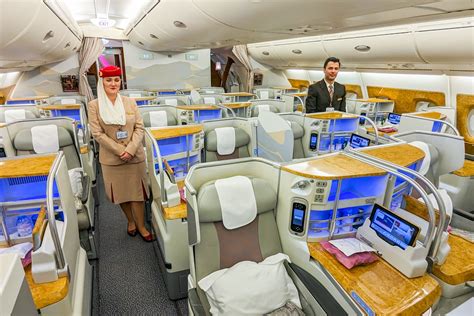
The A380 used on the route has 14 first class seats, 76 business class seats, 56 premium economy seats, and 338 economy seats. That large cabin gives Emirates considerable premium capacity, but it does not mean business class upgrades will necessarily be inexpensive. Demand, fare rules, and the remaining inventory still determine what an individual passenger is offered.
Sample one-way fares illustrate the financial gap. Economy prices were around $1,597, while premium economy started at approximately $2,632. Business class started at about $5,668, and first class at approximately $9,417. These figures are starting fares rather than fixed prices, so they can move substantially depending on availability and fare conditions.
The difference between the lowest economy and business fares in this example is therefore more than $4,000. That does not mean Emirates will offer a $4,000 upgrade, nor does it mean an upgrade will be available for a few hundred dollars. Instead, the fare gap shows why passengers pay attention when a cash upgrade appears: even a substantial discount against the published business fare could represent meaningful savings.
Paying Cash to Upgrade an Emirates Economy Ticket
One of the simplest methods is to check Emirates’ Manage Your Booking function after purchasing an eligible ticket. If an upgrade offer is available, the passenger can review the amount and decide whether to accept it. The airline may also present last-minute cash upgrade opportunities closer to departure, including during online check-in.
Airport upgrades can provide another possibility. A traveler can ask whether a paid upgrade is available on the day of travel, although availability and pricing are not guaranteed.
For a route such as Dubai-Auckland, the cash amount can potentially reach thousands of dollars. The exact number is impossible to establish from the route alone because Emirates dynamically manages inventory and offers. This is why statements such as “an Emirates upgrade always costs $X” are misleading. The actual price belongs to the individual booking and flight circumstances.
There is also an important distinction between the upgrade price and the total amount spent on the journey. If a passenger paid $1,597 for economy and then accepted a $2,500 upgrade, the effective cost would be $4,097. That could still be below a $5,668 business class fare, but the comparison must use the actual fares available when the decision is made rather than a historical starting fare.
Emirates Skywards Miles Can Change the Calculation
Cash is not the only way to move into Emirates business class. Eligible passengers can use Skywards Miles, although the number required varies according to the route and fare. The fare rules are especially important because not every economy ticket qualifies in the same way.
On the Dubai-Auckland example, an Economy Special fare is not eligible for a mileage upgrade. Economy Saver can be upgraded with miles at check-in or onboard, while Economy Flex and Flex Plus provide broader opportunities before departure, subject to availability.
Emirates also offers Cash+Miles for eligible transactions, allowing passengers to combine miles with a cash payment. That can be useful for travelers who have accumulated a partial balance but do not have enough miles to cover the full upgrade requirement. However, the value of miles depends on the specific redemption, so passengers should consider the opportunity cost of using them.
Dubai-Los Angeles Business Class Upgrade Costs
Dubai to Los Angeles is another revealing example because it is Emirates’ second-longest route, covering approximately 8,334 miles (13,412 km). The nonstop flight takes about 17 hours and five minutes, placing it firmly in the ultra-long-haul category.
Sample one-way economy fares on the route can fall between approximately $1,204 and $1,608, while business class fares can range from roughly $5,480 to $7,525. That creates a potential cabin-price difference of more than $4,000. Again, this is not an Emirates upgrade quotation. It is the difference between sample fares and shows the scale of the premium attached to purchasing business class directly.
A cash upgrade could reduce that gap if Emirates offers an attractive deal to a particular passenger. However, there is no universal discount percentage. The passenger could still be asked to pay several thousand dollars, especially when business class inventory is tight.
Skywards Miles provide another route. Depending on the original fare and upgrade method, the requirement can range from approximately 188,000 to 336,000 miles. The wide range reinforces the central point: the fare purchased at the beginning of the journey can be almost as important as the route itself when calculating an upgrade.
Dubai-Houston Shows Why Route Length Is Not the Only Factor
Dubai-Houston is Emirates’ third-longest route, covering around 8,165 miles (13,140 km). The nonstop journey is another extremely long flight where the difference between economy and business class can become substantial.
Sample one-way economy fares range from approximately $1,131 to $1,530, while the business class difference can reach around $3,600 to $5,500 based on the fares available in the reference data. Those figures demonstrate why an upgrade can look attractive, but they also show why travelers need to examine their own booking rather than relying on an average.
The three examples—Auckland, Los Angeles, and Houston—share a common pattern. Long distance increases the value passengers may place on a premium seat, but it does not determine the upgrade price by itself. Route demand, fare class, business class inventory, departure timing, and Skywards eligibility all interact to determine the actual cost.
What Emirates Business Class Includes for the Premium
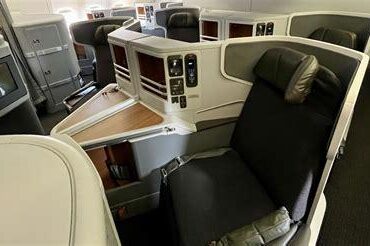
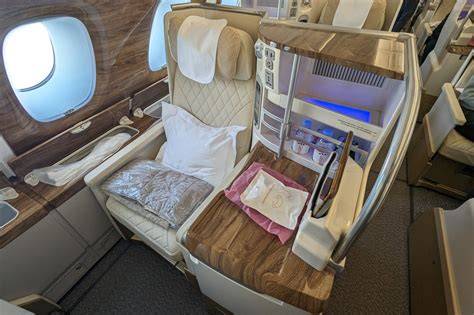
The reason an upgrade can command a large amount is that Emirates business class includes considerably more than a wider economy seat. On eligible itineraries, the experience can begin with lounge access and, in many major cities, complimentary chauffeur-drive transfers associated with qualifying business class tickets.
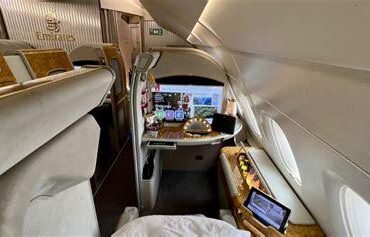
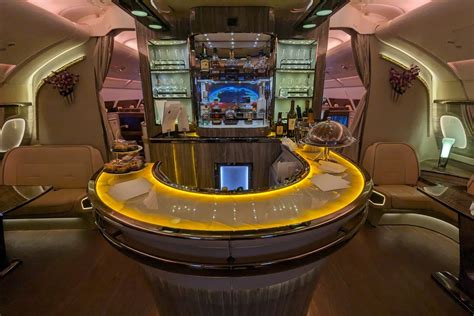
The A380 also features the famous onboard bar at the rear of the upper deck, giving business class passengers a social space away from their seats.
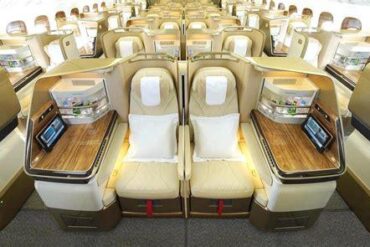
The Boeing 777-200LR, for example, uses a different product with seats arranged in a 2-2-2 configuration. These Collins Aerospace Diamond seats replaced the older 2-3-2 arrangement when Emirates refreshed the cabin and removed first class from the aircraft.
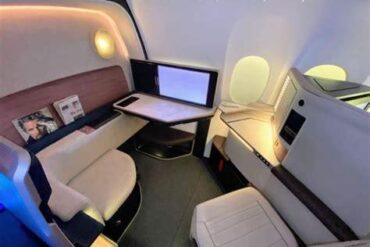
The Boeing 777-300ER fleet has also undergone a significant cabin transition. Emirates has been retrofitting aircraft with a newer business class product featuring a 1-2-1 layout, although some aircraft continue to operate with the older 2-3-2 configuration while refurbishment progresses. This means passengers should check the aircraft and seat map instead of assuming every Emirates business class flight provides exactly the same physical product.
Additional premium touches include Bulgari amenity kits containing items such as skincare products, fragrance, and lip balm. On overnight services, passengers can also receive pajamas, slippers, and an eye mask. Together, these features help explain why the cabin commands a significant premium over economy.
Is an Emirates Upgrade Cheaper Than Buying Business Class?
There is no universal answer because the comparison depends on the exact ticket and upgrade offer. The correct calculation is straightforward: add the original economy fare to the cash upgrade amount, then compare that total with the business class fare available for the same flight and conditions.
For example, if economy costs $1,500 and Emirates offers an upgrade for $2,000, the effective total is $3,500. If the equivalent business class ticket costs $5,500, the upgrade route creates a $2,000 difference. But if the upgrade costs $4,000, the effective total becomes $5,500, eliminating the apparent advantage.
Passengers should also account for the fare conditions. A cheaper economy ticket may have stricter rules, while a more flexible fare may cost more but provide better mileage-upgrade eligibility. This makes the lowest advertised economy fare an imperfect benchmark.
The Real Cost Depends on the Booking, Not Just the Flight
Emirates’ longest routes demonstrate why business class upgrades are difficult to summarize with one number. A cash upgrade can cost hundreds or several thousand dollars depending on the circumstances, while a mileage upgrade can require a substantial Skywards balance. The same route can produce different outcomes for different passengers.
The Dubai-Auckland example is especially striking because the business class fare begins thousands of dollars above economy. Los Angeles and Houston show similar gaps. Yet those fare differences should not be interpreted as guaranteed upgrade prices. They are evidence of the premium associated with buying business class outright, not a promise of what Emirates will charge an individual traveler to move cabins.
Ultimately, Emirates business class upgrades can be cheaper than buying business class outright, but they are not automatically cheaper. On the airline’s longest routes, the potential savings can be significant when a favorable offer appears, while an expensive upgrade can erase most or all of the benefit. The real price is determined by the individual booking, the cabin inventory, the fare, the timing, and whether the passenger pays with cash, miles, or a combination of both.