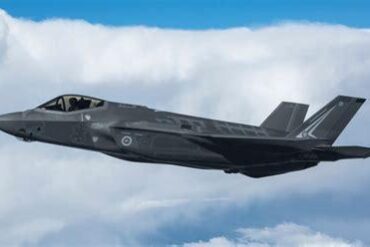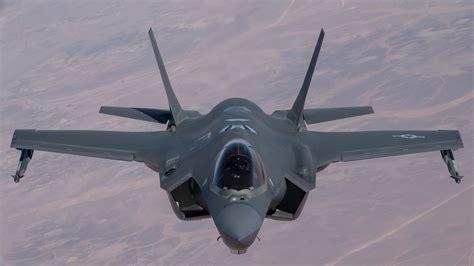
Europe’s role in the F-35 Lightning II program is not peripheral, symbolic, or merely financial. It is deeply structural. From early development funding to daily production, sustainment, and future operational resilience, Europe functions as a critical industrial pillar without which the F-35 program would be slower, less resilient, and strategically narrower. This is not an American fighter with foreign stickers. It is a transatlantic weapons system, designed from its inception to bind allied airpower, industry, and doctrine into a single operational organism.
The F-35 Joint Program Office deliberately engineered this outcome. Modeled on the successful F-16 Multinational Fighter Program, the F-35 expanded that concept into something far more ambitious: a globally distributed manufacturing and sustainment network where partners are not subcontractors, but co-producers. European nations collectively manufacture roughly one quarter of every F-35, an industrial contribution unmatched by any modern combat aircraft program.
This scale of involvement reshapes how airpower is generated in Europe, how NATO fights, and how strategic autonomy is negotiated in the age of fifth-generation warfare.
The Tiered Partnership That Locked Europe In Early
The F-35 program’s tier-based partnership structure was not bureaucratic window dressing. It was a mechanism to translate financial risk into industrial sovereignty. Nations that invested earlier and deeper gained greater access, influence, and production responsibility. Europe stepped forward decisively during the System Development and Demonstration phase, and the results still define the program today.
The United Kingdom, as the sole Tier One partner, invested approximately $2 billion, securing a level of integration second only to the United States. British industry became inseparable from the aircraft’s core architecture, from structural components to electronic warfare systems. Italy and the Netherlands followed as Tier Two partners, committing $1 billion and $800 million respectively, earning them major production roles and final assembly responsibilities. Denmark and Norway joined as Tier Three partners, targeting specialized niches rather than broad manufacturing dominance.
This layered structure ensured that European participation was not interchangeable. Each country became strategically embedded where it could offer the most value, creating a web of interdependencies that still governs F-35 production flows today.
Cameri: Europe’s Gateway to Final Assembly
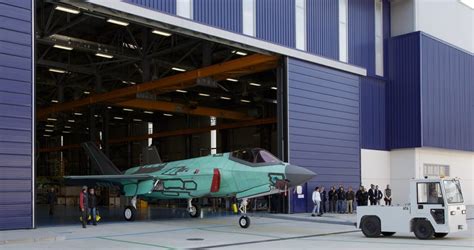
At the heart of Europe’s F-35 manufacturing effort sits Cameri Air Base in northern Italy. Operated by Leonardo, Cameri is the only Final Assembly and Check-Out facility outside the United States capable of assembling the F-35B STOVL variant, the most mechanically complex version of the aircraft. This alone gives Europe a unique position within the global program.
Cameri does far more than bolt parts together. Leonardo manufactures complete wing sets for the entire global fleet, meaning F-35s flying under Asian, American, and Middle Eastern flags often carry Italian-built wings. The facility also serves as the Euro-Mediterranean heavy airframe maintenance hub, handling deep structural work that would otherwise require transatlantic ferry flights.
By anchoring final assembly and depot-level maintenance on European soil, the F-35 program fundamentally altered logistics math. Aircraft availability increased. Sustainment timelines shortened. Operational commanders gained confidence that industrial support would remain viable even during high-tempo crises.
A Continent-Wide Supply Chain, Not a Single Factory
European F-35 production does not revolve around one nation. It is deliberately fragmented across borders to maximize resilience and political buy-in. This mirrors Cold War-era lessons learned from the F-16, but with far greater technological complexity.
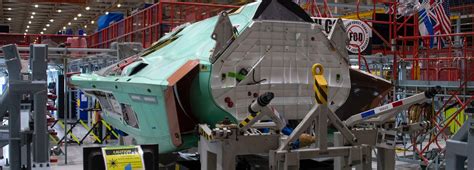
Germany’s entry into the program underscores this logic. As Berlin prepares to field the F-35A from 2026 onward, Rheinmetall’s Weeze facility has begun producing center fuselage sections, one of the aircraft’s most structurally critical components. This factory is not symbolic. It is designed for volume production, integrating Germany directly into the aircraft’s physical backbone.
Across the continent, specialized firms dominate high-value niches. BAE Systems builds the aft fuselage, fuel systems, and electronic warfare suite. Rolls-Royce supplies the LiftSystem that enables vertical landings for the F-35B. Martin-Baker provides the US16E ejection seat used across the global fleet, embedding British engineering into every cockpit.
This approach ensures that no single disruption can halt production entirely. It also ensures that European defense industries retain cutting-edge manufacturing skills that would otherwise atrophy in a purely import-based procurement model.
Missiles, Sensors, and the Scandinavian Edge
Europe’s contribution is not limited to airframes. It extends deep into the F-35’s weapons and sensor ecosystem. Norway’s Kongsberg Joint Strike Missile is the only long-range, precision strike missile designed from the outset for internal carriage inside the F-35, preserving stealth while enabling maritime and land attack roles. This weapon fundamentally expands the aircraft’s mission set in the North Atlantic and Baltic theaters.
Denmark’s Terma produces more than 80 composite and electronic components, including the Multi-Mission Pod that allows the F-35 to carry external sensors when stealth is not required. The Netherlands’ Fokker GKN supplies wiring systems and landing gear components, areas where reliability is non-negotiable and margins for error are microscopic.
Each of these contributions reflects deliberate specialization. Europe does not duplicate American capacity. It complements it, often in areas where precision manufacturing and systems integration are decisive.
Maintenance Without Borders: Europe’s Sustainment Advantage
The F-35 program’s sustainment architecture may ultimately be Europe’s most strategically significant contribution. Cameri handles heavy airframe maintenance. The Netherlands hosts the primary European logistics hub, managing spare parts for more than 500 aircraft. Finland’s Patria is building regional maintenance and component assembly capacity tailored to Nordic operating conditions.
This creates a borderless maintenance ecosystem, echoing the F-16’s Cold War success but scaled for fifth-generation complexity. Aircraft can be serviced where they land. Parts flow regionally rather than globally. Skilled technicians are trained locally rather than flown in.
The operational payoff is immediate. European F-35 fleets are not hostage to transatlantic shipping lanes. They can surge, disperse, and sustain combat operations even under contested logistics conditions.
Operational Integration and the Fifth-Generation Leap
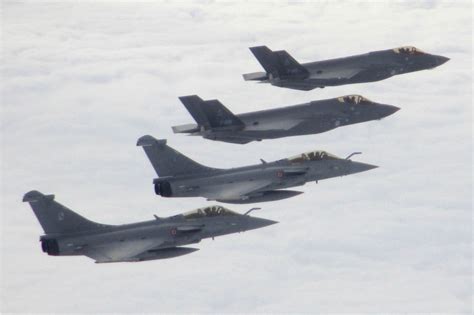
By the end of the decade, more than 600 F-35s will operate across Europe under NATO flags. This concentration of fifth-generation capability has no historical precedent. It transforms airpower from a collection of national squadrons into a continent-wide sensor and strike network.
The F-35’s sensor fusion and Multi-Function Advanced Datalink allow aircraft from different nations to share targeting data seamlessly. A Finnish jet can cue a German one. A Dutch aircraft can guide a strike package without ever firing a weapon. This is not interoperability as a talking point. It is interoperability as daily practice.
The impact on SEAD and DEAD missions is profound. The F-35 does not merely suppress air defenses. It hunts them, mapping radar networks, identifying emitters, and opening corridors for fourth-generation aircraft to operate safely.
Agile Combat Employment and European Geography
Europe’s dense geography and dispersed infrastructure make it ideal for Agile Combat Employment. In 2025 and 2026, Dutch and Finnish F-35s demonstrated highway operations in Nordic regions, conducting touch-and-go landings from austere strips. These were not stunts. They were proof-of-concept for surviving missile-heavy conflicts.
Cross-servicing marked a major milestone. Dutch maintainers launching US aircraft, and vice versa, signaled that the F-35 sustainment model had crossed a psychological threshold. National ownership remained. Operational dependency did not.
Strategic Autonomy, Nuclear Deterrence, and Hard Questions
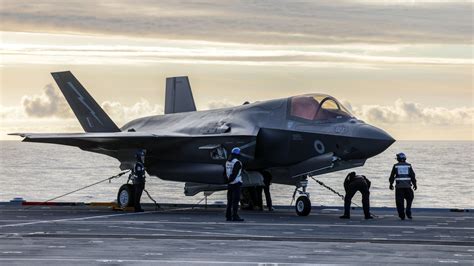
Europe’s industrial role in the F-35 feeds directly into strategic credibility. The aircraft is the first fifth-generation platform certified for NATO’s Dual-Capable Aircraft mission, carrying the B61-12 nuclear gravity bomb internally. The Netherlands assumed this responsibility in 2025. Germany will follow. The United Kingdom has announced plans to rejoin the nuclear mission with the F-35A.
This capability anchors NATO’s deterrence posture at a time of rising uncertainty. It also sharpens debates over software sovereignty. Concerns about closed systems, software control, and the hypothetical “kill switch” persist, even as Washington and Lockheed Martin deny such mechanisms exist.
These tensions are not anomalies. They are the predictable friction of deep integration. Europe’s response has not been withdrawal, but deeper industrial embedding, ensuring that knowledge, skills, and leverage remain distributed rather than centralized.
Why Europe’s Role Is Irreplaceable
The F-35 is not simply flying over Europe. It is being built, sustained, and evolved there. European industry supplies wings, fuselages, missiles, sensors, and software-adjacent systems that cannot be easily substituted without cost, delay, and risk.
This is the quiet power of Europe’s involvement. It is not loud. It does not seek headlines. It ensures that when the F-35 takes off from a NATO runway, it carries with it the accumulated industrial strength of an entire continent.