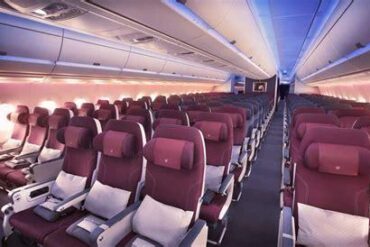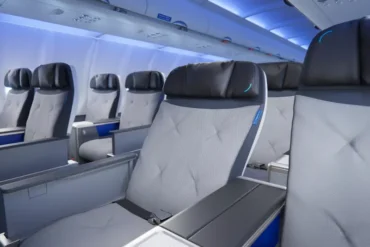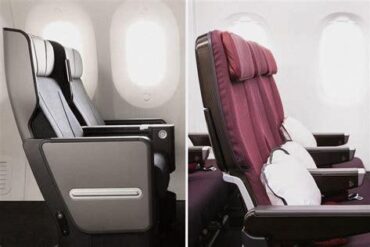
The most consequential change reshaping the American airline cabin is not the disappearance of free snacks, nor another round of checked-bag fees. It is the quiet arithmetic of a few extra inches. On a narrowbody jet where every square foot must justify its existence, extra-legroom economy has become the most profitable address in the aircraft — a high-margin product that sells space the airline already owns, at prices driven by what passengers feel rather than what the carrier spends. Delta Air Lines reported $6.92 billion in premium revenue for the second quarter of 2026, edging past the $6.85 billion generated by Main Cabin and confirming that the industry’s most valuable real estate no longer sits exclusively behind a curtain at the front. That crossover is rewriting cabin economics on the Airbus A321neo, the Boeing 737 MAX, and the A321XLR, where airlines must extract the greatest possible return from every square foot without making the cheapest seats so punishing that travelers abandon the flight altogether.
Delta Comfort+, United Economy Plus, and American Main Cabin Extra now occupy the commercially potent middle ground between standard coach and first class. Each product promises a specific number of additional inches, earlier boarding, and the psychological relief of not being compressed into the tightest row on the aircraft. The result is an industry designed to sell the same basic seat several times over, attaching wildly different prices to the space around it — and discovering that the margins at the top of the coach cabin outperform almost anything else the aircraft carries.
The Revenue Tipping Point That Made Extra Legroom Strategic
Delta’s second-quarter results offer the clearest illustration of how far premiumization has traveled. Premium revenue reached $6.92 billion against $6.85 billion from Main Cabin, a milestone that would have seemed fanciful when domestic economy seating was the unquestioned commercial center of the narrowbody. Premium revenue is broader than extra-legroom economy — it sweeps in first class, Delta One, and other elevated offerings — yet the crossover still signals a fundamental shift in where airlines believe value resides.
The significance lies in generating more money without carrying more passengers. A narrowbody flying San Francisco International Airport (SFO) to Los Angeles International Airport (LAX) has a fixed envelope of space. Adding a passenger costs fuel, crew attention, and gate-turn time; adding a more elaborate service layer introduces catering and staffing complications. Charging an existing passenger more for a better-positioned seat, by contrast, delivers incremental income without a comparable increase in crew, fuel, or aircraft ownership costs. Extra-legroom economy sits at an unusually appealing intersection of price and perceived value: passengers who cannot justify first class will still pay to escape the tightest rows, particularly on business trips, tight connections, or long transcontinental segments where comfort matters more than shaving dollars off the fare. The airline monetizes spending from customers who would otherwise remain in standard economy while preserving first class as a separate, far more expensive product for travelers willing to pay substantially more.
The Anatomy Of A High-Margin Seat
The pricing power becomes startling on short domestic routes. A September 2026 fare sample for United Airlines showed Economy Plus adding $99 to a $59 San Francisco–Los Angeles base fare — a 167% premium over the underlying ticket. The passenger is buying additional space rather than legroom in isolation, yet the comparison demonstrates how dramatically airlines can monetize a small physical distinction.
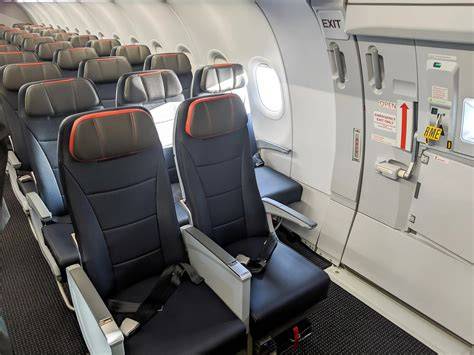
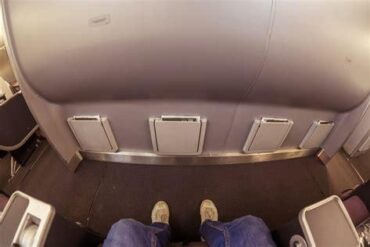
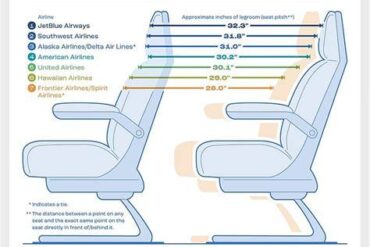
What makes the economics so attractive is that the product frequently demands less investment than a traditional premium cabin. An airline may designate existing exit-row seats as extra-legroom inventory, increase the pitch of selected rows, or adjust a cabin configuration during a broader refurbishment. These moves still carry costs: lost seating capacity, certification requirements, maintenance variance, and customer-service differences. They do not automatically require lie-flat seats, premium dining, or a separate business-class cabin. The margin advantage springs from selling an improvement that is expensive in perceived value but comparatively inexpensive to deliver. A seat offering 34 to 36 inches of pitch feels dramatically less restrictive than standard economy, where some carriers have compressed pitch to roughly 28 inches. Because willingness to pay tracks the value of the experience rather than the airline’s incremental cost, even a modest adjustment to cabin geometry can produce a disproportionate financial return once enough customers purchase the upgrade.
How American, Delta, And United Are Reconfiguring The Cabin
American Airlines is pursuing one of the clearest examples of the shift, planning to raise premium seating from approximately 25 percent to 40 percent across its narrowbody fleet, including the incoming Airbus A321XLR. That is not simply a decision to sell more first-class seats. It is a decision to allocate a greater share of the aircraft to customers willing to pay for differentiated products — and every additional premium seat forces a choice about which lower-priced seats get removed, repositioned, or sacrificed to make room.
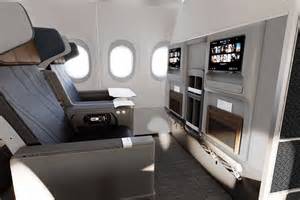
The tension is that reconfiguration is a permanent trade-off between passenger volume and revenue per passenger. Removing standard economy seats can reduce the number of customers carried on a full flight, while expanding premium inventory creates the chance to earn more from travelers who previously purchased the cheapest fare. The calculation hinges on route demand, aircraft utilization, and whether customers consistently pay the premium rather than simply occupying upgraded seats through loyalty status. Delta is making a similar strategic bet across its network while also assigning a substantial share of capacity on its forthcoming Airbus A350-1000 to premium seating categories. Although widebodies operate on different economics than domestic narrowbodies, the principle holds: cabin space should be allocated according to revenue potential rather than the assumption that economy must occupy the overwhelming majority of the tube. Extra-legroom seating becomes especially seductive because it generates premium revenue without demanding a fully separate cabin, separate crew, or separate service ritual.
Seat Fees Have Become A Business Of Their Own
The financial appeal extends beyond ticket pricing, because airlines now treat seat selection as an independent revenue stream. United Airlines collected approximately $1.3 billion in seat fees in 2023, exceeding the roughly $1.2 billion it generated from checked baggage — a milestone that reframes choosing where to sit as commercially comparable to transporting a passenger’s luggage. A purchase that once seemed incidental to the ticket has become a central pillar of the revenue model.
The wider market reflects that change. Southwest Airlines has adapted its onboard offering as global airline ancillary revenue swells and carriers unbundle services that were once included. Estimates place the seat-selection monetization market at $4.8 billion in 2025, with projections reaching $9.9 billion by 2034. Such forecasts rest on assumptions about future demand and pricing practices, but they point toward a market in which seat selection becomes more sophisticated rather than less important. Dynamic pricing sharpens the opportunity because the same seat need not carry the same price on every flight: an extra-legroom row may command a substantial surcharge on a busy Monday morning departure, then sell for considerably less on a lightly booked afternoon service. Airlines adjust prices as departure approaches, weighing remaining inventory, booking patterns, and demand, avoiding the need to set one fixed premium across an entire route network.
The Loyalty Complication Beneath The Headline Revenue
Not every extra-legroom seat produces a cash payment, and that is where headline revenue figures demand careful reading. Airlines routinely fold preferred seating or extra-legroom access into elite benefits, while some passengers receive upgrades through credit-card perks, corporate arrangements, or promotional mechanisms. These customers may value the product enormously without generating a separate seat-selection payment at the time of travel. The commercial calculation therefore depends on more than the number of premium seats installed or the advertised surcharge attached to them. Airlines must decide how much inventory to reserve for paying customers, how much to release as a loyalty benefit, and when to unlock unsold seats for purchase.
An overly generous policy can undermine the very pricing power that makes the product attractive — especially when passengers learn that waiting until check-in frequently produces the same seat for free. Yet loyalty programs can also reinforce premium seating economics by concentrating traveler spending with one carrier. A passenger who repeatedly buys extra-legroom seats may grow more receptive to a co-branded credit card or a higher-status tier, creating value beyond the immediate transaction. The challenge is preserving enough scarcity that customers keep paying while keeping elite benefits meaningful enough to influence future booking decisions.
The Physical And Competitive Limits Of Premiumization
There is a physical ceiling on how far airlines can push this strategy, because every inch granted to one passenger must be taken from somewhere else in a finite cabin. If standard economy becomes too cramped, passengers may respond by switching airlines, booking a competing fare, or abandoning discretionary travel entirely. The premium product is commercially powerful partly because the basic alternative remains available; that relationship destabilizes when the cheapest seats deteriorate too far.
Competition also caps pricing, particularly on routes served by several carriers offering comparable extra-legroom products. A $99 surcharge may be viable when a flight is busy and alternatives are scarce, but far harder to sustain when a rival offers a similar seat at a substantially lower price. The strongest operators will be those that pair carefully managed inventory with credible differences in cabin comfort, reliable operations, and a customer base willing to pay for the distinction. The economics also reward precision: carriers that segment aggressively — separating exit rows, bulkhead seats, and true extra-pitch rows into distinct price points — capture more of the willingness to pay that otherwise leaks into a single flat surcharge.
What Determines Whether Extra Legroom Stays The Cabin’s Best Business
For now, extra-legroom economy occupies an unusually valuable position on the domestic aircraft because it delivers premium pricing without the full cost structure of first class. As American Airlines, Delta Air Lines, and United Airlines continue refining cabins and pricing systems, the decisive question is no longer simply how many seats an aircraft can carry. It is how much revenue each portion of the interior can generate. The standard economy seat remains essential to filling the aircraft, yet the few rows immediately ahead of it — with their extra inches, earlier boarding, and premium price tags — are increasingly central to determining how profitable that aircraft becomes on every SFO–LAX turn, every transcontinental redeye, and every business corridor where a traveler decides that three additional inches are worth more than the difference in fare.