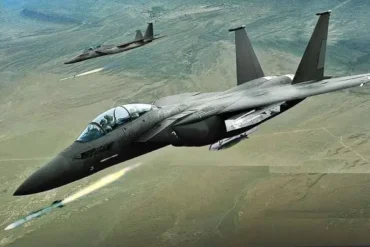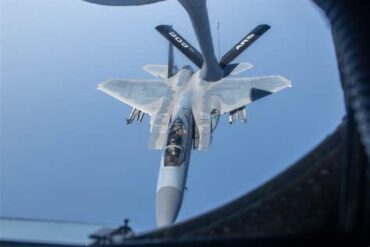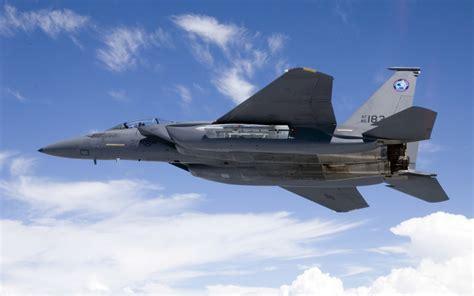
The F-15 Silent Eagle, once hailed as a bridge between fourth-generation fighter dominance and fifth-generation stealth, was shelved before it could leave the ground. As the U.S. Air Force continues to invest in the F-15EX Eagle II while facing rising peer adversaries with growing fleets of stealth aircraft, the question resurfaces: should the Silent Eagle be reconsidered?
The Silent Eagle Concept: Born in the Shadow of Stealth Evolution
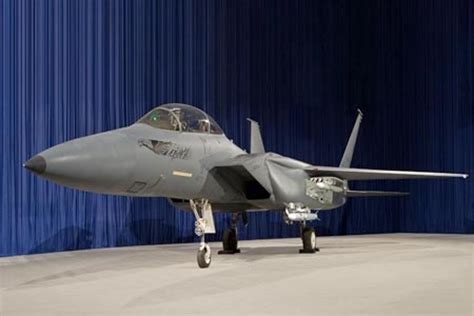
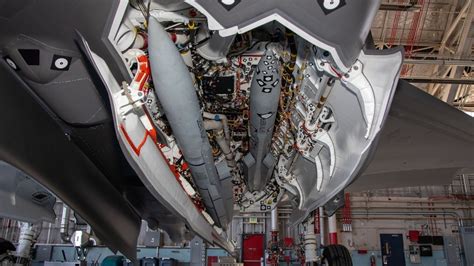
In 2009, Boeing unveiled the F-15SE Silent Eagle, a highly modified variant of the battle-proven F-15 platform. Intended to appeal to export markets and bridge the generational gap between legacy fighters and newer stealth models, the Silent Eagle featured several critical upgrades. These included canted vertical tails, internal weapons bays (converted from conformal fuel tanks), radar-absorbent materials, and coatings designed to reduce radar cross-section (RCS), along with upgraded avionics and digital flight systems.
Yet despite the innovation, the Silent Eagle never secured a buyer. South Korea, one of the targeted export markets, opted instead for the F-35. The Silent Eagle faded into the archives of “what could’ve been.”
F-15EX vs. F-15SE: A Matter of Mission, Not Just Technology
With the F-15EX Eagle II now being produced as a next-gen multirole workhorse, it begs the question: was the Silent Eagle truly redundant? Or are there strategic roles where its stealth-lite profile could prove advantageous?
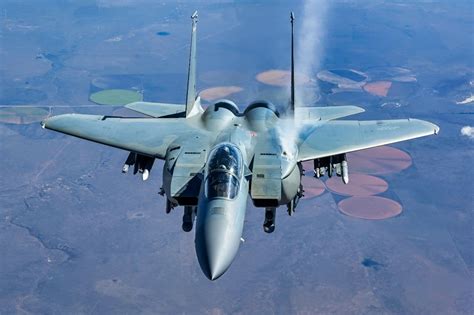
The F-15EX, while boasting the world’s fastest mission integration capability and massive payload capacity—up to 22 air-to-air missiles or multiple air-to-ground munitions—lacks the stealth profile needed for penetrating highly contested airspace. It’s built to dominate in semi-permissive environments, relying on its speed, range, and electronic warfare (EW) capabilities.
In contrast, the Silent Eagle, while never truly stealth like the F-35 or F-22, offered a significant RCS reduction over the standard F-15. It was never intended to be invisible, but instead to be less visible. The concept was simple: increase survivability without abandoning the massive payload, speed, and range the F-15 is known for.
Cost-Benefit Equation: Why the Numbers Still Don’t Work
The argument for resurrecting the Silent Eagle faces cold, hard numbers. In 2009, the projected flyaway cost of the F-15SE hovered around $100 million—a premium even at that time. Today, the F-35A, the cornerstone of U.S. fifth-gen airpower, costs roughly $80 million per unit. It offers full-spectrum stealth, cutting-edge avionics, and a maturing logistics and maintenance pipeline.
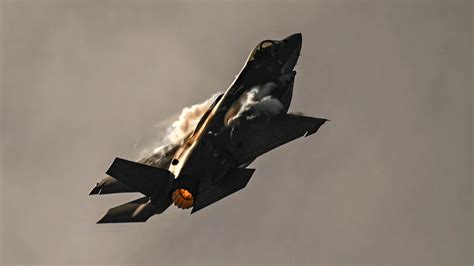
Factor in the economies of scale that now benefit the F-35 program and the support infrastructure already in place across NATO and allied nations, and the Silent Eagle’s case becomes harder to make. The logistics tail alone—unique spare parts, training, and mission software—would be a costly divergence from the streamlined path.
Tactical Realities: Is Stealth Always the Answer?
Yet not all combat scenarios call for absolute stealth. In many mission profiles, especially air dominance patrols, standoff strike coordination, or homeland defense, partial stealth can be good enough—if paired with high-speed sensors and long-range weapons.
The Silent Eagle’s proposal was not to rival the F-35 in stealth but to complement it: carry bigger missiles like AIM-120D or even future hypersonic weapons, act as a command node, or loiter with electronic warfare capabilities while remaining less visible to low-frequency radars. It could also operate in tandem with fifth-gen fighters, offering overwhelming firepower while letting stealth aircraft act as scouts and target designators.
Critics argue that the F-15EX already fits this role. It too is an updated platform based on the F-15, features modern sensors like AN/APG-82 AESA radar, electronic warfare systems like EPAWSS, and even better payload capacity than the Silent Eagle. But it lacks even the reduced RCS features of the SE, making it more detectable in anti-access/area denial (A2/AD) environments.
Operational Complexity vs. Lethal Simplicity
A major flaw in resurrecting the Silent Eagle lies in operational redundancy. Introducing yet another airframe means retraining pilots, creating new logistical chains, and diverting funds from programs that are either already maturing or more strategically aligned with future warfare.
Modern U.S. combat air strategy is evolving toward manned-unmanned teaming (MUM-T) and distributed lethality. Aircraft like the F-35 will increasingly operate alongside loyal wingmen drones, while legacy fighters are expected to serve as bomb trucks or electronic warfare platforms. In this context, the Silent Eagle becomes a solution looking for a problem.
Foreign Buyers and the Export Mirage
Some supporters of the Silent Eagle believed it could find a home in allied air forces seeking a stealth-lite alternative to the F-35. But those hopes largely dissipated. Nations like South Korea, Japan, and Israel that were seen as potential buyers either went with the F-35 or procured upgraded legacy aircraft instead.
Today, with more countries integrated into the F-35 program, the Silent Eagle has no viable export path. Modern geopolitical alignments favor interoperability, and the F-35, with its secure communications, shared logistics, and common training architecture, offers seamless coalition integration.
Silent Eagle’s Legacy: A Strategic What-If
Despite its cancellation, the Silent Eagle serves as a critical reminder of transitional design thinking in aerospace defense. It encapsulated a moment when stealth was expensive, logistics weren’t yet streamlined, and export politics still played a large role in fighter development.
Had the Silent Eagle entered service, it might have filled a niche role—perhaps in suppression of enemy air defenses (SEAD) or acting as a heavily armed wingman to stealth aircraft. But as the defense landscape evolved, the space it was meant to occupy was devoured by more specialized tools and better-integrated systems.
The Final Verdict: Let Sleeping Eagles Lie
With the F-35 program now mature, and the F-15EX proving its worth in multiple mission profiles, a return to the Silent Eagle would be a strategic misstep. The financial burden of developing and fielding a one-off stealth-lite platform would outweigh any marginal benefits, especially when the F-35 offers better survivability, and the F-15EX offers superior payload and sensor capabilities.
Veterans and current Air Force personnel echo this sentiment. While some acknowledge the Silent Eagle’s innovation, most view it as an obsolete detour, particularly as attention shifts toward sixth-generation initiatives like NGAD (Next Generation Air Dominance) and AI-piloted drones.
The Silent Eagle will remain a fascinating footnote in military aviation history—a symbol of the F-15’s unmatched adaptability and Boeing’s ambition to squeeze every ounce of relevance from a design that first flew in the 1970s. But in today’s high-tech battlespace, part-stealth isn’t enough, and building new fleets of specialized aircraft without strategic longevity is a risk few are willing to take.
So should the Air Force take a second look? Perhaps. But only to understand how far the operational environment has evolved—not to bring back an aging concept in a world already flying beyond it.