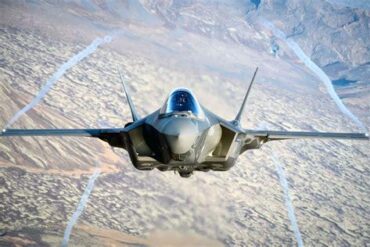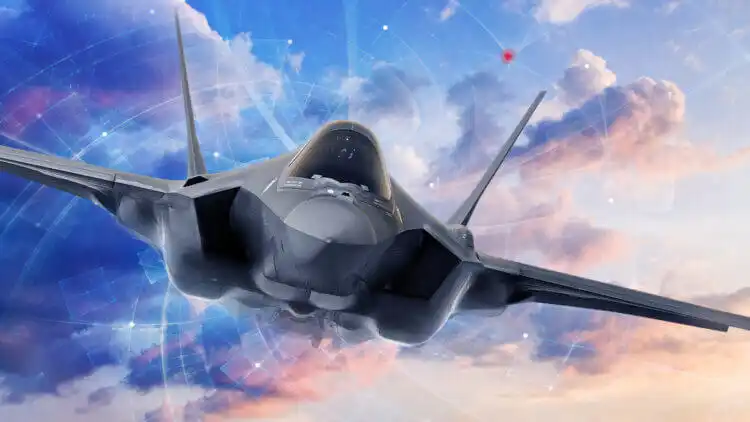
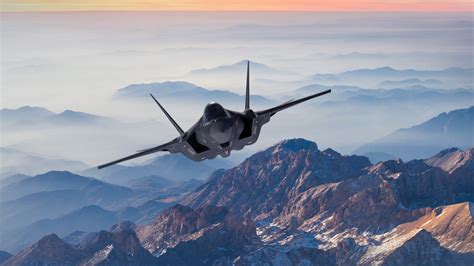
The F-35 Lightning II, a fifth-generation stealth fighter, has revolutionized aerial combat not only through its low-observable stealth design but also via its unmatched electronic warfare (EW) capabilities. Central to this dominance is the AN/ASQ-239 Electronic Warfare Suite, a system that goes far beyond traditional threat warning, encompassing a multi-spectrum electronic battlefield superiority. Engineered by BAE Systems in the United Kingdom, the AN/ASQ-239 transforms the F-35 from a single combat platform into a networked, sensor-integrated electronic warfare hub capable of operating in the world’s most contested environments.
Comprehensive Threat Detection Through 360° Coverage
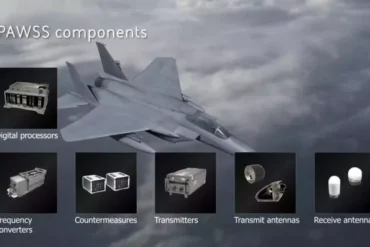
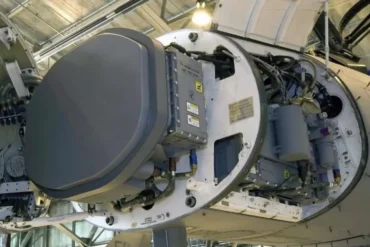
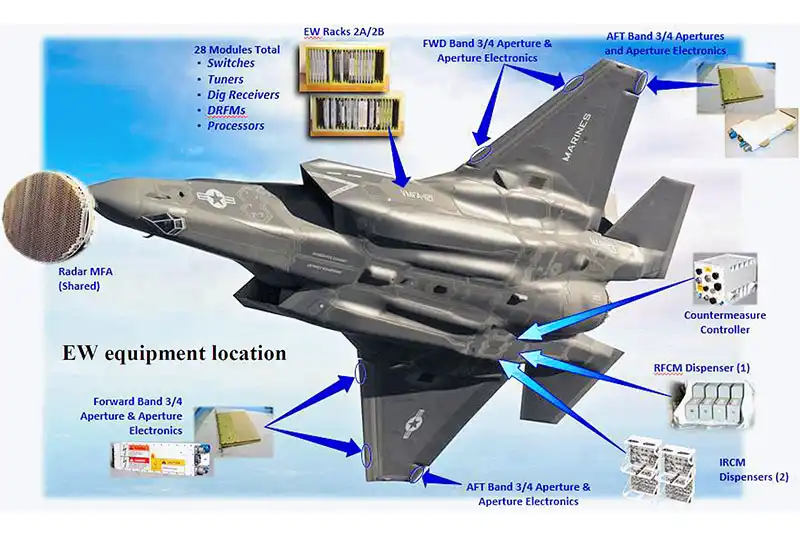
The AN/ASQ-239 provides full-spectrum situational awareness and a 360-degree electromagnetic threat coverage by integrating ten advanced radio-frequency (RF) antennas distributed along the aircraft’s wings and tail. This setup enables passive signal detection at ranges exceeding 480 kilometers, offering the F-35 the ability to monitor and track both airborne and ground-based threats long before they become imminent dangers.
Unlike traditional radar warning receivers (RWRs), the ASQ-239 acts as a multi-role signal analyst, detecting, classifying, and prioritizing threats across multiple domains. It supports cross-domain electronic attack operations, ensuring that even infrared (IR) guided threats and radar-guided surface-to-air missiles (SAMs) are engaged and countered with precision.
Sensor Fusion with Advanced Combat Systems
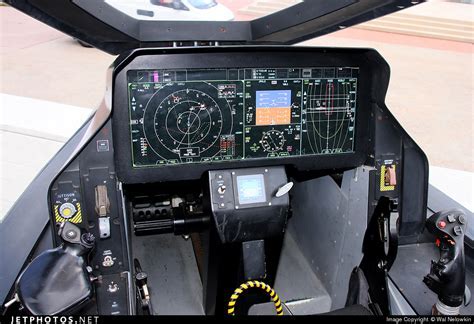
One of the F-35’s defining characteristics is its deep sensor integration, where the EW suite is not an isolated subsystem but an integral part of the platform’s mission systems network. The AN/ASQ-239 is seamlessly fused with the AN/APG-81 Active Electronically Scanned Array (AESA) radar, Electro-Optical Targeting System (EOTS), and the Distributed Aperture System (DAS). This fusion generates a single, coherent battlefield picture, eliminating ambiguity in threat recognition and enabling real-time countermeasure deployment.
The synchronization across systems provides the F-35 pilot with a real-time threat envelope, allowing instantaneous adjustments in flight behavior, countermeasure tactics, and target engagement strategies—all executed while maintaining the platform’s stealth integrity.
Block 4 Enhancements: The Next Evolution
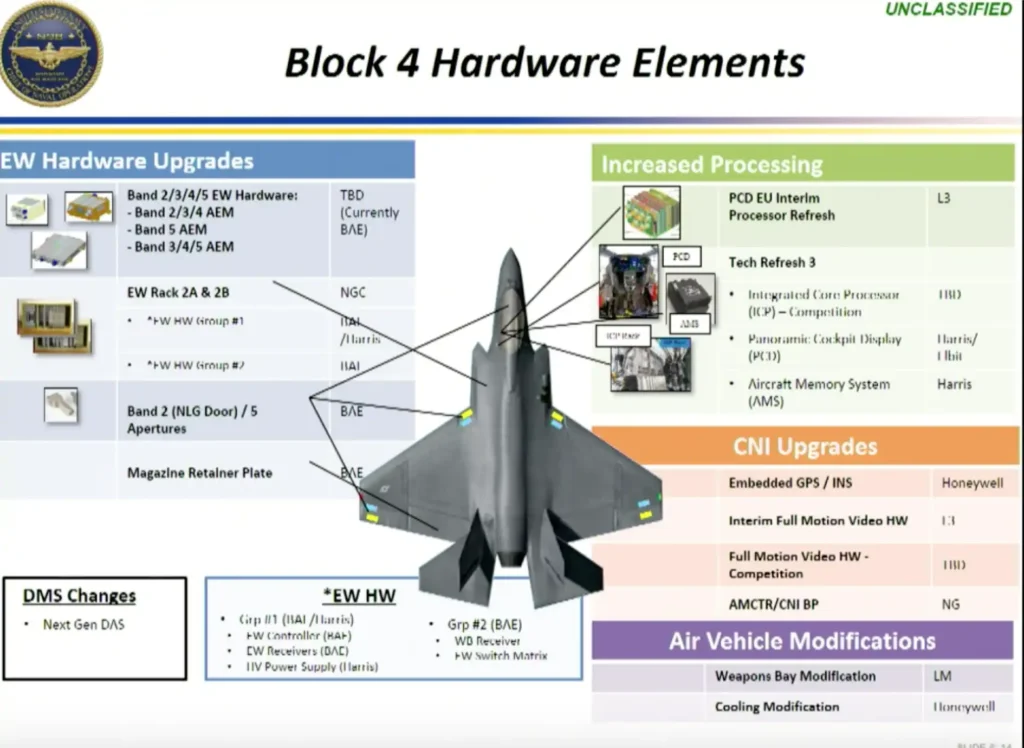
The Block 4 software and hardware upgrade package, currently being rolled out, significantly enhances the AN/ASQ-239’s capabilities. With the integration of gallium nitride (GaN)-based transmit-receive modules (TRMs), the F-35 benefits from:
- Faster signal processing and higher gain across threat frequencies
- Enhanced resistance to electronic counter-countermeasures (ECCM)
- Improved spatial resolution for signal-of-interest identification
Additionally, Block 4 introduces the Non-Intrusive EW Test System (NIEWTS), a diagnostics module that enables on-the-fly fault isolation and system recalibration, dramatically reducing maintenance downtimes in operational scenarios.
A particularly notable development under Block 4 is the next-generation Distributed Aperture System (DAS), deployed post-2023. This system boasts a fivefold increase in reliability, superior IR imagery resolution, and enhanced classification accuracy, essential for detecting camouflaged or low-signature threats in complex environments.
Stealth-EW Synergy: Coordinated Tactical Deception
The F-35’s electronic warfare capabilities are intricately aligned with its stealth architecture, allowing the aircraft to engage in low-observable electronic disruption tactics. Instead of broadcasting conventional jamming signals that would expose its location, the F-35 employs directional electronic deception techniques—disrupting enemy radar and IR tracking systems without compromising stealth.
Through signal shaping and selective emission, the AN/ASQ-239 enables the aircraft to suppress enemy defenses while remaining undetected, even as it penetrates sophisticated integrated air defense systems (IADS). Furthermore, F-35s can share electronic intelligence through encrypted tactical data links, forming a distributed triangulation network to geolocate and track radar emitters such as airborne early warning (AEW) aircraft or surface-to-air missile radars, without activating their own radars.

Combat-Proven Electronic Warfare Applications
The real-world utility of the F-35’s electronic warfare suite has been proven in Suppression of Enemy Air Defenses (SEAD) and Destruction of Enemy Air Defenses (DEAD) missions. The AN/ASQ-239 identifies, localizes, and guides anti-radiation missiles (ARMs) to enemy radar positions within seconds of detection.
In aerial engagements, the EW suite coordinates with the APG-81 radar to conduct narrow-beam 2°×2° scans, allowing the F-35 to lock onto enemy aircraft with minimal emissions footprint. This reduces the likelihood of interception or jamming by enemy RWRs, giving the pilot an edge in both Beyond Visual Range (BVR) and Within Visual Range (WVR) combat scenarios.
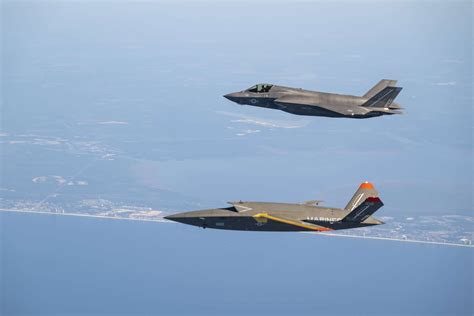
The F-35 also plays a multi-domain command role through its “combat server” capabilities, controlling drone platforms like the XQ-58A Valkyrie to extend its EW coverage. In swarm-based missions, the Valkyrie fleet can perform decoy, jamming, or reconnaissance functions under the direction of a single F-35, multiplying the force’s operational radius.
Adaptation and Future Trajectory of the AN/ASQ-239
The F-35’s EW system is not only confined to the fighter program. The Northrop Grumman B-21 Raider, America’s next-generation stealth bomber, has integrated a derivative of the AN/ASQ-239, affirming the architecture’s modular and scalable design. Its ability to be adapted across platforms with different mission profiles and electromagnetic signatures is a testament to the system’s resilience and forward-compatibility.
Looking ahead, ongoing research is focused on embedding Artificial Intelligence (AI) within the EW suite. By utilizing machine learning for real-time threat classification, the AN/ASQ-239 is expected to shift from rule-based jamming to adaptive, predictive countermeasures, reducing pilot workload and reaction times. This evolution supports autonomous threat prioritization, particularly valuable in dense signal environments or electronic denial zones.
Strategic Implications and Competitive Edge
The F-35’s electronic warfare dominance is a decisive factor in establishing air superiority in high-threat environments. By combining signal stealth, networked multi-platform coordination, and automated countermeasure execution, the platform transcends the role of a mere strike fighter. It becomes an information warfare asset, crucial for the modern doctrine of Joint All-Domain Operations (JADO).
In contested theaters such as the Indo-Pacific, where adversaries field advanced anti-access/area denial (A2/AD) systems, the F-35’s ability to penetrate undetected, disrupt command networks, and relay actionable data makes it indispensable. Its EW system not only enables survivability but also empowers other assets within the battlespace—ranging from legacy aircraft to naval and ground-based forces.
Conclusion
The AN/ASQ-239 electronic warfare system equips the F-35 Lightning II with an unparalleled edge in electromagnetic spectrum dominance, situational awareness, and survivability. Through its sensor fusion, stealth synergy, and continuous upgrades, it remains the cornerstone of fifth-generation combat effectiveness. As AI, advanced materials, and distributed command systems continue to evolve, the F-35’s electronic warfare capability will define the next era of networked airpower.
Frequently Asked Questions
What makes the AN/ASQ-239 different from traditional electronic warfare systems?
Unlike legacy EW systems that function as separate components, the AN/ASQ-239 is deeply integrated with all onboard sensors of the F-35. It not only detects and classifies threats but also works in tandem with radar, IR systems, and communication tools to create a single, real-time threat picture, enabling automated and precise responses.
How does the F-35 maintain stealth while using electronic warfare?
The F-35’s EW system uses directional jamming and deception techniques, limiting its emissions and maintaining its radar stealth profile. This ensures the aircraft can disrupt enemy systems without revealing its location, a crucial capability in modern, radar-saturated battle zones.
Will the AN/ASQ-239 continue to evolve with future threats?
Yes, the system is designed with a modular and open architecture, allowing easy integration of new hardware and AI-driven software upgrades. With its adoption in future platforms like the B-21 and anticipated AI enhancements, the AN/ASQ-239 will remain at the forefront of next-generation electronic warfare.