Flying an aircraft is not merely a technical skill; it is an exercise in judgment, alertness, and responsibility—qualities that demand a sharp mind and a healthy body. The Federal Aviation Administration (FAA) enforces medical fitness standards through a structured certification process to ensure that every pilot who takes the controls meets minimum health benchmarks essential for flight safety. Understanding the FAA Medical Certificate Requirements is not only a legal obligation for aviators but a critical factor in aviation risk management.
Who Needs an FAA Medical Certificate?
A valid FAA Airman Medical Certificate is required for any pilot acting as pilot-in-command (PIC) or as a required flight crew member during any flight operation. This includes pilots-in-training during solo operations, where even student pilots must hold a valid Third-Class Medical Certificate. Without this, solo flight is not legally permitted under FAA regulations.
While BasicMed offers an alternative route for certain private pilots, a formal medical certificate remains the cornerstone of commercial, recreational, and student-level operations. Moreover, a pilot cannot rely solely on their medical certificate; they are expected to self-evaluate their fitness to fly before every flight. The medical certificate is not a blanket clearance—it is a baseline.

Types of FAA Medical Certificates: Classifications and Privileges
FAA medical certificates are divided into three classes, each tailored to specific operational roles in aviation. These distinctions are governed by 14 CFR Part 67, where medical standards are codified based on the level of responsibility a pilot holds.
First-Class Medical Certificate
This is the highest medical standard and is primarily required for Airline Transport Pilots (ATPs) acting as PICs. Additionally, it is mandatory for:
- Second-in-command on aircraft requiring three or more pilots
- ATP holders over 60 years of age
The First-Class certificate involves the most stringent health checks, including cardiovascular and neurological assessments, and is often the most scrutinized class.
Second-Class Medical Certificate
This class is applicable to pilots engaged in commercial aviation, including:
- Commercial pilots operating under Part 135 and Part 121 regulations
- Second-in-command ATP holders not meeting First-Class requirements
While less restrictive than the First-Class, the Second-Class still demands a high standard of medical integrity.
Third-Class Medical Certificate
Used by the vast majority of private, recreational, and student pilots, this certificate also applies to:
- Certified Flight Instructors (CFIs)
- Designated Pilot Examiners (DPEs) during flight tests
It has the least stringent requirements among the three classes, but is still essential for any solo training or unsupervised flight.
BasicMed: An Alternative for Private Pilots
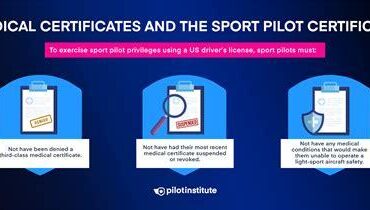
Introduced in 2016, BasicMed offers a pathway for eligible private pilots to fly without holding a traditional FAA medical certificate. However, this route is not free of oversight. To qualify, pilots must:
- Hold a valid U.S. driver’s license
- Have held an FAA Third-Class medical certificate anytime after July 14, 2006
- Complete a Comprehensive Medical Examination Checklist (CMEC) with a state-licensed physician
- Pass an online BasicMed course
BasicMed pilots face certain limitations:
- Aircraft must be 6,000 lbs or less Maximum Takeoff Weight (MTOW)
- Cannot carry more than 5 passengers (6 total seats)
- Flights must remain under 18,000 feet MSL and 250 knots
- Operations must be non-compensated (i.e., not for hire)
Medical Certificate Duration and Expiration Rules
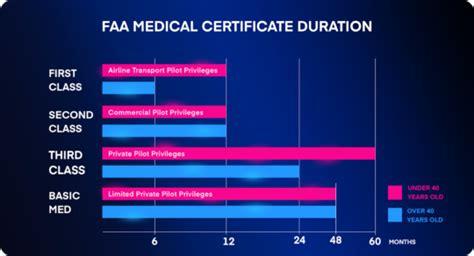
A crucial aspect of FAA medical certification is duration of validity, which varies based on the pilot’s age and certificate class. Once the certificate’s time-based validity ends, pilots may still exercise privileges of a lower class, provided no new disqualifying condition has arisen.
Validity Timelines
- First-Class: Valid for 12 months if pilot is under 40, and 6 months if 40 or older
- Second-Class: Valid for 12 months regardless of age
- Third-Class: Valid for 60 months if under 40, and 24 months if 40 or older
Importantly, the expiration clock begins at the end of the month in which the exam is conducted—not on the exam day itself.
Medical Examination: The Role of Aviation Medical Examiners (AMEs)
The FAA does not conduct medical exams directly; instead, it delegates the responsibility to qualified Aviation Medical Examiners (AMEs). These physicians are trained in both general medicine and the specific regulatory criteria outlined in 14 CFR Part 67.
During an FAA medical exam, an AME assesses several key physiological systems, including:
- Vision (distance, intermediate, and color)
- Hearing (ability to perceive conversational speech)
- Equilibrium (inner ear and vestibular health)
- Cardiovascular health
- Neurological function and mental health
A pilot begins the process by submitting medical history via the FAA MedXPress online portal. This form must be completed before the appointment. The AME uses this data, along with physical and diagnostic tests, to evaluate medical eligibility.
Disqualifying Conditions and Special Issuance
Some health conditions are considered automatically disqualifying unless the FAA grants a Special Issuance Authorization. These include:
- Epilepsy or seizure disorders
- Psychosis or severe psychiatric illnesses
- Myocardial infarction (heart attack)
- Substance dependence or abuse
A pilot who has a history of these conditions may still fly if they undergo additional evaluation, submit medical records, and are cleared through FAA Aerospace Medical Certification Division. A special issuance typically requires annual renewal and monitoring.

Pilot Responsibility Beyond Certification
A valid certificate is not a blank check to fly under all circumstances. FAA regulations explicitly state that pilots must self-assess their health before every flight. This includes:
- Assessing recent illness or injury
- Considering side effects of medications (even OTC drugs)
- Evaluating fatigue, stress, and mental state
The concept of “I’m safe”—Illness, Medication, Stress, Alcohol, Fatigue, Emotion—is a popular mnemonic that encapsulates this duty. Even with a current certificate, a pilot must self-ground if unfit.
Final Thoughts: Medical Fitness is Aeronautical Responsibility
Maintaining an FAA medical certificate is more than a compliance requirement; it is a lifeline of operational readiness. Aviation is a dynamic environment where quick thinking, spatial orientation, and sustained focus are indispensable. Any compromise in medical health can jeopardize not only the pilot but also passengers, other aircraft, and communities below.
As the aviation industry continues to evolve—with aging pilot populations and expanding roles for general aviation—the FAA’s commitment to health oversight remains a pillar of public safety. It is the pilot’s responsibility to uphold these standards, not just on paper, but in the cockpit, every single time the wheels leave the ground.