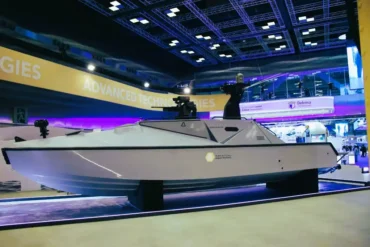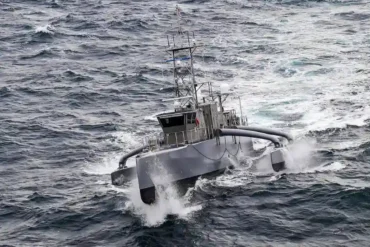
France is moving decisively to harden its maritime defenses with a fast-tracked program to field armed autonomous surface drones capable of protecting naval bases and escorting high-value warships. Announced in late January 2026, the initiative signals a sharp doctrinal shift by the Marine Nationale toward unmanned systems designed to counter the reality of asymmetric, low-cost maritime threats now shaping naval conflict from the Black Sea to the Red Sea.
The program, known as DANAE—short for Drone de surface Autonome Naval avec capacité d’Armement Embarqué—is built around urgency. Rather than following traditional, multi-year procurement cycles, France is prioritizing rapid experimentation, real-world trials, and accelerated operational integration. The objective is blunt: ensure French ports, overseas bases, and deployed task groups are no longer vulnerable to unmanned attack vectors that can slip past conventional defenses.
Recent conflicts have exposed how uncrewed surface vessels (USVs), often cheap and expendable, can threaten billion-euro platforms and fixed infrastructure. Paris has drawn its conclusions. DANAE is intended to close that gap quickly, using existing technologies adapted at speed instead of waiting for bespoke systems that may arrive too late.
At the center of DANAE is a procurement philosophy driven by the Agence de l’Innovation de Défense (AID), France’s defense innovation authority. AID issued a targeted call for projects in 2025, selecting seven industrial candidates to submit operational prototypes. These systems are now undergoing extensive trials in the waters around Toulon, one of France’s most strategically important naval hubs.
The emphasis is not on paper specifications but on performance in realistic maritime conditions. Endurance, autonomy, command-and-control resilience, and payload modularity are all being evaluated under operational stress. This approach reflects a wider French effort to shorten the distance between laboratory innovation and frontline capability.
A Diverse Industrial Field Competing at Speed
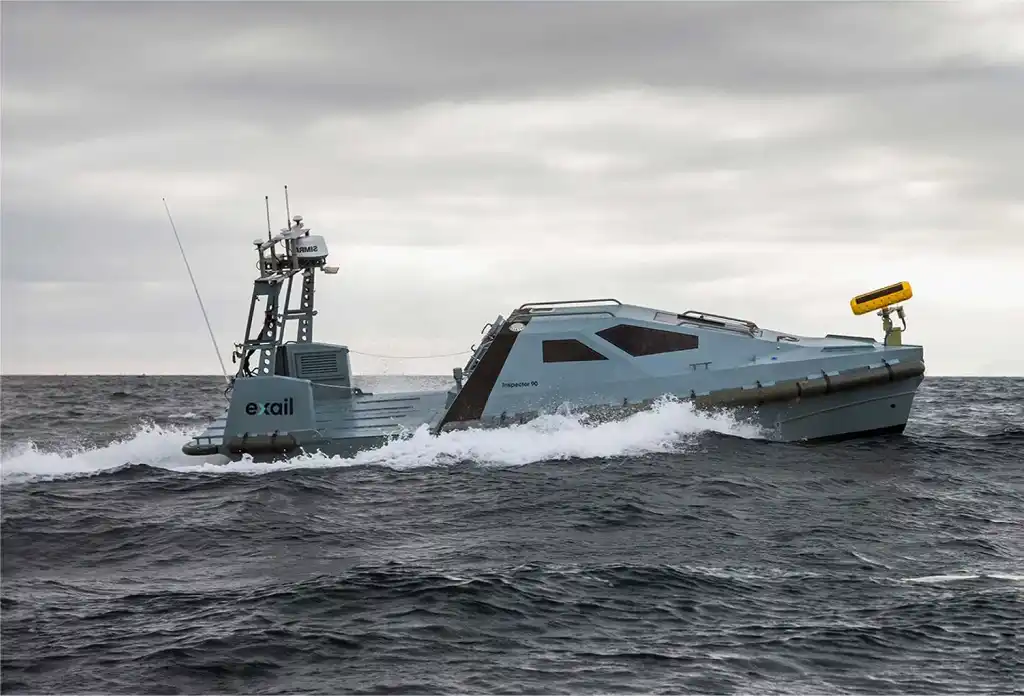
The companies involved span the breadth of France’s naval innovation ecosystem. Major defense players such as Thales and Sirehna—a subsidiary of Naval Group—are competing alongside agile small and medium-sized enterprises including Keys4sea, SeaOwl Group, Marine Tech, SEAir, and unmanned systems specialist Exail. Each entrant brings a distinct design philosophy, from high-end sensor fusion platforms to compact, fast USVs optimized for swarm operations.
Exail, already known for its work in mine countermeasures and underwater robotics, has positioned itself as a frontrunner by offering a full-spectrum unmanned maritime solution, spanning surface and subsea operations. This breadth is attractive to a navy seeking integrated systems rather than isolated platforms.
Crucially, DANAE does not impose a single design template. Instead, the French Navy is exploring multiple operational concepts simultaneously, allowing doctrine to evolve alongside hardware rather than after it.
From Port Defense to Warship Escort Missions
DANAE’s mission set is deliberately dual-purpose. The first priority is naval base and port security, particularly in France’s overseas territories where facilities are dispersed, lightly defended, and often located in congested coastal environments. In these settings, USVs can provide persistent surveillance, rapid interception, and a visible deterrent presence without tying down crewed patrol craft.
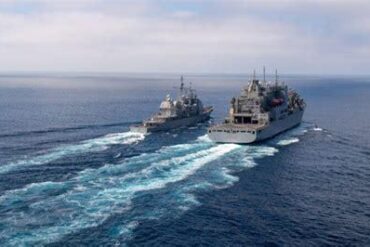
The second mission is more ambitious: escort operations for frigates, patrol vessels, and potentially the aircraft carrier Charles de Gaulle. In this role, surface drones would operate ahead of or alongside manned ships, extending sensor coverage and acting as the first line of defense against surface and subsurface threats.
While armed variants are a core part of the program, early operational versions may prioritize ISR and deterrence. Likely payloads include electro-optical sensors, radar, electronic surveillance suites, and active sonar for detecting underwater threats. Non-lethal options are also being considered to provide graduated responses in peacetime and gray-zone scenarios.
A New Model of Military Acquisition
Senior French defense officials have been explicit about why DANAE matters. General Patrick Aufort, Director of AID, has underscored the strategic risk of delay. In a security environment defined by rapid technological diffusion, time itself has become a vulnerability. France’s answer is to accept iterative improvement in exchange for early operational capability.
This mindset aligns with reforms within the Direction générale de l’armement (DGA), which is shifting toward what officials describe as a “combat-ready” acquisition model. Systems are expected to be usable early, upgraded continuously, and replaced when necessary rather than perfected in isolation.
The current trial phase will conclude with the selection of three finalists, each tasked with building refined operational prototypes. This phase is expected to last 12 to 18 months, after which a single design will be chosen for scaled production. Initial deployment with the Marine Nationale is targeted for 2027, an aggressive timeline by naval procurement standards.
Backed by Long-Term Funding and Strategic Urgency
DANAE is not an isolated experiment. It fits squarely within France’s 2024–2030 Loi de programmation militaire (LPM), which earmarks €5 billion for unmanned and remotely operated systems across all domains. Naval drones are emerging as a central pillar of this investment, reflecting their cost-effectiveness and adaptability.
During a recent visit to Toulon’s Naval Technical Center, Armed Forces Minister Catherine Vautrin captured the program’s underlying logic. Modern warfare, she noted, rewards adaptation and acceleration, not perfection delayed by bureaucracy. Capabilities must arrive while they are still relevant.
Redefining French Naval Doctrine
For the French Navy’s leadership, DANAE represents more than a new platform. Admiral Nicolas Vaujour, Chief of Naval Staff, has indicated that unmanned systems will assume an increasingly central role in future operations. Surface drones are expected to reshape how France thinks about maritime presence, base defense, and force projection.
If successful, DANAE will deliver an indigenous armed USV capability tailored to France’s global commitments, from the Mediterranean to the Indo-Pacific. It will also position France as a leading European innovator in autonomous naval warfare at a moment when NATO allies are racing to counter similar threats.
In a maritime battlespace defined by speed, saturation, and stealth, France’s armed surface drone program is a clear signal: the era of crewed ships operating alone is coming to an end.