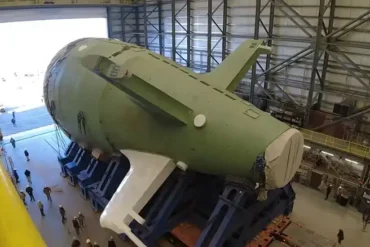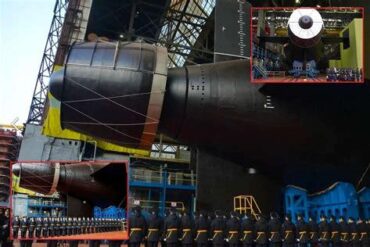
France has crossed a decisive threshold in the renewal of its sea-based nuclear deterrent as the SNLE 3G ballistic missile submarine program officially enters full industrial construction at Naval Group’s Cherbourg shipyard in Normandy. This transition from design maturity to physical realization marks one of the most consequential defense-industrial milestones for France in decades, anchoring its strategic autonomy well into the second half of the 21st century.
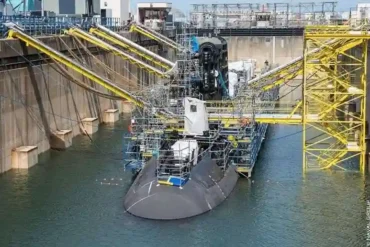
The move follows years of upstream studies, classified design reviews, and gradual industrial reconfiguration. Confirmed during a late January 2026 visit by senior French naval leadership, the start of full construction signals that the program has cleared its most critical technical and organizational gates. From this point forward, Cherbourg becomes the focal point of France’s future nuclear deterrence at sea, transforming abstract blueprints into steel, reactors, and missile compartments.
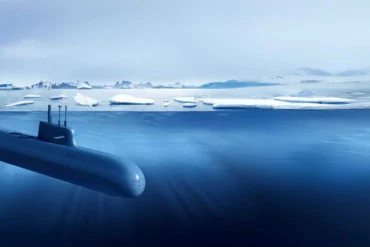
The SNLE 3G program, formally launched in 2021, is designed to replace the four Triomphant-class submarines that have formed the backbone of France’s Force océanique stratégique since the late 1990s. Those submarines, while continuously modernized, will begin reaching the limits of their operational life from the mid-2030s onward. The new class is engineered not merely as a replacement, but as a generational leap tailored for a far more complex and contested undersea environment.
By design, publicly available information remains limited. This opacity is intentional and consistent with France’s strategic culture surrounding its nuclear forces. Even so, enough details have emerged to outline the scale and ambition of what is now taking shape inside the covered halls of Cherbourg.
From Concept to Steel: A Program Years in the Making
The transition to full industrial construction represents the culmination of more than a decade of conceptual and preliminary work. Long before the program’s formal launch, French defense planners and engineers were already modeling future threat environments, missile evolutions, and advances in undersea detection technologies. These studies informed a submarine design intended to remain credible against adversaries not yet fully known.
The program is overseen by the Direction générale de l’armement (DGA), with Naval Group responsible for overall submarine design and construction, and TechnicAtome in charge of the nuclear propulsion system. Together, they have progressively adapted Cherbourg’s industrial infrastructure to accommodate what is expected to be the largest submarine ever built in France.
Unlike attack submarine programs, where multiple units are built in relatively quick succession, ballistic missile submarines demand extreme precision, extended timelines, and uncompromising quality control. Every weld, system interface, and acoustic treatment carries strategic consequences. Entering the industrial phase confirms that these risks are now sufficiently mastered to proceed at scale.
A Larger Hull for a Heavier Strategic Payload
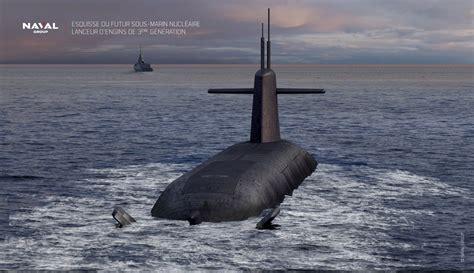
Available indicators suggest the SNLE 3G will significantly exceed its predecessor in size. While final dimensions remain classified, converging estimates point to a hull length approaching or slightly exceeding 150 meters, compared to the 138 meters of the Triomphant class. This growth is not cosmetic. It reflects the physical and structural demands of next-generation strategic weaponry.
The enlarged missile compartment is tailored for the M51 family of submarine-launched ballistic missiles, known in France as Mer-Sol Balistique Stratégique (MSBS). Current planning centers on the future M51.4 variant, which is expected to feature enhanced range, improved penetration aids, and adaptability against evolving missile defense systems. Integrating this missile drives not only length but also internal volume, shock resistance, and structural reinforcement throughout the pressure hull.
Submerged displacement is projected to reach approximately 15,000 tonnes, placing the SNLE 3G among the heaviest operational submarines in the world. This mass supports increased endurance, improved habitability for extended patrols, and the integration of advanced quieting technologies designed to preserve stealth across decades of service.
Nuclear Propulsion Optimized for Silence and Longevity
At the heart of the submarine lies a new-generation nuclear reactor developed by TechnicAtome. While performance figures remain undisclosed, the design priorities are clear: acoustic discretion, operational reliability, and extended life cycles. The reactor is optimized to support months-long patrols, with endurance limited more by crew logistics than by propulsion constraints.
Crew size is expected to remain around 100 personnel, a figure that reflects a careful balance between automation and human redundancy. Strategic deterrence patrols typically last close to two months, demanding not only technical resilience but also psychological endurance. Layout, noise management, and onboard systems are therefore designed as much around human factors as around weapons performance.
The propulsion architecture also plays a central role in stealth. Reduced mechanical complexity, advanced vibration isolation, and refined propulsor design are all aimed at lowering the submarine’s acoustic signature below detection thresholds anticipated well into the future.
Sustaining France’s Continuous At-Sea Deterrence
France’s nuclear posture is built on a single, non-negotiable principle: permanence at sea. At least one ballistic missile submarine must be on patrol at all times, undetected and ready to execute its mission if ordered. The SNLE 3G is engineered to sustain this posture seamlessly as the Triomphant class is progressively retired.
Today, the French Navy operates four Triomphant-class SSBNs, each equipped with 16 M51 launch tubes. This strategic force is complemented by Suffren-class nuclear-powered attack submarines, which handle conventional missions ranging from anti-submarine warfare to intelligence collection and land-attack strikes using the MdCN cruise missile. Together, these platforms give France a balanced and credible undersea force.
The arrival of the SNLE 3G will not alter this structure but will reinforce it, ensuring that France’s strategic submarines remain effectively invisible in an era of proliferating sensors, unmanned systems, and undersea surveillance networks.
Sensors, Communications, and the Fight for Invisibility
Maintaining stealth is no longer a passive endeavor. The SNLE 3G is expected to feature a new generation of sonar and sensor fusion systems, combining large-aperture flank arrays with advanced signal processing. The goal is to maximize situational awareness while minimizing active emissions that could compromise the submarine’s position.
Equally critical are secure, redundant communications systems capable of receiving strategic orders under the most constrained conditions. Very-low-frequency and extremely-low-frequency reception, antenna design, and data integrity all shape the submarine’s operational envelope. These systems ensure that even at depth, and under adversarial pressure, command authority can be exercised without ambiguity.
An Industrial Effort Spanning Three Decades
The SNLE 3G is as much an industrial project as a military one. French authorities estimate roughly 100 million working hours spread across the program’s life cycle, including around 15 million hours of engineering work. Each submarine represents approximately 20 million production hours, reflecting the extreme complexity of strategic submarine construction.
More than 400 companies across France are involved, many of them small and medium-sized enterprises specializing in high-precision manufacturing, nuclear components, and advanced materials. This industrial ecosystem preserves sovereign skills that few nations in the world still possess, anchoring them firmly on French soil.
For Cherbourg, the program ensures long-term continuity following the completion of the Barracuda-class attack submarines. It also cements the site’s role as one of the most important submarine construction hubs globally.
A Carefully Sequenced Transition to the Future
Current planning foresees delivery of the first SNLE 3G around 2037, aligning with the fortieth year of service of the lead Triomphant-class submarine. Subsequent units will enter service in a phased manner, each replacing an older boat without creating any gap in deterrence coverage.
If timelines hold, the final SNLE 3G could remain operational until around 2090, projecting French strategic capability across an entire century. Few defense programs carry such temporal weight or such long-term geopolitical implications.
By committing fully to the SNLE 3G, France sends a clear signal of strategic continuity. In a global environment marked by renewed nuclear signaling and maritime competition, the program underscores a deterrence philosophy rooted in discretion, permanence, and technological credibility rather than numerical escalation. Beneath the surface, where silence still defines power, the SNLE 3G is now moving from vision to reality.