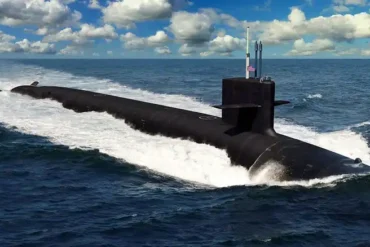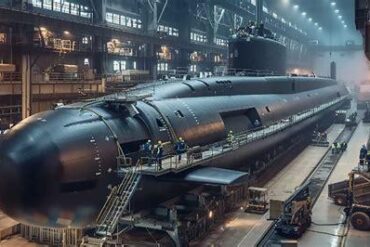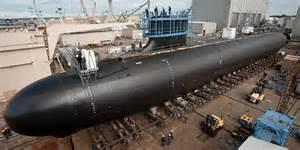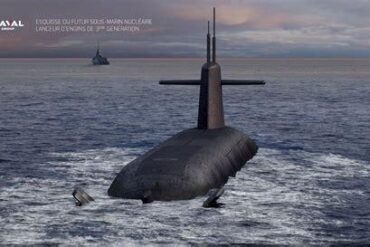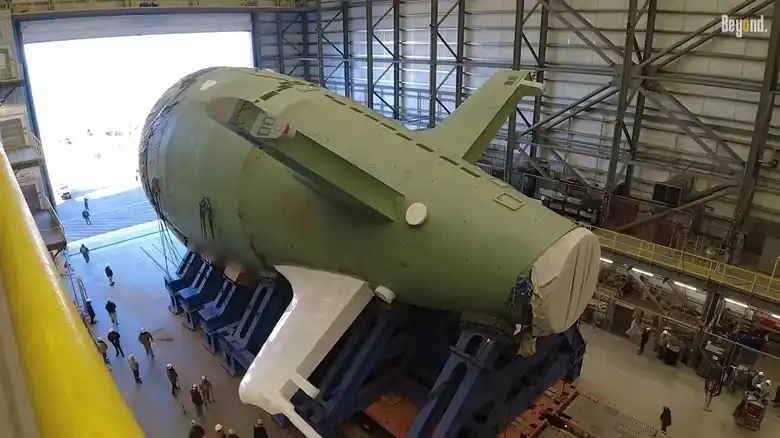
The emergence of a new photograph showing the USS District of Columbia (SSBN-826) has provided one of the clearest visual demonstrations yet of the immense size of the United States Navy’s next-generation ballistic missile submarine. Captured at Newport News Shipbuilding, the image features lead photographer Ashley Cowan standing beside the vessel’s towering structure, creating a striking sense of scale that statistics alone cannot convey. While defense analysts have long known the dimensions of the Columbia-class program, the photograph transforms abstract numbers into a tangible reality, highlighting just how massive America’s future sea-based nuclear deterrent will be.
The USS District of Columbia is the lead vessel of the Columbia-class ballistic missile submarine fleet, a program destined to become the backbone of the United States’ strategic nuclear forces for decades. Measuring approximately 560 feet in length and displacing around 20,810 tons, it will surpass every submarine previously built by the United States Navy. Its enormous dimensions are not simply a product of carrying nuclear missiles; they also reflect the sophisticated technologies, enhanced survivability systems, and next-generation propulsion architecture incorporated into the design.
As construction continues at Newport News Shipbuilding and General Dynamics Electric Boat, the submarine represents one of the most ambitious naval engineering projects undertaken in modern American history. The vessel is expected to enter operational service in 2029, marking the beginning of a long transition from the aging Ohio-class fleet that has served as the nation’s primary sea-based nuclear deterrent since the early 1980s.
Why the Columbia-Class Submarine Is So Important
The Columbia-class program is designed to replace the legendary Ohio-class ballistic missile submarines, which first entered service in 1981. These submarines form one leg of the United States nuclear triad, providing a highly survivable second-strike capability that remains hidden beneath the world’s oceans.
The Navy plans to acquire 12 Columbia-class submarines, with production scheduled over the next two decades. Following the delivery of the lead vessel, additional submarines are expected to arrive roughly once per year, with the final boat projected to enter the fleet around 2041 or 2042. These submarines are expected to remain operational into the 2080s, making them among the longest-serving and most strategically significant naval assets ever built.
The scale of investment reflects their importance. The procurement cost for only the next five boats in the class has been estimated at approximately $62 billion, underscoring the central role these submarines will play in American national security planning for generations.
Advanced Stealth Technologies Define the New Design
Although the Columbia-class is physically larger than the Ohio-class, its most significant advancements are hidden beneath the hull. The Navy has focused heavily on reducing acoustic signatures, ensuring the submarine remains extremely difficult to detect in hostile environments.
A major innovation is the introduction of an electric-drive propulsion system. Unlike traditional mechanical-drive submarines, this technology significantly reduces noise generated by moving machinery. Lower acoustic output directly enhances survivability, allowing the submarine to operate more discreetly while conducting strategic deterrence patrols.
Additional improvements include upgraded sonar systems, advanced sensor arrays, and extensive quieting technologies integrated throughout the vessel. Together, these enhancements create a platform specifically engineered to evade detection by increasingly sophisticated anti-submarine warfare capabilities employed by potential adversaries.
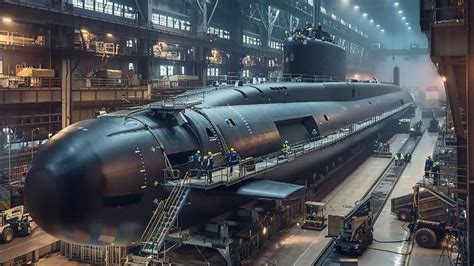
Nuclear Deterrence Remains the Core Mission
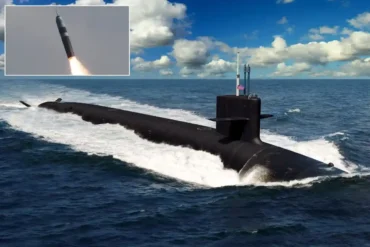
Despite major technological improvements, the Columbia-class retains a familiar strategic role. Its primary mission remains the deployment of UGM-133 Trident II D5LE ballistic missiles, one of the most capable submarine-launched ballistic missile systems ever developed.
Interestingly, the new submarines will carry 16 missile tubes, fewer than the Ohio-class fleet’s 24. However, this reduction does not diminish their strategic value. Each submarine will contain four missile compartments, with each compartment housing four Trident II D5LE missiles.
These missiles possess an intercontinental range of approximately 6,200 nautical miles, allowing them to strike targets across vast distances while the submarine remains concealed far from hostile shores. Because launches can occur while submerged, the platform preserves a powerful element of surprise and survivability, reinforcing its role as a credible nuclear deterrent.
A Submarine Built for the Future
The newly circulated photograph offers more than a glimpse of a large warship. It provides visual confirmation of the extraordinary engineering effort behind the Columbia-class program. The USS District of Columbia is not merely larger than its predecessors; it represents a generational leap in stealth, endurance, reliability, and strategic capability.
As construction progresses and additional boats join the production pipeline, the Columbia-class will gradually assume responsibility for one of the most critical missions in American defense. With service expected well into the latter half of the 21st century, these massive submarines are poised to become the silent guardians of the United States’ nuclear deterrent for decades to come.