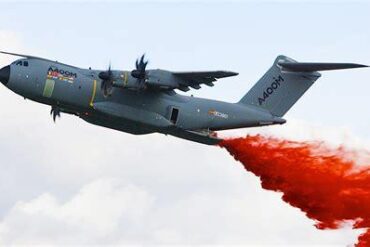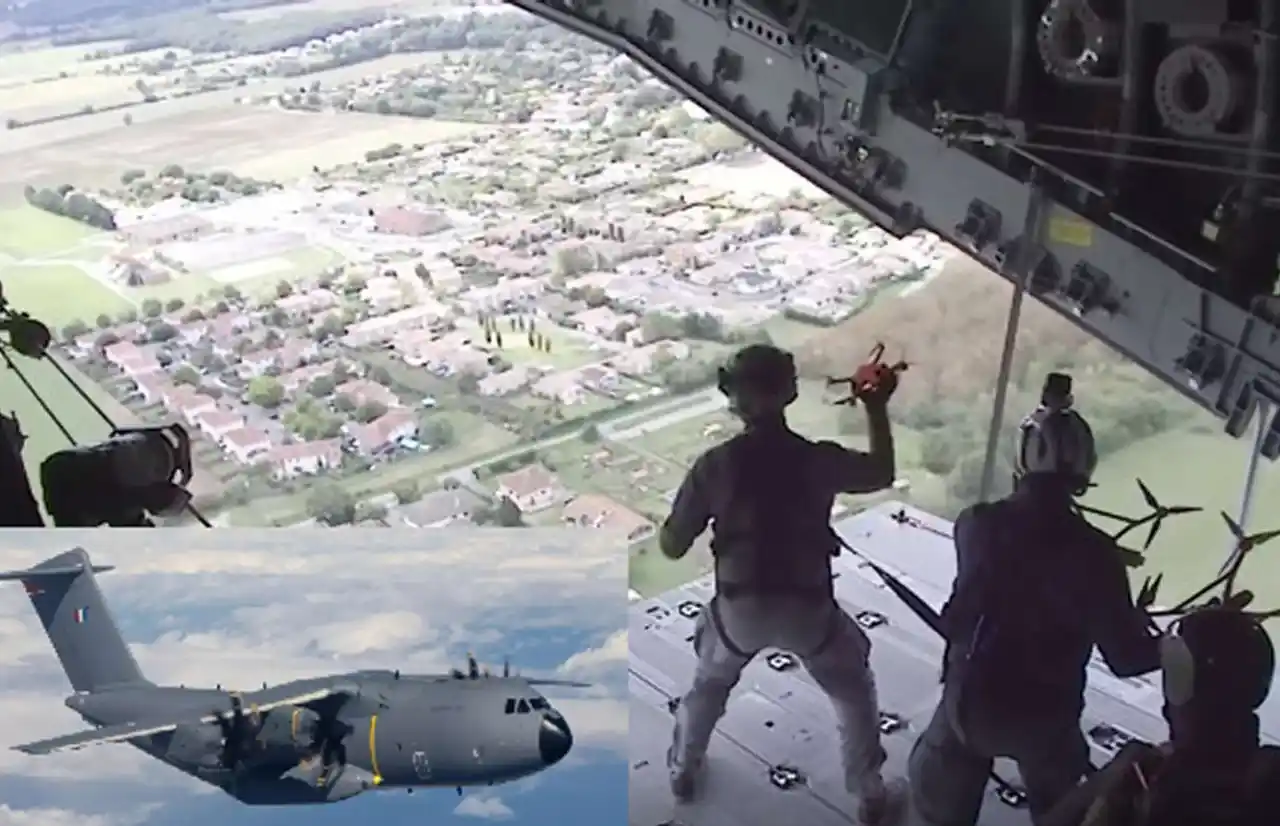
French defense authorities have taken a significant step forward in future warfare capabilities with the first large-scale drone deployment trials from an A400M Atlas transport aircraft, aiming to transform this strategic airlifter into a multi-domain force multiplier. Conducted under the auspices of France’s Directorate General of Armaments (DGA), the tests mark a watershed moment in operational experimentation, laying the groundwork for a new era of airborne drone swarming and rapid UAV deployment from crewed platforms.
The test campaign began on January 7, 2026, under the leadership of DGA Techniques Aérospatiales (DGATA) and DGA Essais en Vol (DGAEV). The trials used inert drone mockups, devoid of electronics, to rigorously test the feasibility and dynamics of launching various UAV configurations from the A400M. This heavy-lift platform, originally built for logistics and troop transport, now stands on the threshold of being reimagined as an airborne drone carrier capable of dispatching unmanned assets deep into contested zones.
A400M: The Emerging Backbone of Drone Air Launch Concepts
The Airbus A400M Atlas has long been recognized for its strategic and tactical versatility. It boasts a cargo capacity of 37,000 kilograms in a voluminous 340 m³ hold, combined with the agility to operate from semi-prepared or austere runways. Its four TP400-D6 turboprops, each delivering approximately 11,000 shp, allow for cruise speeds nearing Mach 0.72 and altitudes approaching 40,000 feet.
These capabilities are critical for the drone deployment concept. The A400M’s speed, range, and high-altitude performance mean it can insert UAVs over wide operational theaters while remaining safely outside enemy air defense bubbles. With a range exceeding 3,000 nautical miles at partial loads, the platform can rapidly reposition and project drone swarms into high-threat environments, offering a standoff launch advantage previously limited to missile systems or stealth assets.
Testing the Envelope: Dual-Mode Drone Release Trials
During the DGA’s three flight trials, engineers tested 72 inert drones using both the side paratroop doors and the rear cargo ramp. This dual-mode testing architecture is more than a technical footnote—it defines how drone magazines might operate in real-world conditions.
- 21 drones were released via the paratrooper side door, facing intense airflow and fuselage-induced turbulence.
- 51 drones exited through the rear ramp, navigating the complex aerodynamic wake and prop wash of the massive aircraft.
These configurations replicate realistic exit scenarios, and the results—supported by extensive numerical simulations—helped define safe release envelopes, map separation trajectories, and lay the foundation for automated launch systems in future iterations.
Multirotors to Loitering Munitions: Diverse Drone Architectures Evaluated
Significantly, the mockups used were not homogenous. DGA intentionally tested multiple classes of drones, representing a broad spectrum of UAV types that could be employed in mission-critical situations:
- Compact multirotors: Suitable for ISR (Intelligence, Surveillance, Reconnaissance) and communications relay.
- Small fixed-wing drones: Ideal for wide-area surveillance, tactical mapping, or ELINT roles.
- Heavier effectors: Including loitering munitions and potential strike-capable drones, introducing the concept of offboard kinetic engagement.
Each type brings its own aerodynamic behavior post-release. By examining stabilization patterns, mass-induced drift, and deployment responsiveness, engineers now better understand which platforms are most compatible with high-speed air release protocols.
Tactical Implications: A New Paradigm for Unmanned Warfare
The strategic potential of launching drones from high-speed, high-altitude aircraft cannot be overstated.
Firstly, it dramatically shortens mission timelines. Instead of drones expending battery life or fuel to reach operational zones, they are inserted closer to the target area—maximizing on-station endurance. Secondly, a single A400M can disperse a multitude of drones simultaneously across a broad front, executing ISR, EW, strike, or decoy missions in parallel.
Moreover, this methodology enables deep operational reach with minimized risk. The carrier aircraft remains outside heavily defended airspace, while unmanned assets penetrate forward, gathering data, jamming communications, or saturating defense systems with overwhelming quantity and complexity.
Manual Release as a Foundation for Autonomous Systems
While the current trials used manual crew deployment, the rationale behind this is sound. Manual release allows testers to:
- Rapidly iterate on drone shapes, masses, and configurations.
- Observe real-time crew handling safety issues.
- Fine-tune drop timing and dynamic stabilization feedback.
Once aerodynamics and safe envelopes are verified, the program will progress to automated launch systems, including palletized drone swarms, modular ejectors, and eventually intelligent drone magazines with dynamic load-balancing algorithms.
Other countries are following a similar arc. The United States has tested palletized effects from C-130 aircraft and is actively investing in drone motherships. Similarly, European defense consortia have demonstrated remote carrier deployments from A400M-class aircraft, hinting at a shared future vision of air-launched swarm warfare.
The Road Ahead: Scaling Up to Multi-Platform Integration
The January trials are not the endpoint. DGA has already confirmed expansion of the methodology to the C-130J Hercules and the CN-235 light transport aircraft, representing a broader strategy to equip the French tactical transport fleet with drone launch capabilities.
Upcoming tests will include:
- Enhanced simulations incorporating real-time turbulence modeling.
- Integration of active stabilization fins and deployable sensor packages.
- Initial trials of semi-autonomous drone launch racks embedded in aircraft fuselages.
This modularity means drone-launching capacity can be scaled by aircraft type, mission parameters, and geographic theatre requirements. For high-intensity scenarios, multiple transport aircraft can act as aerial drone artillery, flooding the battlespace with autonomous platforms. In lower-intensity operations, a single CN-235 might quietly dispatch surveillance drones to patrol a border or monitor a naval chokepoint.
Strategic Significance: France’s Vision for Multi-Domain Dominance
France’s innovation in airborne drone deployment isn’t simply about UAVs—it represents a fundamental shift in force projection philosophy. By converting tactical airlifters into multi-role enablers, the French Army can:
- Leverage existing platforms without massive new procurement.
- Create distributed unmanned ISR and strike networks.
- Remain resilient against centralized airbase threats.
Furthermore, in a future conflict where air denial and electronic warfare are prevalent, the ability to project, replace, and replenish drones mid-campaign becomes a game-changer. The A400M-as-drone-mothership doctrine allows for in-theatre replenishment of unmanned capabilities even as ground or sea-based options are degraded.
The January 2026 campaign has put France at the forefront of operational UAV deployment doctrine, not just in Europe, but globally. As the program matures and real drones replace mockups, the world will watch closely to see whether this transforms into a fielded battlefield advantage—or the next great military-industrial challenge.