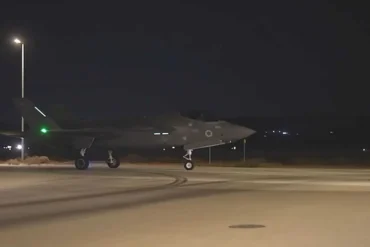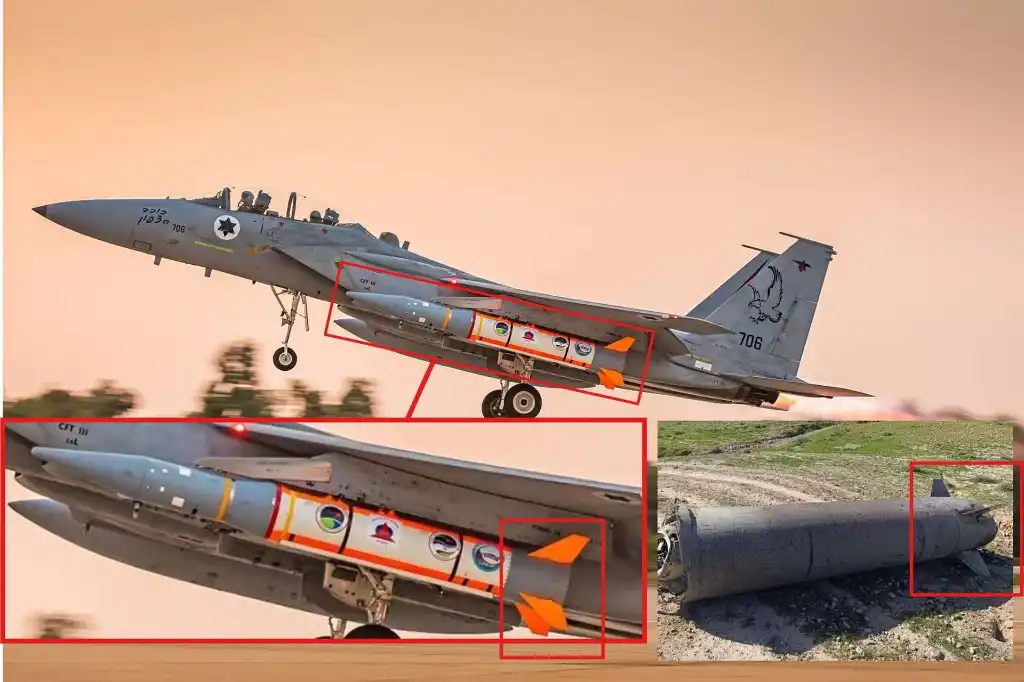
Open-source imagery emerging after the 28 February 2026 US–Israeli strike campaign against Iran has intensified scrutiny over a capability long discussed but never officially acknowledged in combat: Israel’s potential operational use of the Blue Sparrow air-launched ballistic missile. Debris photographed in western Iraq, combined with footage of Israeli Air Force F-15 fighter jets departing at night, has led analysts to assess that Sparrow-family systems may have been employed during the opening phase of the operation. While no formal confirmation has been issued by Israeli or American authorities, the material circulating online aligns closely with known characteristics of the Sparrow missile series.
The strategic implications are substantial. If confirmed, the employment of an air-launched ballistic missile would demonstrate a calibrated, high-speed, long-range strike option capable of penetrating or bypassing advanced air defence networks. Such a development would mark a significant evolution in the operational use of systems originally developed for missile defence testing.
The discussion must remain anchored in verifiable facts. The Israeli Ministry of Defense has not publicly detailed the specific munitions used in the strikes, and no independent forensic investigation has yet confirmed the identity of the debris found in Iraq. However, the physical geometry of the recovered booster sections closely resembles components associated with the Blue Sparrow and Silver Sparrow target missile family, both developed by Rafael Advanced Defense Systems.
Blue Sparrow Missile System: From Target Drone to Potential Strike Weapon
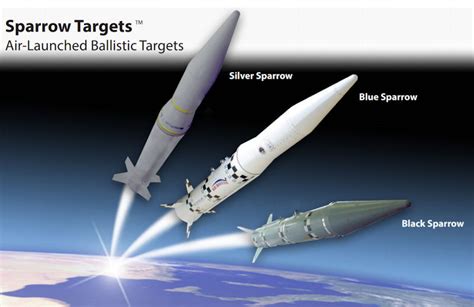
The Blue Sparrow missile belongs to a family of air-launched ballistic target systems originally designed to simulate hostile missile threats for Israel’s Arrow missile defence programme. The Sparrow series includes Black Sparrow, Blue Sparrow, and Silver Sparrow, each engineered to replicate different classes of regional ballistic missiles in range, trajectory, and re-entry dynamics.
Technically, Blue Sparrow measures approximately 6.5 meters in length and weighs around 1.9 tonnes at launch. It uses a single-stage solid-fuel booster, propelling a separable payload section along a ballistic trajectory. Guidance relies on an inertial navigation system (INS) enhanced by satellite navigation, allowing for precisely programmed flight paths. These characteristics enable the missile to mimic realistic threat profiles during interception tests.
Silver Sparrow, the larger variant, is often associated with simulating systems comparable to the Shahab-3 medium-range ballistic missile, typically cited with a range envelope between 1,500 and 2,000 kilometers, depending on launch parameters. Blue Sparrow itself is generally categorized as a medium-range system within a similar band, though exact operational specifications remain classified.
A defining feature of the Sparrow architecture is its modular payload section. In its primary role, this section carries inert or instrumented components for testing interceptor performance. However, the external envelope can technically accommodate alternative payloads, including high-explosive fragmentation warheads. This modularity has long fueled assessments that Sparrow-family systems possess inherent dual-use potential.
Integration on F-15 Aircraft and Operational Flexibility
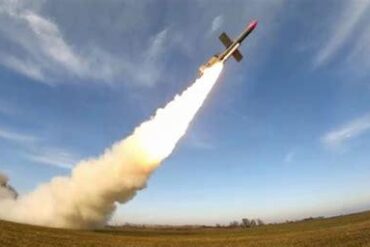
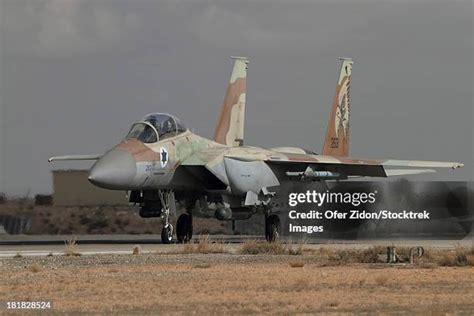
Public imagery from past test campaigns confirms that the Sparrow missiles are launched from Israeli Air Force F-15 platforms, including F-15D and F-15C variants. The F-15I “Ra’am” strike aircraft, a heavily modified derivative optimized for long-range missions, is widely believed to be compatible with the system as well.
Air-launching a ballistic missile provides substantial operational advantages. Unlike ground-based ballistic systems, an air-launched missile benefits from the aircraft’s altitude and forward velocity at release, effectively extending range and optimizing trajectory. The launch aircraft can remain outside heavily defended airspace while the missile proceeds along a high-speed ballistic path toward its target.
In the context of the February 2026 strikes, footage showing Israeli F-15 jets conducting nighttime departures has reinforced speculation that stand-off ballistic systems may have been deployed early in the operation. The timing aligns with what military doctrine would describe as a suppression or degradation phase, targeting critical air defence and missile infrastructure before subsequent strike waves.
Debris in Iraq: Open-Source Evidence and Analytical Caution
Photographs circulating on social media show rocket booster segments discovered in western Iraq and parts of Syria shortly after the strikes. Analysts specializing in open-source intelligence have pointed to structural similarities between these fragments and previously documented Sparrow booster sections recovered in earlier regional incidents.
Comparable debris was reported in 2024 and 2025 following long-range strikes attributed to Israel against targets deep inside Iran. In those cases, the geometry, nozzle design, and casing features were described as consistent with Sparrow-family hardware. However, none of those incidents resulted in official confirmation.
The February 2026 material follows a similar pattern. The debris appears consistent with Sparrow-series components, yet without a verified chain of custody, laboratory analysis, or official acknowledgment, definitive identification remains premature. In a region where information operations accompany kinetic operations, analytical restraint is essential.
Strategic Implications for Regional Missile Defense
If Blue Sparrow or a related variant was indeed employed in an operational configuration, the implications extend beyond the immediate strike campaign. An air-launched ballistic capability complicates regional missile defence calculations in several ways.
First, ballistic trajectories differ fundamentally from cruise missile profiles. Ballistic systems travel at extremely high speeds, often reaching hypersonic velocities during descent. This compresses reaction time for defenders and stresses interceptor systems designed primarily for predictable threat vectors.
Second, the ability to launch from airborne platforms introduces uncertainty in launch location. Ground-based ballistic missile launches are typically detectable via satellite early-warning systems due to their infrared signatures and fixed launch sites. An aircraft-launched system can originate from shifting positions, potentially reducing early detection advantages.
Third, the modular nature of the Sparrow platform means that its flight characteristics are already tailored to simulate realistic regional threats. Inverting that testing logic into operational employment would leverage decades of interceptor trial data.
Operation Context: Escalation and Precision Targeting
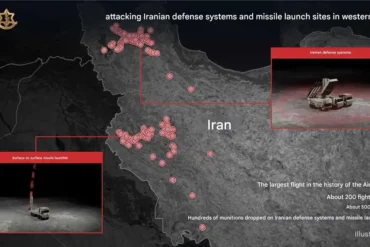
The February 28 strike campaign was described by US and Israeli officials as targeting Iranian missile infrastructure, drone production facilities, and nuclear-related sites. Iran responded with ballistic missile launches against regional targets, underscoring the escalation dynamics at play.
Airspace closures across parts of Iran, Iraq, and Israel reflected the operational scale. Several international airlines temporarily suspended flights, highlighting the broader security ripple effects. In such an environment, stand-off precision strike systems reduce the need for deep penetration sorties while maintaining high lethality against hardened targets.
Ballistic systems, particularly those with steep terminal trajectories, can be effective against reinforced facilities. Whether Blue Sparrow was configured with an explosive payload in this instance remains unconfirmed, yet its structural adaptability supports such a possibility from a technical standpoint.
Confirmed Capabilities Versus Unverified Combat Use
It is firmly established through official documentation that the Sparrow missile family was developed for the Arrow missile defence programme, that these systems are air-launched from Israeli F-15 aircraft, and that their design supports modular payload integration. These facts are not speculative.
What remains unverified is the operational conversion of Blue Sparrow into a combat-configured strike weapon during the February 2026 campaign. Open-source imagery provides circumstantial indicators but not conclusive proof.
Distinguishing between confirmed capability and inferred employment is essential for accurate analysis. The presence of Sparrow-like debris suggests plausibility; it does not constitute definitive confirmation.
A Shift in Long-Range Strike Doctrine?
Even without formal acknowledgment, the renewed attention on Blue Sparrow reflects a broader trend in regional warfare: the blending of missile defence technologies with offensive strike applications. Systems originally designed to simulate adversary missiles for interception testing may now represent flexible strike assets.
Air-launched ballistic missiles occupy a unique niche between traditional cruise missiles and ground-based ballistic systems. They combine the unpredictability of aerial launch platforms with the speed and kinetic characteristics of ballistic trajectories. In a theatre defined by layered air defences and long-range missile exchanges, such hybrid capabilities carry strategic weight.
The February 2026 strike campaign has already demonstrated coordinated US–Israeli operations involving precision-guided munitions and advanced platforms. Whether Blue Sparrow joined that arsenal in an operational capacity remains officially undisclosed. Yet the convergence of imagery, historical precedent, and known system integration ensures that the question will persist in defence analysis circles.
For now, the most accurate conclusion is measured: the debris recovered in Iraq is consistent with Blue Sparrow–series missile hardware, and the operational context makes its use plausible. Confirmation, however, awaits authoritative disclosure.