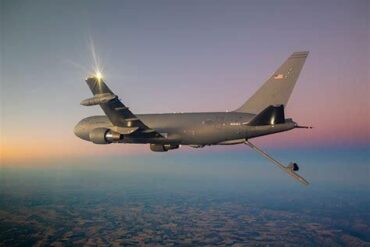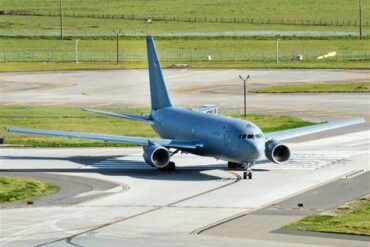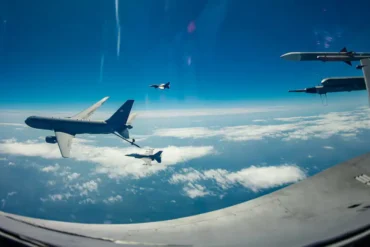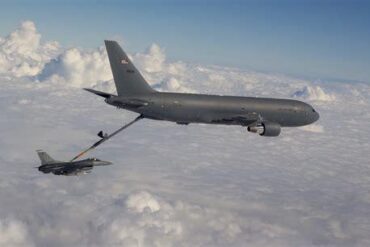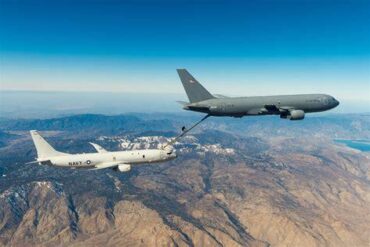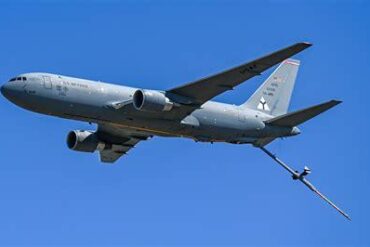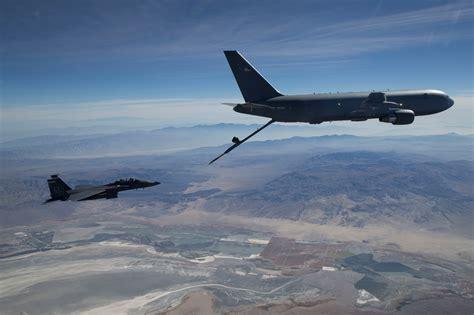
On July 8, 2025, a critical in-flight emergency unfolded off the Virginia coastline as a KC-46A Pegasus aerial refueling aircraft, operating under the call sign “FELL 17”, lost its fuel boom during an active refueling mission involving F-22 Raptor fighter jets. The aircraft, tail number 46033-46, had been conducting standard air-to-air refueling maneuvers when the incident occurred east of Norfolk, raising urgent safety and operational concerns within the U.S. military aviation community.
Emergency Declared Over Atlantic Airspace
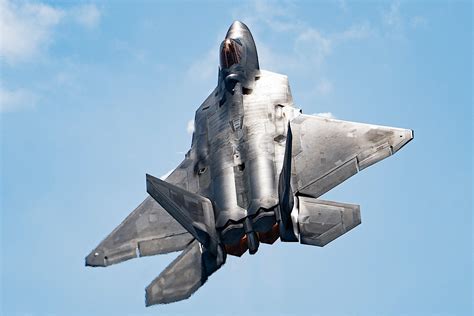
Shortly after the mid-air separation of the refueling boom, the KC-46 crew contacted the Fleet Area Control and Surveillance Facility Virginia Capes (FACSFAC VACAPES) — colloquially known as “Giant Killer” — to declare an emergency. Initial reports suggest that the boom detached while the KC-46 was transferring fuel to a group of F-22 Raptors stationed along the aerial refueling track known as AR-636. While all participating fighter aircraft reportedly returned to base without incident, the status of potential airframe damage remains unconfirmed.
The precise trajectory of the fallen boom — whether it landed in the Atlantic Ocean or elsewhere — has not been disclosed by the Department of Defense. However, observers have noted that airborne fuel booms, being rigid, heavy mechanical arms, pose serious mid-air hazards both to the refueling tanker and the receiver jet, making the incident a matter of intense scrutiny for aviation safety officials.
Understanding the KC-46 Boom and Fueling Systems
The KC-46 employs two primary aerial refueling technologies: the boom system and the probe-and-drogue system. The boom system, which failed during this mission, involves a rigid, operator-guided telescopic arm that connects to a receptacle on the receiving aircraft. It offers faster and more efficient fuel transfer but requires precise maneuvering by both tanker and fighter pilots. This system is particularly effective when refueling larger or high-performance aircraft such as F-22s, F-15s, or B-52s.
By contrast, the probe-and-drogue system uses a flexible hose with a drogue (basket), which the receiving aircraft must “plug” into using its extended probe. While slightly less efficient in terms of transfer rate and more susceptible to wind and turbulence, the drogue system poses less physical risk in case of detachment and can accommodate more distance between tanker and receiver during connection.
Post-Incident Aircraft Maneuvers and Diversion
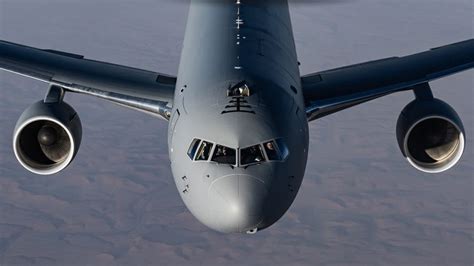
Following the boom detachment, the KC-46A circled south of the Chesapeake Bay, likely engaging in fuel dumping procedures to reduce landing weight and eliminate explosive risks. The aircraft then moved to a holding pattern near Greenville, North Carolina, before ultimately diverting to Seymour Johnson Air Force Base, where it made a safe and controlled landing. The aircraft will now undergo a full technical inspection and safety review, as confirmed by a statement from McConnell Air Force Base, where the tanker is based.
The official McConnell AFB statement read:
“On July 8, a McConnell-based KC-46A Pegasus operating over the eastern United States declared an in-flight emergency. The crew decided to land at Seymour Johnson Air Force Base, and a safe landing was achieved. A safety investigation has been launched.”
KC-46 Fleet Faces Persistent Technical Issues
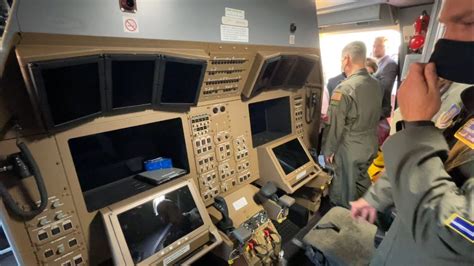
This incident has once again thrown a spotlight on the troubled operational record of the KC-46A Pegasus fleet. Since entering service, the aircraft has faced repeated issues, particularly related to its Remote Vision System (RVS) and fuel boom hardware reliability. The RVS, a critical system for allowing operators to guide the boom visually using a series of cameras and sensors, has experienced significant accuracy and distortion problems under certain lighting conditions.
These visual discrepancies compromise the operator’s ability to safely align the boom with the receiving aircraft, especially during maneuvers requiring high precision. As a result, misalignment, accidental strikes, and now detachment have plagued several operations. An RVS software and hardware overhaul — known as RVS 2.0 — was originally scheduled for 2025 but has since been delayed to mid-2027, further prolonging the operational limitations of the KC-46 fleet.
Previous Boom Failure Echoes Lingering Concerns
This is not the first time the KC-46A has suffered such a critical failure. In 2024, a similar detachment occurred during a mission to refuel an F-15E Strike Eagle off the coast of California. In that case, too, the boom separated from the aircraft mid-air, prompting an emergency landing and an inquiry by the Air Mobility Command (AMC). These repeated occurrences suggest underlying mechanical vulnerabilities that may not be fully addressed by software updates alone.
Moreover, the combination of hardware reliability concerns and inadequate visual systems places additional strain on boom operators, who must make real-time decisions under high-pressure conditions. Inaccuracies can lead to collisions with the receiving aircraft, damage to sensitive airframe components, and in extreme cases, loss of life or critical equipment.
Implications for US Air Force Aerial Refueling Strategy
The KC-46A is slated to replace the aging KC-135 Stratotanker, forming the backbone of the U.S. aerial refueling strategy for decades to come. With over 179 units planned for procurement, the reliability of the Pegasus platform is of paramount importance. Yet, ongoing incidents — especially high-profile failures like boom detachment — cast doubt on its readiness for full-scale global deployment.
This recent incident also has broader implications for joint operations, particularly with NATO allies, who often rely on interoperable tanker fleets during multinational missions. Any question about the safety or reliability of KC-46 systems could impact future coalition planning, airspace control agreements, and rapid deployment exercises.
Industry and Military Response Moving Forward
As the investigation unfolds, stakeholders from the Department of Defense, Boeing (KC-46’s manufacturer), and Air Mobility Command will undoubtedly collaborate to determine both the root cause and the technical remedies needed. A failure of this nature — involving a multi-million-dollar asset mid-mission — is not only operationally disruptive but politically significant, especially amid budget reviews for upcoming defense appropriations.
With the Pentagon’s ongoing push for modernization of airborne logistics, including the controversial decision to continue funding the KC-46 despite its flaws, pressure is mounting for the defense sector to deliver reliable aerial refueling capabilities without further delays or safety compromises.
Conclusion: A Tipping Point for the Pegasus Program?
The July 8 boom detachment is a stark reminder that despite advanced avionics, complex refueling architectures, and decades of aerial refueling experience, hardware integrity and visual guidance remain non-negotiable pillars of mission safety. As the KC-46 inches closer to becoming the U.S. military’s primary aerial refueling asset, these incidents threaten to undermine not only mission success but also the credibility of one of the most ambitious logistics platforms in modern U.S. military aviation.
Until comprehensive solutions — both software and structural — are implemented and tested across the fleet, the Pegasus program will continue to be monitored under a magnifying glass, both by internal stakeholders and global observers alike.