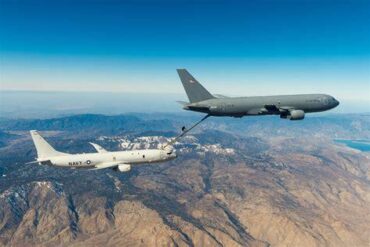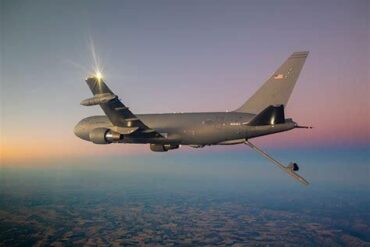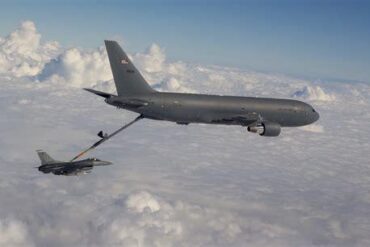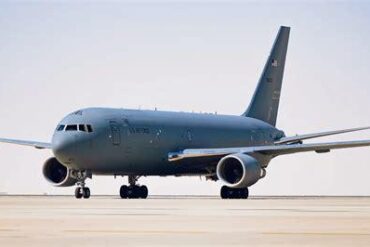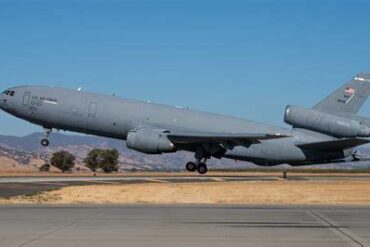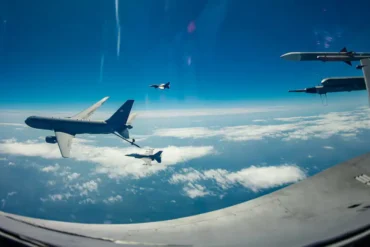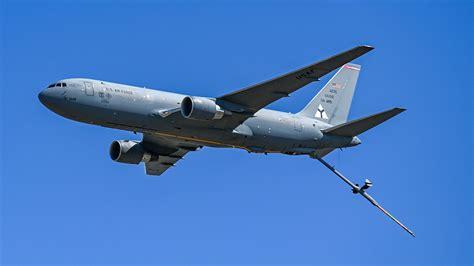
The KC-46A Pegasus was supposed to be one of the most important modernization programs in the history of the United States Air Force. Built to replace aging aerial refueling aircraft and secure American global reach for decades to come, the tanker was designed around a mission so fundamental that every major combat operation depends upon it: delivering fuel to aircraft in flight. Yet after more than a decade of development, billions of dollars in spending, and nearly one hundred aircraft delivered, the KC-46 remains burdened by a troubling reality. The tanker still struggles with the very capability it was built to provide.
The result is one of the most unusual procurement stories in modern military aviation. The Air Force has invested roughly $10 billion into fielding the aircraft, while Boeing has absorbed more than $7 billion in losses trying to fix persistent technical problems. Despite these extraordinary expenditures, the Pegasus continues operating under restrictions because unresolved deficiencies affect its aerial refueling system. Even more remarkably, the Air Force continues purchasing additional aircraft because its aging tanker fleet is running out of time.
The Critical Role Of Aerial Refueling In American Airpower
Modern military aviation is built around range and endurance. Fighters, bombers, surveillance platforms, transport aircraft, and command-and-control systems all depend on aerial refueling to remain effective across vast distances. Without tankers, many aircraft would struggle to reach operational areas, remain on station long enough to complete missions, or respond rapidly to emerging crises.
The United States has relied on aerial refueling for decades to maintain its global military presence. Whether supporting operations in the Middle East, deterring adversaries in the Indo-Pacific, or enabling strategic bomber patrols across multiple continents, tankers act as force multipliers that dramatically extend operational reach.
This dependence made the replacement of the aging KC-135 Stratotanker and KC-10 Extender fleets a national priority. Many KC-135s entered service during the 1950s, making them some of the oldest operational military aircraft still flying anywhere in the world. Their replacement was not simply desirable—it was becoming increasingly necessary.
The KC-46A Pegasus emerged as the chosen solution, promising a new generation of aerial refueling capability built upon the proven Boeing 767 airframe. Expectations were enormous. The aircraft would introduce modern avionics, enhanced survivability, improved cargo flexibility, and a revolutionary digital approach to refueling operations.
Unfortunately, that revolution would become the program’s biggest weakness.
The Ambitious Technology At The Center Of The Program
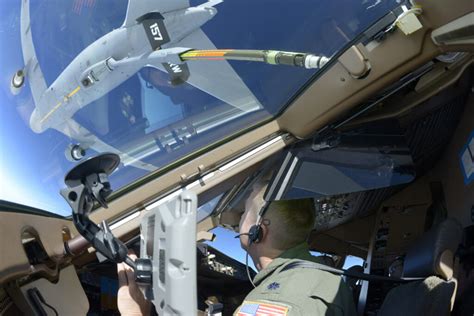
One of the defining innovations of the KC-46 was the decision to eliminate the traditional boom operator station found on earlier tankers.
Historically, boom operators physically positioned themselves in the rear of the aircraft and observed receiving aircraft directly through windows while controlling the refueling boom. The arrangement had worked effectively for generations, but Boeing and Air Force planners envisioned something more advanced.
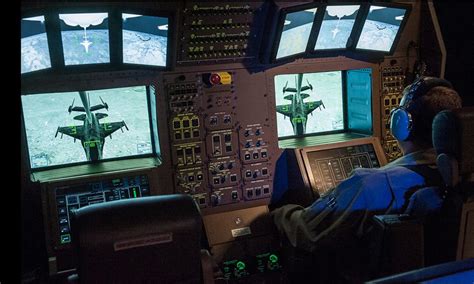
Instead of looking through windows, KC-46 boom operators would use a sophisticated Remote Vision System, commonly known as RVS. Multiple cameras and sensors mounted around the aircraft would transmit high-definition imagery to operators seated near the cockpit. From this position, operators could guide the refueling boom using digital displays and remote controls.
The concept offered several advantages on paper. Crew fatigue could potentially be reduced. Situational awareness could improve through enhanced sensor integration. The digital architecture appeared capable of delivering more precise control while modernizing a process that had changed little over decades.
What looked revolutionary during development would become one of the most expensive technological miscalculations in recent military aviation.
How The Remote Vision System Became A Major Failure
Almost immediately after operational testing began, serious problems emerged.
The Remote Vision System struggled under real-world lighting conditions. Shadows, glare, reflections, cloud cover, and changing sun angles frequently degraded image quality. Operators reported difficulty accurately judging distance between the boom and receiving aircraft, creating challenges during one of the most delicate phases of aerial refueling.
Depth perception became a recurring concern. Even slight inaccuracies can create substantial risks when a large refueling boom is maneuvered toward another aircraft traveling hundreds of miles per hour. Under ideal conditions, boom operators require precise visual information to maintain safe contact. The KC-46’s vision system often failed to provide that reliability.
Reports indicated that operators experienced eye strain, headaches, and fatigue after prolonged use. More importantly, Air Force officials became concerned that visual distortions could increase the risk of accidental contact with receiver aircraft.
These concerns eventually escalated to the point where the Air Force classified the issue as a Category 1 deficiency. Such a designation is reserved for problems that could potentially result in severe injury, loss of life, or significant damage to critical equipment.
For a tanker whose primary purpose is aerial refueling, this represented a devastating setback.
A Decade Of Development Problems
The origins of the Remote Vision System issues can be traced back to early design decisions made during the program’s development phase.
Engineers attempted to push the KC-46 toward a highly digital operating environment, but testing revealed that laboratory assumptions did not always translate into operational reality. Lighting conditions encountered during actual missions proved far more complex than expected.
The difficulties were not minor software glitches that could be solved through routine updates. Instead, they reflected deeper challenges involving camera placement, sensor performance, image processing, and human visual perception.
As testing expanded, the scale of the problem became increasingly clear. The original vision system could not consistently meet operational requirements across the full range of environments expected during global military operations.
The longer the issues persisted, the more the program became defined by efforts to correct them.
While the aircraft itself demonstrated many positive attributes, public discussion increasingly focused on a single uncomfortable question: how could a tanker struggle with aerial refueling?
RVS 2.0: The Expensive Attempt To Fix The Problem
Recognizing the seriousness of the issue, Boeing launched a comprehensive redesign effort known as Remote Vision System 2.0.
The upgraded architecture promised significant improvements. Engineers incorporated six advanced cameras, upgraded sensors, and a sophisticated full-color 3D 4K display intended to restore accurate depth perception. The redesign sought to eliminate the image distortions that had plagued the original system while providing operators with a clearer and more realistic view of refueling operations.
Initially, expectations were optimistic.
The upgraded system was presented as the solution that would finally unlock the tanker’s full capabilities and remove long-standing operational restrictions. Confidence was high that the redesigned architecture would address the deficiencies that had overshadowed the program.
Yet the replacement effort soon developed its own reputation for delays.
Target dates repeatedly slipped. Initial expectations that the new system would arrive relatively quickly gave way to a series of schedule revisions. What was once expected years earlier has gradually moved farther into the future, extending the period during which the Air Force must operate aircraft that still carry known limitations.
Each delay reinforces concerns that the underlying challenges may be more difficult than originally anticipated.
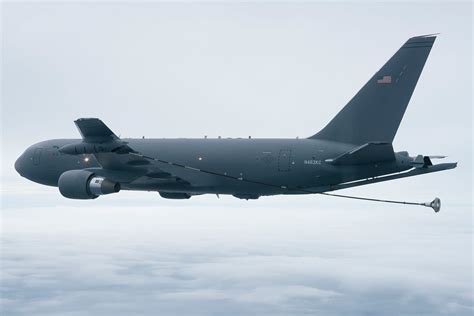
Operational Restrictions Continue To Affect The Fleet
Despite ongoing improvements, the KC-46 has not yet achieved the level of unrestricted operational capability originally envisioned.
Testing and evaluation reports continue highlighting shortcomings that affect readiness calculations and mission planning. Availability rates have often fallen short of targets, while certain operational limitations remain in place.
One particularly important distinction involves mission-capable status. An aircraft may technically be considered available for service while still carrying restrictions that limit specific refueling scenarios. This creates a more complicated picture than raw readiness statistics alone might suggest.
Compatibility challenges have also persisted.
The KC-46 has experienced difficulties supporting certain aircraft types, including long-standing issues involving refueling operations with the A-10 Thunderbolt II. Other aircraft integrations continue requiring additional testing and validation before full operational compatibility can be confirmed.
These challenges do not render the tanker unusable. The fleet conducts missions and provides valuable capability every day. However, they demonstrate that the aircraft remains short of the seamless operational flexibility envisioned when the program began.
The Financial Toll On Boeing
While defense procurement programs frequently experience cost growth, the KC-46 stands apart because of its contractual structure.
Unlike many government programs where taxpayers absorb substantial portions of overruns, the KC-46 operates under a fixed-price arrangement. This means Boeing bears much of the financial burden associated with development setbacks, redesign efforts, and technical corrections.
The consequences have been staggering.
Over time, Boeing has accumulated more than $7 billion in charges related to the tanker program. Additional losses have continued appearing as delays and redesign work extended beyond original expectations.
What was intended to showcase advanced engineering and efficient procurement instead became one of the most financially painful defense contracts in the company’s history.
The situation illustrates the risks associated with highly ambitious military modernization programs. Even when an aircraft eventually enters service, unresolved technical challenges can continue generating costs long after production begins.
For Boeing, the KC-46 has become a reminder that winning a contract and successfully executing it are often very different challenges.
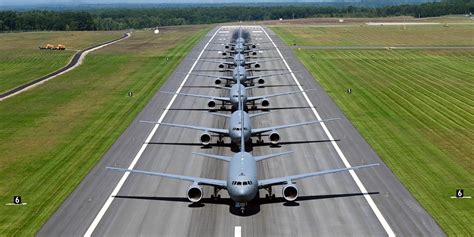
Why The Air Force Keeps Buying More KC-46 Tankers
Given the aircraft’s ongoing issues, an obvious question emerges: why does the Air Force continue purchasing additional KC-46s?
The answer lies in the condition of the aircraft the Pegasus is replacing.
Many KC-135 Stratotankers have been flying for generations. Although remarkably durable, these aircraft face growing maintenance demands, structural aging, and increasing sustainment costs. Keeping them operational becomes more difficult and expensive with every passing year.
The Air Force therefore confronts a difficult reality.
Waiting indefinitely for a perfect solution is not an option. The service requires replacement tankers now, not decades from now. Even with its deficiencies, the KC-46 offers significant advantages in cargo capacity, communications, defensive systems, and future growth potential compared with aircraft designed during the Eisenhower era.
In many respects, the Air Force has concluded that a partially restricted replacement remains preferable to relying indefinitely on increasingly elderly tankers.
This logic explains why procurement continues despite unresolved deficiencies. New contracts have added more aircraft to the fleet, and long-term planning assumes continued production well into the coming decade.
The strategy effectively represents a bet that remaining technical problems will eventually be solved while fleet modernization proceeds simultaneously.
The Procurement Paradox Defining The Pegasus Program
The KC-46 program now embodies a unique contradiction within modern defense acquisition.
The aircraft remains essential to the future of American aerial refueling. At the same time, it continues carrying limitations associated with the very mission that justified its existence. The Air Force cannot fully abandon the program because no realistic alternative exists. Boeing cannot easily walk away because production commitments continue and contractual obligations remain in force.
As a result, both organizations find themselves deeply invested in achieving a successful outcome.
The Pegasus has already become a significant component of America’s tanker fleet, and its importance will only increase as older aircraft retire. Future operations across Europe, the Pacific, and other strategic regions will depend heavily on its performance.
The ultimate success or failure of the program may therefore depend on whether the long-awaited Remote Vision System redesign finally delivers the capability promised more than a decade ago.
Until then, the KC-46 remains one of the most expensive lessons in military procurement: a $10 billion tanker designed around aerial refueling that is still working to fully master its most important job.