The USS Abraham Lincoln (CVN-72) limped back into port in August 2026 coated in rust, and the sight unsettled observers who expected a capital ship to look immaculate. Saltwater is relentless and highly corrosive, and rust is the ordinary byproduct of months at sea — but it also hides a more serious problem. Cracks can form beneath blistered paint and weathered steel, and the human eye cannot reliably find them before they compromise a hull. That gap between what sailors can see and what a ship actually needs is exactly where the Navy has now placed a $300 million bet.
The Gecko Robotics Contract and the Numbers Behind It
In October 2026, the US Navy signed a $300 million contract with Gecko Robotics to deploy the company’s artificial intelligence robots across its fleet, hunting for structural defects that traditional inspections miss. According to Gecko Robotics’ own release, the technology “can save the U.S. Navy up to $8 million in repair costs per ship and return vessels to sea quicker by identifying structural issues up to 50 times faster than traditional methods — reducing inspections from months to days.” Those figures matter because ship repairs never stop; they are a permanent drain on budgets and, more critically, on readiness. A vessel tied to a pier waiting for an inspection team is a vessel that cannot answer a deployment order.
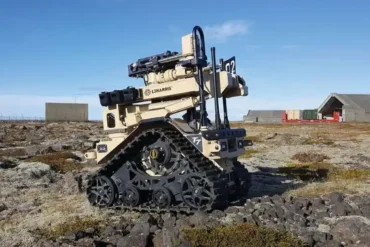
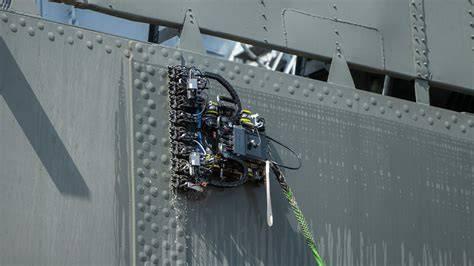
The robots are not merely flying drones, though Gecko builds those too. These machines climb the vertical steel of a ship’s hull, pressing sensors against painted plating and harvesting data at a density no scaffolding crew could match. The company’s Komodo system pushes the concept further, scanning deck coatings and hull plates without gouging into them at all.
How Komodo Scans Steel Through Paint and Rust
For decades, technicians have done rough justice to hulls: scraping paint from scattered sample spots and extrapolating from a handful of patches. Komodo eliminates the guesswork by reading the entire plate. Its sensors work through paint, through rust, and along frames and seams, building a full picture of a ship’s condition while it sits in drydock.
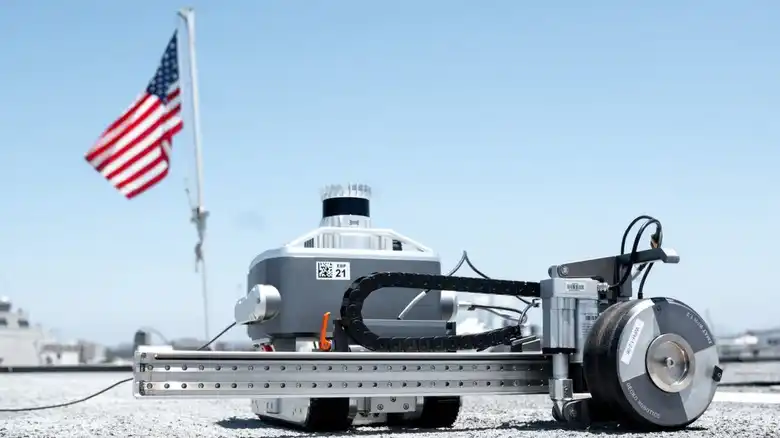
The core instrument is the EMAT, or Electromagnetic Acoustic Transducer, which launches ultrasonic waves electromagnetically through a ship’s steel. EMAT penetrates layers of coating and corrosion and reads through as much as 150mm of metal plating, exposing defects the naked eye would never register. Equally valuable, Komodo reaches void spaces and cramped compartments where sailors cannot work comfortably, and every scan becomes a permanent record attached to that hull — a running inspection history that informs future repairs instead of vanishing into a binder.
Axolotl and the Push Below the Waterline
Komodo is currently confined to ships in drydock, which limits its reach to vessels already pulled from service. Gecko Robotics is developing a successor tool called Axolotl designed to operate beneath the waterline, which would allow full inspections without hauling a ship into a dry dock or an Auxiliary Floating Dry Dock Medium (AFDM). That capability would compress the maintenance cycle itself, letting hulls be assessed where they float rather than after weeks of repositioning and setup.
Why Wall-Crawling Inspections Change Navy Readiness
The strategic value lies in tempo. Rust on the Abraham Lincoln is normal; undetected cracking beneath it is not. By shrinking inspections from months to days and catching structural issues at their earliest stage, Gecko’s wall-climbing machines convert a reactive repair pipeline into a predictive one — fewer emergency welds, shorter drydock stays, and more ships at sea when the fleet is called.