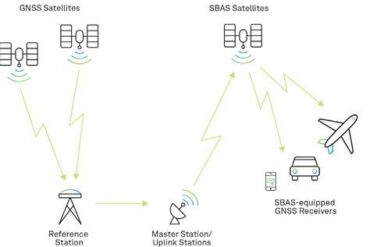
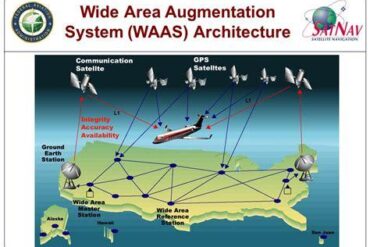
A Ground Based Augmentation System, or GBAS, is designed to enhance the accuracy and reliability of Global Navigation Satellite System (GNSS) data. It achieves this by providing differential corrections and integrity monitoring. To do this, GBAS uses signals from three or four GNSS satellites, which are received at three or four different antennas. The system processes these signals and generates a differential correction message.
This correction message is then transmitted every half second using a VHF frequency broadcast, covering an area of about 23 nautical miles around the airport. GBAS primarily supports GNSS-based precision approaches, offering more design flexibility than traditional Instrument Landing Systems (ILS). While its main purpose is to ensure signal integrity, GBAS also boosts positioning accuracy, typically achieving errors of less than one meter both horizontally and vertically.
One GBAS Ground Station at an airport can assist multiple aircraft as they approach and land on various runways, as well as manage departures and surface movements for all GBAS-equipped planes. This application is specifically known as the GBAS Landing System or GLS. Currently, Category I GLS approaches using GPS have received regulatory approval, and similar approvals for Categories II and III are expected soon. It’s worth noting that the FAA initially called GBAS the Local Area Augmentation System (LAAS).