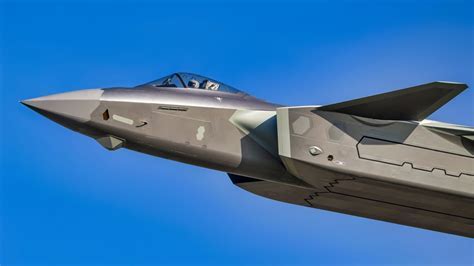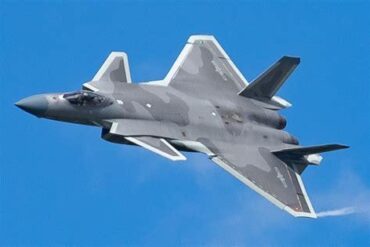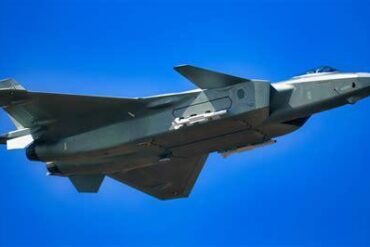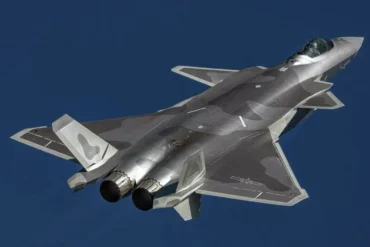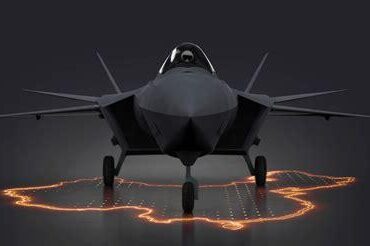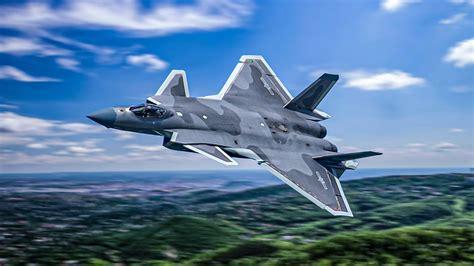
In the unforgiving theater of modern aerial warfare, visibility has become a liability. The days when air power meant raw thrust and brute speed are over. Now, the silent predator rules the skies — a role increasingly fulfilled by China’s Chengdu J-20 Mighty Dragon, a fifth-generation stealth fighter that has forced a global rethinking of air dominance. Its ability to slip past radar undetected, strike from a distance, and operate deep into contested airspace has earned it the moniker: the ‘Invisible Hawk’.
The J-20’s Origins: From Underdog to Predator
China’s journey to fielding its own stealth fighter began from a place of clear disadvantage. In the 1990s, its air force relied heavily on Soviet-era Sukhoi Su-27s and license-built variants. Indigenous projects lagged behind global standards. But with the launch of Project 718, everything changed. It was China’s gamble to leapfrog into the stealth age — one that paid off. The prototype J-20 first flew in January 2011, coinciding with a visit from then-U.S. Defense Secretary Robert Gates — a calculated geopolitical message.
Built by Chengdu Aerospace Corporation, the J-20’s initial design drew immediate comparisons to the American F-22 Raptor and Russia’s MIG 1.44, but analysts quickly noticed distinctly Chinese elements: forward canards, blended wing body, and a twin-engine configuration concealed within an angular fuselage designed for radar evasion.
Breaking the Radar: Engineering the Invisible
At the heart of the J-20’s combat edge lies its stealth architecture. Every inch of its airframe is optimized to minimize radar cross-section:
- Angular design to deflect radar waves
- Radar-absorbent materials (RAM) coating critical surfaces
- Internal weapons bays to avoid external signature clutter
- Infrared and electronic signature suppression mechanisms
Together, these features enable the aircraft to function as a ghost in the sky — an opponent undetected until it’s too late. The nose-mounted Active Electronically Scanned Array (AESA) radar, coupled with infrared search and track (IRST), lets the J-20 silently track targets without revealing its own position.
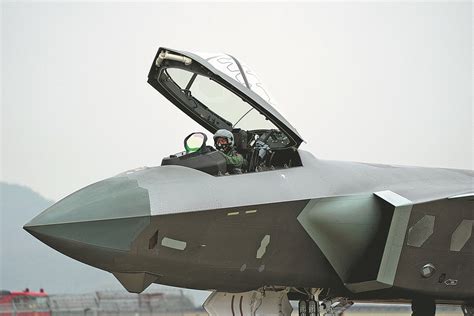
Strike Without Warning: Firepower from the Shadows
Stealth alone doesn’t win dogfights or determine air superiority. The J-20’s lethality stems from its ability to pair invisibility with devastating reach. Its primary weapon is the PL-15 long-range air-to-air missile, featuring an active radar seeker and a range estimated to exceed 200 kilometers.
This kind of engagement range fundamentally alters the rules of air combat. Where once victory depended on close-quarters maneuvering, now it hinges on Beyond Visual Range (BVR) strikes. The J-20’s weapons system allows it to destroy adversaries before they are even aware they are being targeted.
Supercruise and the Powerplant Evolution
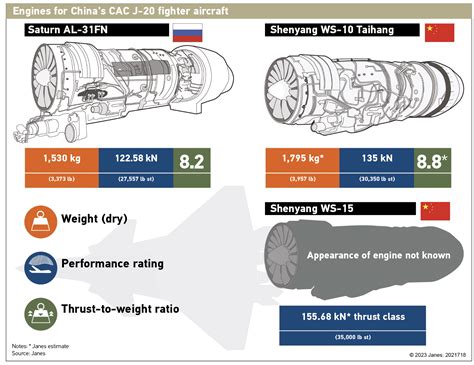
Initially reliant on Russian AL-31F engines, the J-20’s Achilles heel was its lack of supercruise capability — sustained supersonic flight without afterburners. But recent developments suggest that China’s indigenous WS-15 engines are entering final testing, unlocking new operational advantages:
- Supercruise performance enhances fuel efficiency and surprise attack capability
- Higher thrust-to-weight ratio for better agility and altitude control
- Reduced heat signature from advanced exhaust cooling
With these engines, the J-20 evolves from a regional threat to a truly strategic weapon capable of high-speed penetration and persistent loitering over high-value zones.
Dominating Asia-Pacific Skies: Strategic Utility
The Asia-Pacific region has become the most hotly contested airspace on Earth. From the Taiwan Strait to the South China Sea, nations are rapidly arming and modernizing. In this volatile climate, the J-20’s long range and high-altitude operating profile grant China overwhelming air denial capabilities.
With increasing numbers — estimated to exceed 150 operational units by 2023 — the J-20 forms the tip of China’s spear for enforcing anti-access/area denial (A2/AD) strategies. From patrolling maritime chokepoints to shadowing adversary aircraft near disputed islands, it operates as an unseen guardian of Beijing’s regional ambitions.
Beyond the Jet: Digital War Ecosystem
Unlike legacy air dominance models that center around a single aircraft, China is building a distributed, AI-assisted war network. The J-20 is a core node in a broader digital kill chain:
- KJ-500 AWACS aircraft extend situational awareness
- GJ-11 Sharp Sword stealth drones conduct reconnaissance and high-risk strike missions
- Data-link systems allow for real-time tactical coordination
- Loyal wingman programs enable semi-autonomous drone swarms
This system-wide integration gives China a combat multiplier, allowing fewer J-20s to deliver greater battlefield impact. In recent patrols over the East China Sea, J-20s remained invisible to radar and only revealed their presence when intercepting adversary aircraft — a powerful psychological tactic that reinforced the message: “We’re here. You just didn’t see us coming.”
J-20 vs. F-22 & F-35: Clash of the Titans
For years, the F-22 Raptor was unmatched in the skies. Then came the F-35 Lightning II, built for multirole versatility and global interoperability. But both were designed in an era when it was assumed China would struggle for decades to field a comparable stealth platform.
That assumption has collapsed.
While the F-22 maintains an edge in close-range dogfighting and super maneuverability, the J-20 appears to outmatch the F-35 in both range and missile loadout. Its twin engines and larger airframe provide superior loiter time and payload capacity. In an age where long-range engagement is paramount, the J-20 is increasingly seen as a true peer adversary.
Evolution in Real Time: Future-Proofing the Dragon
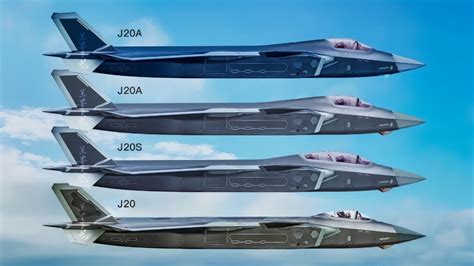
The J-20 is not a finished product. It is a continuously evolving platform. Satellite and runway images have revealed multiple experimental variants:
- Two-seat J-20s believed to be optimized for electronic warfare and drone command
- Navalized prototypes hinting at future carrier-based stealth fighters
- Advanced electronic suites testing cognitive AI and autonomous systems
China’s air doctrine sees the J-20 not just as a fighter, but as a multi-role ecosystem leader. Aerial warfare is moving toward man-machine collaboration, and the J-20 is being positioned at the forefront of this transformation.
The Psychological Warfare of Stealth
Perhaps the most chilling aspect of the J-20’s operational role is its psychological effect. Knowing that an undetectable aircraft may be circling overhead at any time creates uncertainty in the minds of enemy commanders. In high-stakes standoff zones, the J-20 becomes not just a machine of war, but a tool of strategic intimidation.
By integrating patrols in contested areas like Taiwan’s ADIZ or near disputed islets, the J-20 exerts pressure without firing a shot. Its very existence deters escalation while simultaneously projecting dominance. In this sense, it is the ultimate shadow warrior, exerting influence through absence as much as presence.
Conclusion: The Age of the Invisible Hawk
The J-20 Mighty Dragon represents a tectonic shift in global air power dynamics. From humble beginnings, China has engineered a stealth fighter that not only flies — it commands. Its stealth profile, range, missile capacity, and integration with AI-based support systems make it a uniquely potent adversary.
More than a jet, it is a statement: China will not fight on yesterday’s terms. With the J-20 at the center of a growing digital combat web, the skies above Asia — and perhaps beyond — are being silently, invisibly, and unrelentingly transformed.