When people picture the F/A-18 Hornet, fuel is rarely the first thing that comes to mind. Speed, noise, and high-G turns steal the spotlight, while endurance quietly dictates everything behind the scenes. Yet fuel is the invisible metronome of naval aviation. Every launch from a carrier deck, every combat air patrol, and every strike mission is choreographed around how long a Hornet can stay airborne before gravity, physics, and empty tanks demand a landing.
Understanding how many hours an F-18 can fly on internal fuel alone reveals far more than a simple number. It exposes design philosophy, operational limits, and the reason the aircraft evolved from the original Hornet into the much larger Super Hornet. Internal fuel endurance shapes how the U.S. Navy plans missions across oceans where land is optional and tankers are precious.
This is not a marketing number pulled from a brochure. It is a practical, pilot-relevant reality grounded in fuel flow, altitude, payload, and the unglamorous discipline of engine management. The answer changes depending on the variant, the mission profile, and how aggressively the aircraft is flown. What follows is a detailed, grounded explanation of how long the F/A-18 family can really fly on internal fuel, and why that endurance matters far beyond the cockpit.
Internal Fuel Explained: What “Internal Only” Actually Means
Before talking about hours, it helps to clarify what internal fuel actually refers to in a fighter jet. Internal fuel is the aviation kerosene stored inside the aircraft’s wings and fuselage tanks. It is fuel that is always present at takeoff, regardless of mission, and it defines the jet’s baseline endurance.
Internal fuel excludes:
- External drop tanks
- Aerial refueling from tankers
- Emergency or contingency fuel planning
This distinction matters because internal fuel is the only endurance figure guaranteed on every sortie. Everything else is optional, situational, and sometimes unavailable.
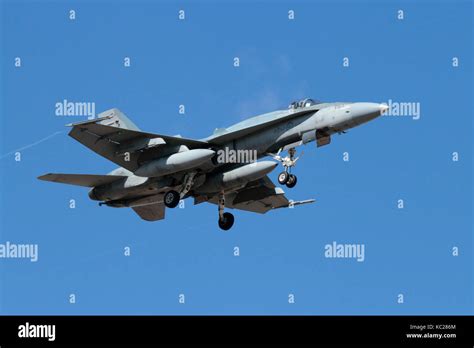
For the legacy F/A-18A, B, C, and D Hornet, internal fuel capacity sits at approximately 10,860 pounds, equivalent to about 1,629 gallons. By modern fighter standards, this is relatively modest. The Hornet was designed in the 1970s with a focus on agility, carrier suitability, and multirole flexibility rather than long-range endurance.
The later F/A-18E and F Super Hornet dramatically changed that equation. The airframe grew substantially, and internal fuel capacity increased by roughly 33 percent, rising to approximately 14,400–14,700 pounds depending on configuration. This single design decision reshaped how long the aircraft could remain airborne without external help.
Fuel, in other words, became strategy.
Legacy F/A-18 Hornet: Realistic Internal Fuel Endurance
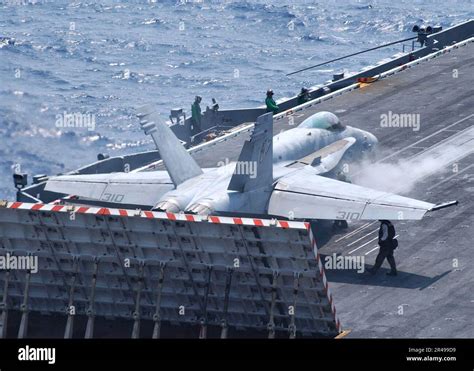
The original Hornet was never meant to loiter endlessly. It was built to launch, fight, return, and trap on a carrier deck with precision and reliability. When flown on internal fuel only, without afterburner and without external tanks, its endurance is best measured in hours, not minutes, but it is also firmly bounded.
Under typical cruise conditions, the legacy F/A-18 Hornet can remain airborne for approximately 1.5 to 2.2 hours on internal fuel alone. This range reflects realistic operational flying rather than idealized maximum efficiency profiles.
Combat radius figures help translate this endurance into distance. Official performance data places the Hornet’s air-to-air combat radius at roughly 400–460 nautical miles, accounting for a return to the carrier with reserve fuel intact. That radius aligns well with a two-hour class sortie when cruise, climb, descent, and recovery are factored in.
Aggressive maneuvering changes everything. High-G turns, repeated throttle changes, and afterburner usage dramatically increase fuel flow. A Hornet flown hard can burn through its internal fuel shockingly fast, which is why pilots plan conservatively and treat fuel state as a continuously managed resource rather than a static number.
In contrast, when flown efficiently at altitude, avoiding afterburner and maintaining steady cruise power, the Hornet can stretch its endurance toward the upper end of that range. Ferry-style profiles demonstrate that the aircraft can cover close to 1,000 miles on internal fuel alone when handled gently, reinforcing the idea that endurance is as much about discipline as design.
Why Fighters Don’t Chase Airline-Style Efficiency
Comparing a fighter jet’s endurance to a commercial airliner misses the point entirely. Fighters are not optimized for maximum miles per gallon. They are optimized for responsiveness, survivability, and power on demand.
The F/A-18’s engines are designed to deliver rapid thrust changes, tolerate carrier landings, and survive battle damage. That design philosophy trades fuel efficiency for reliability and performance. Even at cruise, the engines operate far from the sweet spots that define airline efficiency.
Additionally, fighters carry external stores that disrupt airflow. Missiles, pylons, targeting pods, and sensors all increase drag. Even when flying on internal fuel only, the aircraft rarely flies “clean” in operational settings.
The result is predictable: endurance is limited by intent, not by engineering oversight. The Hornet burns fuel because it is expected to fight, not commute.
External Fuel Tanks: Stretching Time Aloft Without Refueling
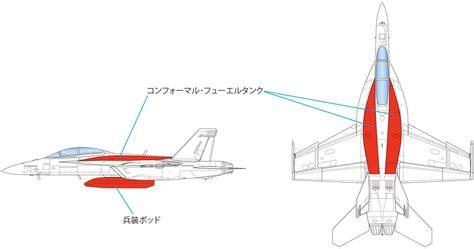
Although the focus here is internal fuel, understanding endurance without acknowledging external tanks would be incomplete. External fuel tanks fundamentally alter how long an F/A-18 can stay airborne, even though they are not part of the internal fuel equation.
Legacy Hornets commonly carry 330-gallon drop tanks on wing and centerline stations. When installed, these tanks add thousands of pounds of fuel and can increase total onboard fuel by well over a third.
With external tanks fitted, Hornet sorties routinely exceed three hours under efficient cruise profiles. Ferry missions can stretch even further, approaching 1,200 to 1,800 miles depending on configuration and routing.
The trade-off is drag and payload. External tanks reduce available weapon stations and slightly degrade performance. For high-threat missions, commanders often prefer aerial refueling over tanks, preserving weapons capacity while still extending endurance.
Fuel, in naval aviation, is always a balancing act.
The Super Hornet: Internal Fuel as a Design Revolution
The F/A-18E and F Super Hornet represents more than an incremental upgrade. It is a philosophical shift driven largely by fuel and range limitations exposed during real-world operations.
The Super Hornet’s enlarged airframe allowed engineers to embed significantly more internal fuel without sacrificing carrier compatibility. That increase alone transformed endurance.
On internal fuel only, the Super Hornet typically achieves 2.5 to 3 hours of flight time under comparable cruise conditions to the legacy Hornet. This is not a marginal improvement. It is a meaningful extension that changes how the aircraft is used.
Longer internal endurance allows:
- Greater patrol persistence
- More flexibility in recovery timing
- Reduced dependence on tankers for routine missions
- Safer margins during bad weather or deck delays
In vast operational theaters like the Pacific, this extra endurance is not a luxury. It is necessity.
EA-18G Growler: Endurance in the Electronic Battlespace
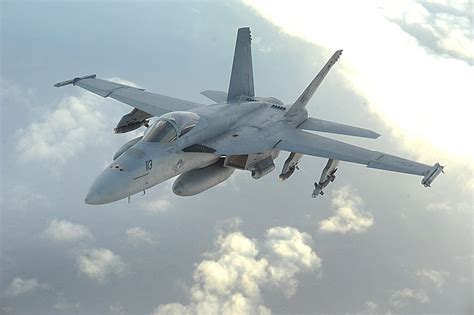
The EA-18G Growler, derived from the Super Hornet, shares much of its fuel and propulsion architecture. Despite carrying specialized electronic warfare equipment, the Growler retains nearly identical internal fuel capacity, approximately 13,900 to 14,000 pounds.
On internal fuel alone, Growlers can remain airborne for roughly 2.5 to 3 hours, similar to their strike-fighter counterparts. The difference lies not in raw endurance but in mission intent.
Growlers are designed to stay with the fight. Their role often involves maintaining electronic attack coverage over extended periods, escorting strike packages, or suppressing enemy air defenses. As a result, Growlers frequently refuel multiple times during a single sortie, transforming internal fuel endurance from a hard limit into a scheduling variable.
This illustrates an important truth: internal fuel defines the baseline, not the ceiling.
Mission Profile: The Invisible Variable That Changes Everything
No two F/A-18 flights burn fuel the same way. Mission profile determines endurance more than almost any other factor.
A high-altitude cruise at steady throttle sips fuel relative to:
- Low-altitude penetration flights
- Repeated vertical maneuvers
- Supersonic dashes
- Sustained high-G combat
Afterburner usage is the most dramatic variable. Engaging afterburner can increase fuel flow several times over normal military power. Minutes of afterburner can erase tens of minutes of endurance.
This is why endurance figures are always given as ranges rather than absolutes. A Hornet flown gently is a different aircraft than one flown aggressively, even though the fuel tanks are identical.
Aerial Refueling: Turning Hours Into Persistence
While internal fuel defines how long an F/A-18 can fly unassisted, aerial refueling defines how long it can remain relevant.
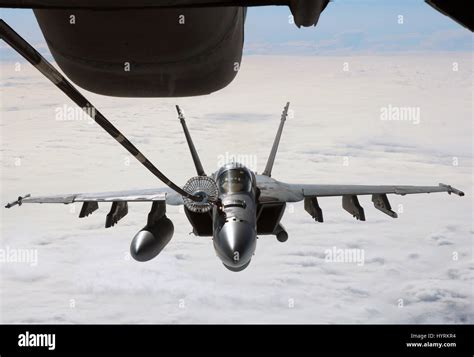
Both legacy and Super Hornets are fully capable of probe-and-drogue refueling. In carrier air wings, Super Hornets can even serve as buddy tankers, refueling other fighters using externally mounted refueling pods.
With refueling, sorties can extend far beyond four or five hours. The practical limit becomes pilot endurance rather than fuel capacity.
For Growlers, this capability is mission-critical. Sustained electronic warfare coverage depends on coordinated refueling cycles, allowing aircraft to rotate on station without leaving gaps in protection.
Fuel Endurance as a Window Into Naval Strategy
Asking how many hours an F-18 can fly on internal fuel is really a way of asking how naval aviation balances reach, flexibility, and risk.
The legacy Hornet reflects an era when carriers operated closer to shore and missions were shorter. Its internal endurance of roughly 1.5 to 2.2 hours fit that world.
The Super Hornet reflects a strategic shift toward longer distances and dispersed operations. Its 2.5 to 3 hours of internal endurance provides breathing room in an increasingly complex battlespace.
Neither design is flawed. Each is optimized for its moment in history.
The Bottom Line on F/A-18 Internal Fuel Endurance
Strip away the hype and the answer becomes clear.
On internal fuel only:
- Legacy F/A-18 Hornets typically fly 1.5 to 2.2 hours
- F/A-18E/F Super Hornets typically fly 2.5 to 3 hours
- EA-18G Growlers mirror Super Hornet endurance at 2.5 to 3 hours
Add external tanks, and endurance stretches past three hours. Add aerial refueling, and endurance becomes a matter of planning rather than limitation.
Fuel may be invisible, but it is the quiet architect of every F-18 mission ever flown.