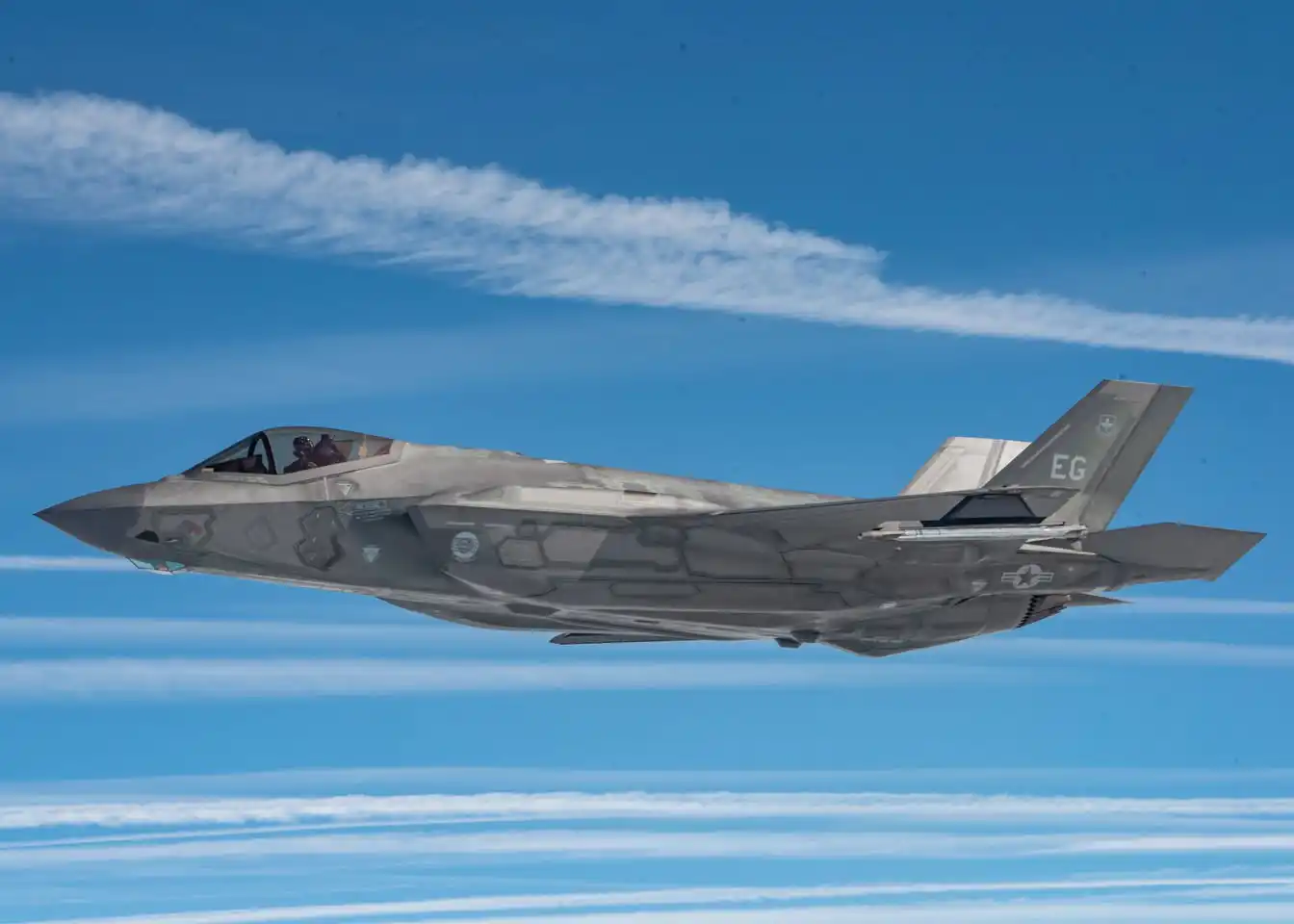
The F-35 Lightning II, developed by Lockheed Martin, represents a pinnacle of 5th-generation multirole fighter aircraft engineering. One of the most critical yet often underappreciated aspects of its design is its fuel capacity, which directly impacts operational range, stealth endurance, combat effectiveness, and strategic deployment. Understanding the fuel dynamics of the F-35 variants — F-35A, F-35B, and F-35C — requires a detailed look at internal fuel storage, external augmentation systems, real-world consumption metrics, and the trade-offs between range extension and stealth performance.
Internal Fuel Capacity Across Variants
F-35A: The Air Force Variant
The F-35A, designed for conventional takeoff and landing (CTOL), carries 8,278 kilograms (18,498 pounds) of fuel internally. This makes it a balanced platform between range and maneuverability, with a maximum unrefueled range of approximately 2,200 kilometers.
Such range grants the US Air Force strategic flexibility, enabling the F-35A to operate from forward bases without depending heavily on aerial refueling — a critical asset in contested airspaces. The internal-only configuration also preserves the jet’s low-observable (stealth) profile, which is foundational to its survivability and first-strike effectiveness.
F-35B: The Short Takeoff/Vertical Landing (STOVL) Variant
Engineered for the US Marine Corps and allied forces requiring amphibious deployment or operations from shorter runways, the F-35B sacrifices fuel capacity for vertical lift capability. It carries only 6,123 kilograms of internal fuel, equating to a maximum range of 1,667 kilometers and a combat radius of just 833 kilometers.
Despite this limitation, the F-35B fills a vital role in expeditionary strike groups, leveraging mobility over endurance. Its ability to take off from amphibious assault ships and austere runways necessitates design compromises — with fuel volume being a primary trade-off.
F-35C: The Carrier-Based Variant
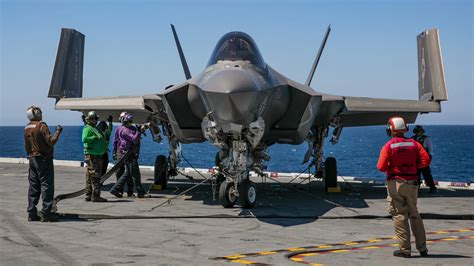
Designed for catapult launches and arrested recoveries aboard aircraft carriers, the F-35C carries the largest internal fuel load at 8,958 kilograms (19,750 pounds). This extended capacity results in a maximum range similar to the F-35A — about 2,200 kilometers, but with an expanded combat radius of 1,241 kilometers.
The additional fuel makes the F-35C ideal for long-duration naval strike missions, where carrier standoff distances and maritime patrols demand longer loiter times. Its wider wingspan and reinforced airframe allow for more substantial internal storage without compromising carrier compatibility.
Fuel Consumption and Operational Efficiency
Burn Rate and Tactical Metrics
All F-35 variants share a high-thrust single-engine design, resulting in relatively high fuel burn rates. On average, the F-35 consumes 1,340 gallons of fuel per hour, or roughly 5.06 metric tons. This equates to 2.37 gallons (8.9 kilograms) per mile flown under standard cruising conditions.
This consumption escalates dramatically during high-speed maneuvers, supersonic flight, or in afterburner mode, significantly reducing effective range and requiring precise mission planning or aerial refueling support.
Real-World Constraints on Range
While theoretical maximum ranges suggest robust endurance, actual mission parameters — such as weapon payloads, evasive flight paths, air combat engagements, and fuel reserves for emergencies — reduce operational range considerably.
For instance, an F-35A in a standard air superiority mission with internal ordnance, mid-altitude cruise, and minimal external drag might achieve 1,800–2,000 kilometers. However, factoring in combat air patrol (CAP) loiter, evasive flight envelopes, and return buffer, the effective combat radius may fall closer to 1,100 kilometers.
External Fuel Augmentation Options
Drop Tanks and Stealth Penalties
Despite the F-35’s internal fuel design favoring stealth, external fuel tanks have been developed to expand range for missions where low observability is not a priority. Each external drop tank carries 600 gallons (approximately 2,300 liters), and up to four can be mounted underwing.
With four tanks, the F-35C’s total fuel capacity can reach nearly 17,000 kilograms — including 8,000 kilograms externally and 9,000 kilograms internally. This configuration enables over 40% range extension, albeit with a notable radar cross-section (RCS) increase, negating many stealth benefits.
Such loadouts are typically employed in:
- Long-range ferry flights
- Humanitarian missions
- Deterrent patrols in permissive airspaces
“Beast Mode” Configurations
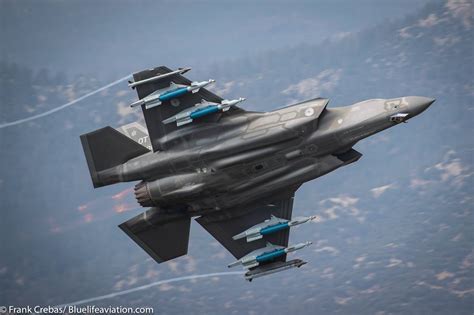
In non-stealth operations, the F-35 can also enter what’s referred to as “Beast Mode” — a loadout configuration maximizing weapon and fuel carriage. For the F-35A, this might include:
- 6 AIM-120 AMRAAMs
- 2 AIM-9X Sidewinders
- 2 external drop tanks
This setup not only boosts firepower but adds significant operational range, making the aircraft suitable for full-spectrum conflict environments where stealth is deprioritized in favor of air dominance and endurance.
Operational Challenges and Fuel Management Realities
Emergency Landings and Fuel Exhaustion
In March 2025, a Japan-based F-35C was forced to execute an emergency landing at Matsuyama Airport due to fuel exhaustion during an extended training sortie. Investigation revealed that unexpected rerouting, tactical deviation, and lack of aerial refueling coordination led to the near-catastrophic event.
This incident underscores the vital importance of precise mission fuel modeling and logistical synchronization for fifth-generation fighters. Even with high internal capacity, operational unpredictability can push aircraft to their limits — a reminder that strategic refueling remains a linchpin in extended deployments.
Maintenance Complexity and Operational Costs
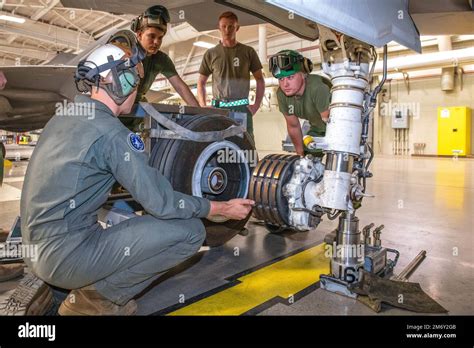
The F-35’s fuel system is deeply integrated with its stealth design, including fuel bladder lining materials compatible with radar-absorbent coatings. This complexity, while necessary for survivability, also contributes to longer maintenance cycles.
Each flight hour of the F-35 requires up to 34 hours of maintenance, with fuel system inspections, leakage checks, and coating compatibility assurance forming part of this intensive process. This increases operational costs, especially in forward-deployed or maritime environments where maintenance resources are constrained.
Strategic Balancing: Stealth vs. Range
The F-35’s fuel system reflects a carefully curated balance between:
- Stealth preservation via internal-only storage
- Extended range via external tanks and mission-specific trade-offs
- Mission adaptability across land-based, STOVL, and carrier roles
This design philosophy enables the F-35 to shape-shift between first-strike penetration missions, air superiority campaigns, and extended deterrence patrols, depending on operational priorities and regional threats.
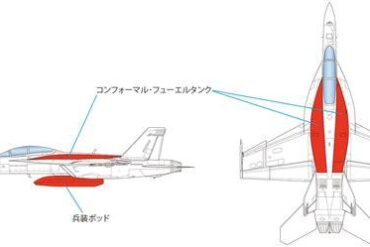
As adversaries enhance long-range sensor and anti-access capabilities, the F-35’s fuel strategy will continue evolving — potentially incorporating conformal tanks, refueling drones, or even hybrid propulsion modules in future block upgrades.
FAQ: Common Questions About F-35 Fuel Capacity
How far can the F-35 fly without refueling?
The F-35A and F-35C can fly up to 2,200 kilometers on internal fuel alone under optimal conditions. The F-35B, optimized for vertical takeoff and landing, reaches around 1,667 kilometers due to structural constraints and reduced internal tank volume.
Does carrying external fuel tanks affect stealth?
Yes. External fuel tanks significantly increase radar cross-section (RCS) and compromise the aircraft’s stealth profile. These tanks are typically used in non-combat roles, ferry flights, or in air superiority missions where stealth is not a primary requirement.
Can the F-35 be refueled mid-air?
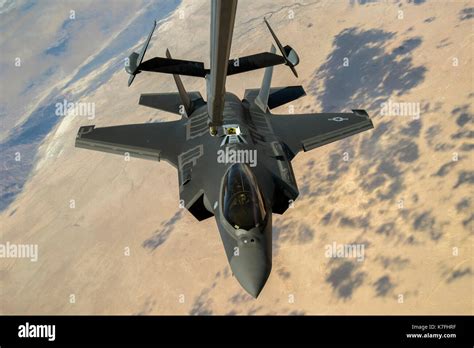
Absolutely. All F-35 variants are compatible with aerial refueling systems, allowing for extended mission duration and flexibility. The F-35A uses a boom refueling system, while the B and C variants rely on probe-and-drogue systems suitable for naval operations.
By harmonizing fuel efficiency, modular augmentation, and mission-specific design, the F-35 remains at the forefront of aerial warfare — not merely through stealth or speed, but through its ability to adapt and endure in a complex global theater.