When it comes to military engineering marvels, few vessels command more respect than the aircraft carrier. Towering above the waves with their vast flight decks and nuclear-powered propulsion systems, these floating cities represent the pinnacle of naval dominance. Among them, the U.S. Navy’s Gerald R. Ford-class carriers stand as the largest and most technologically advanced warships ever built. Yet, a question often asked by those fascinated by these giants remains: How long does it take an aircraft carrier to cross the Atlantic Ocean?
The answer reveals much about the immense power, speed, and logistical might required to operate such formidable vessels.
The Modern Titan: Gerald R. Ford-Class Aircraft Carriers
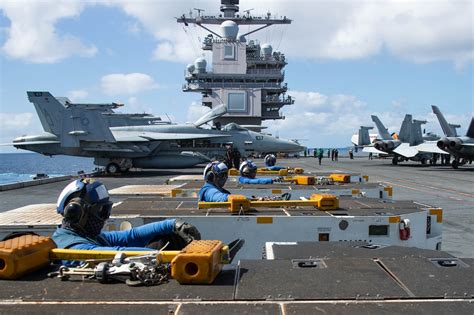
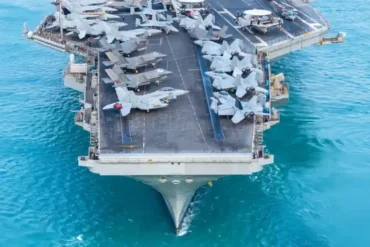
The Gerald R. Ford-class aircraft carriers symbolize the cutting edge of naval warfare. Designed to replace the aging Nimitz-class, these colossal ships stretch 1,092 feet in length, with a flight deck spanning 256 feet in width. Each ship displaces roughly 100,000 tons of seawater, making them floating fortresses capable of projecting American power across the globe.
Despite their massive size, these carriers move with impressive speed, thanks to their advanced Bechtel A1B nuclear reactors, each capable of generating around 700 megawatts thermal (MWt). Combined, these reactors provide more than triple the electrical output of previous-generation carriers, ensuring both propulsion and onboard systems operate at peak efficiency.
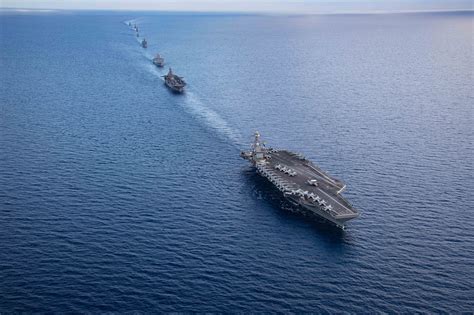
Crossing the Atlantic: Speed Versus Strategy
In raw numbers, the USS Gerald R. Ford (CVN 78), the lead ship of its class, boasts a maximum flank speed of approximately 34.5 miles per hour (mph). However, in practice, carriers typically sail at a cruising speed near 23 mph, balancing efficiency, maintenance needs, and operational readiness.
To put this into perspective, the shortest transatlantic route—approximately 3,400 miles between North America and Europe—can be traversed by the Ford-class carrier in about:
- Just over six days (147.8 hours) at cruising speed (23 mph)
- Roughly four days (98.5 hours) at maximum speed (34.5 mph)
While the Ford-class carrier can push to higher speeds, doing so continuously adds significant stress to its propulsion systems, reducing long-term efficiency and increasing maintenance demands. Thus, the U.S. Navy typically opts for a steady cruising pace unless circumstances demand urgency.
Historic Crossings: From World War II to Today
Modern Atlantic crossings by aircraft carriers trace their roots back to World War II. The iconic Essex-class carriers, like the USS Intrepid, served as the backbone of the U.S. Navy’s carrier fleet during the conflict. These ships achieved a maximum speed of 37.4 mph, slightly outpacing even today’s Ford-class vessels in theoretical top-end velocity.
Yet operational realities meant Essex-class carriers usually cruised at a more modest 17.2 mph, resulting in an Atlantic crossing time of approximately:
- Just under four days (90.9 hours) at top speed (37.4 mph)
- A little over eight days (197.6 hours) at cruising speed (17.2 mph)
In comparison, today’s nuclear carriers not only maintain higher average cruising speeds but also sustain operations without the need for traditional refueling stops—a significant strategic advantage.
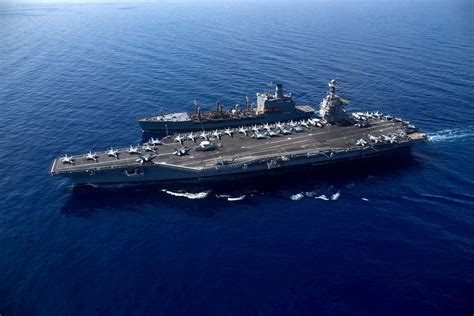
Real-World Deployments and Crossing Durations
The USS Gerald R. Ford‘s maiden Atlantic crossing occurred in 2022, departing from Halifax, Canada, and retracing historic naval routes forged during the Second World War. This inaugural voyage showcased not only the ship’s advanced capabilities but also its role in modern power projection.
Since entering active service, the USS Gerald R. Ford has made multiple Atlantic crossings, including its notable deployment in October 2023, when the carrier sailed to the Eastern Mediterranean amid escalating tensions during the Israel-Hamas conflict. Such operations highlight the strategic flexibility of these vessels, capable of reaching distant theaters within days, ready for combat or humanitarian missions.
Depending on mission profiles, these crossings may vary in duration. Factors influencing the total time include:
- Departure and destination ports, which affect total mileage
- Operational tasks during transit (training exercises, refueling of escorts, etc.)
- Navigational considerations, including weather conditions and sea state
- Security protocols and formation requirements with accompanying naval vessels
Nevertheless, in optimal conditions and along standard transatlantic routes, a six-day crossing remains the benchmark for modern carriers traveling at cruising speed.
Engineering Feat: Nuclear Power Driving Uninterrupted Voyages
The linchpin of rapid Atlantic crossings lies in nuclear propulsion. With two A1B nuclear reactors, Ford-class carriers eliminate the need for traditional fuel stops, allowing weeks or months of continuous operations. These reactors also generate abundant electrical power, essential for running catapults, radar systems, and advanced defensive technologies.
Notably, the A1B reactors provide:
- 700 MWt per reactor, significantly increasing total shipboard energy output
- Simplified design with fewer moving parts, enhancing reliability
- Extended operational range without requiring refueling for over 20 years
This engineering mastery grants U.S. carriers unparalleled endurance and reach, enabling rapid deployment across vast oceans like the Atlantic with fewer logistical constraints.

Beyond Speed: Operational Realities of Carrier Crossings
While pure speed fascinates the public, naval strategists understand that carrier crossings involve more than maximum velocity. Carrier strike groups, which include destroyers, cruisers, and submarines, accompany the carrier to provide layered defense. These supporting vessels often dictate overall transit speed, emphasizing formation integrity over raw speed.
Moreover, crossings serve as critical opportunities for:
- Crew training in navigation, flight operations, and emergency drills
- Aircraft maintenance and readiness checks
- Interoperability exercises with allied navies during multi-national operations
Thus, while the Ford-class carrier can dash across the Atlantic in approximately four days, operational priorities frequently extend voyages to around six to eight days, aligning with strategic and training requirements.
The Broader Picture: Naval Mobility in the 21st Century
Atlantic crossings remain central to U.S. naval strategy. With tensions simmering globally—from the Baltic Sea to the Eastern Mediterranean—aircraft carriers act as floating diplomatic symbols and, when necessary, instruments of military force.
Their ability to traverse vast ocean expanses rapidly ensures that American interests remain protected, allies reassured, and adversaries deterred. The combination of nuclear propulsion, advanced engineering, and unmatched mobility solidifies aircraft carriers’ status as irreplaceable components of modern naval power.
As history has shown, from World War II to today’s dynamic geopolitical landscape, the time it takes an aircraft carrier to cross the Atlantic speaks volumes about technological progress, strategic foresight, and the enduring importance of naval supremacy.