Sweden’s Archer self-propelled howitzers have emerged as a pivotal asset on Ukraine’s ever-evolving battlefield, transforming the tempo and survivability of its counter-battery operations. Far from a token gesture, the deployment of Archer units reflects a deliberate alignment with Ukraine’s battlefield reality—an environment where seconds define survival and where artillery duels are dictated not just by firepower, but by agility, precision, and the ability to disappear before return fire lands.
By January 2026, 26 Archer units out of a total pledged 44 had been delivered to Ukraine, as confirmed by Sweden’s Ministry of Defence. This move, coupled with additional support in the form of replacement barrels to offset wear from high-intensity firing, signals a long-term operational commitment. It also confirms a clear shift in how Ukraine conceptualizes artillery: less as blunt-force siege weapons, and more as scalpel-like precision tools used in fast raids that neutralize threats and vanish before becoming targets themselves.
A Revolutionary System Tailored for Rapid Strike Missions
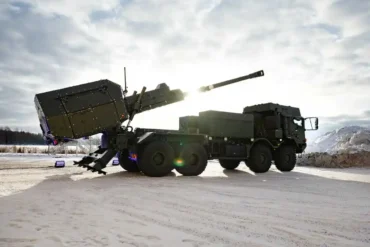
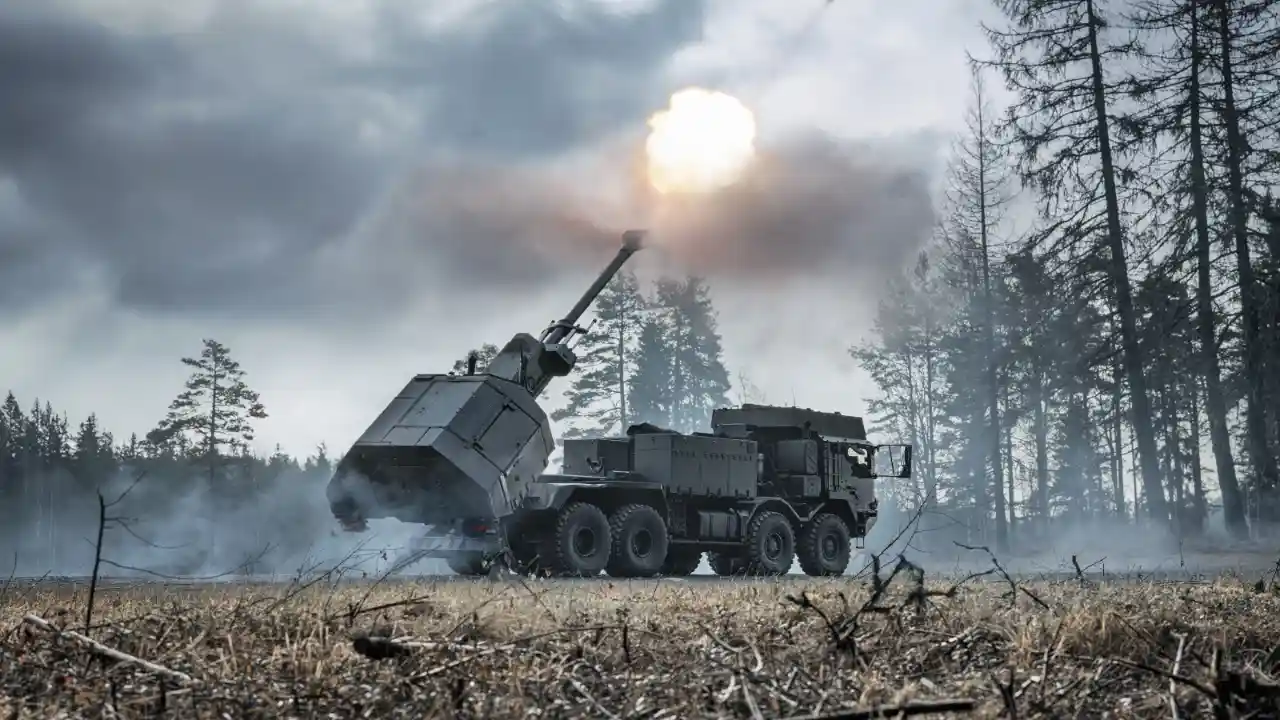
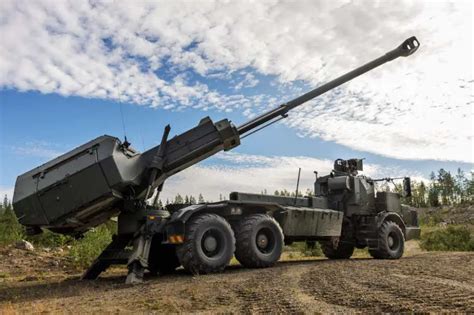
The Archer system, developed by Sweden and based on the 155 mm FH 77 BW L52 gun, is unique in its category. Mounted on a 6×6 articulated all-terrain vehicle, it’s not just mobile—it’s mobile with a purpose. Every design feature converges toward the goal of shoot-and-scoot effectiveness:
- A fully automated turret allows the gun to be operated from a protected, armored cabin.
- The crew never needs to leave the safety of their vehicle during firing.
- Archer can deliver a three-round burst in 20 seconds, or unload all 21 rounds in its internal magazine in about 3.5 minutes.
- It uses NATO-standard 155 mm munitions, including high-explosive rounds with a 40 km range, BONUS anti-armor munitions up to 35 km, and Excalibur precision rounds reaching 50 km.
Crucially, Archer’s entire fire cycle—into action and out again—takes just 20 seconds each. That rapid tempo minimizes exposure and greatly reduces the chance of being tracked and targeted by Russian drones or counter-battery radar.
Combat-Proven in a Drone-Dominated Warzone
Ukrainian artillery operations have had to evolve rapidly under constant drone surveillance. Russian reconnaissance UAVs and loitering munitions have made traditional artillery tactics—longer firing sessions from semi-fixed positions—untenable. Here, Archer’s value becomes unmistakable.
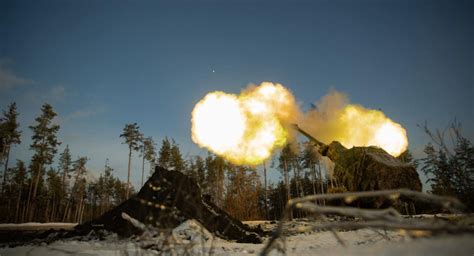
In March 2024, a dramatic example illustrated this point. The 45th Artillery Brigade used drone reconnaissance to pinpoint Russian 152 mm D-20 guns near Kreminna. An Archer unit was dispatched to conduct a precision counter-battery strike. The howitzer fired swiftly, destroying three Russian artillery pieces, then repositioned before enemy drones could coordinate a strike.
This “raid, fire, vanish” approach is the only viable path in a theater saturated with FPV drone teams and loitering munitions. Archer’s speed and automation allow Ukrainian gunners to strike surgically and leave no signature behind, preventing the Russian military from leveraging its extensive drone and artillery network for retaliation.
Automation and Protection: Key to Sustained Operations
Unlike older Soviet artillery systems or even some NATO contemporaries, Archer doesn’t require crews to manually load shells or set fuzes at the gun line. Instead, automation takes over most of the physical labor, reducing the fatigue burden on crews already stretched thin across multiple fronts. This not only boosts efficiency but enhances survivability. Less time outside equals less time vulnerable.
Furthermore, Ukraine’s artillery units rotate personnel frequently to avoid burnout. Archer’s semi-autonomous design makes it easier to train new crews and maintain consistency in high-stress environments.
Yet, Archer is not without its constraints. Its 21-round magazine requires discipline in targeting and resupply. Unlike systems with larger storage, Archer must be integrated into a well-oiled logistics chain. Sweden’s provision of spare barrels and maintenance support in mid-2025 was thus not a bureaucratic footnote—it was a strategic enabler.
Niche Superiority: How Archer Fits into Ukraine’s Artillery Ecosystem
Ukraine fields a diverse array of 155 mm artillery systems, including the CAESAR, PzH 2000, and Krab. Each has distinct strengths:
- CAESAR offers excellent mobility, particularly on roads, but lacks the deep automation of Archer.
- PzH 2000 and Krab bring robust armor and larger ammo loads, but their tracked platforms are more maintenance-intensive and less agile in quick-strike roles.
Archer fills a critical niche. It is not built for long fire missions or siege warfare. Instead, it’s a counter-battery assassin—swift, efficient, and hard to pin down. Comparable systems like Zuzana 2 or ATMOS also emphasize mobility, but few match Archer’s integration of speed, protection, and automation.
This niche is especially relevant in Ukraine’s current strategic doctrine, which emphasizes attrition through smart targeting, rather than simply matching the Russian military gun-for-gun.
Timeline of Delivery and Escalating Impact
Sweden’s commitment to deliver Archer units to Ukraine began in January 2023, with the first eight systems arriving following crew training in Sweden by November 2023. These initial units served both as a battlefield test and training model.
Momentum accelerated in March 2025, with approval for 18 additional units and counter-battery radars, deepening Sweden’s strategic bet on Ukraine’s artillery capabilities. A third tranche was announced in September 2025, bringing the total to 44 units. By January 8, 2026, 26 Archers were already in Ukrainian hands.
This deliberate delivery schedule mirrors battlefield realities: as Ukraine’s need for highly responsive artillery platforms grows, Sweden’s incremental contributions offer both material and psychological reinforcement.
Strategic Implications for NATO and Beyond
The Archer deployment also offers broader insights for NATO observers. It signals that future artillery effectiveness may depend more on fire cycle speed, automation, and protection than on raw shell count or armor. In an age of instant battlefield transparency—where drones provide targeting data in seconds—systems like Archer are not luxury options. They are foundational tools for survival and tactical success.
Moreover, Archer’s battlefield utility offers Sweden a way to assert itself militarily and politically within the Western coalition supporting Ukraine. It is a show of not just solidarity, but technological maturity—a demonstration that smart engineering can define battlefield outcomes.
Conclusion: A Model for the Future of Artillery Warfare
Ukraine’s use of Sweden’s Archer howitzers has proven transformative. On a battlefield where exposure equals death, and where speed equals survival, Archer allows Ukrainian crews to outmaneuver their adversaries in both time and space. With its automated firing, protected mobility, and blistering deployment tempo, Archer has redefined how Ukraine conducts counter-battery missions.
It’s not just a gun. It’s a mobile ambush system—one that changes the rhythm of the war, turning defense into preemptive strike and forcing the enemy to think twice before firing. As more systems arrive, and as logistics chains deepen, Archer will likely become an even more integral part of Ukraine’s counter-artillery doctrine.
And for military planners across NATO and beyond, the message is clear: the future of artillery lies not just in range or caliber—but in automation, survivability, and speed.