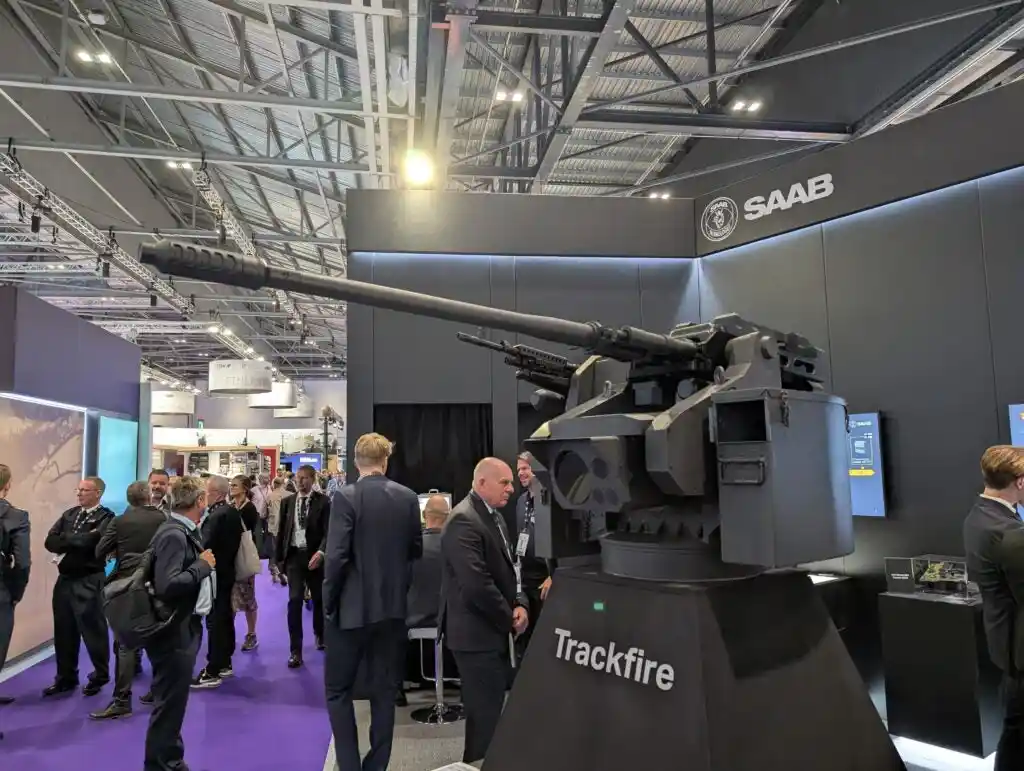
Sweden has taken a decisive step in modernizing its defense capabilities with a $160 million contract awarded to Saab for the procurement of Trackfire ARES 30 mm Remote Weapon Stations (RWS). The move, announced on January 9, 2026, reflects Stockholm’s commitment to bolstering both its army and amphibious forces against the rising threat of unmanned aerial systems (UAS), especially in the wake of NATO integration and intensified regional threats.
Strategic Context: Replacing Donated Inventory and Adapting for NATO
The order, placed by Sweden’s Defence Materiel Administration (FMV), serves a dual purpose: replacing remote weapon stations donated to Ukraine and strengthening domestic self-defense capabilities. As part of its Amphibious Battalion 2030 program, Sweden aims to develop highly mobile, tech-integrated units suited for Baltic littoral environments, aligning with NATO’s evolving force posture. With first deliveries expected within 15 months, the system will equip new combat boats and vehicles alike.
This procurement marks not a revolution but an evolution—an upgrade of Sweden’s existing Trackfire-equipped platforms to meet higher-end counter-drone and precision engagement demands. The need for adaptable, multi-domain defense tools has grown since Russia’s 2022 invasion of Ukraine, and Sweden’s accession to NATO in March 2024 only intensified the imperative to modernize.
Trackfire ARES: Purpose-Built for Counter-UAS Warfare
The new ARES configuration is built around the M230LF 30×113 mm chain gun, selected specifically for its suitability in counter-drone roles. Unlike traditional heavier-caliber weapons, the ARES variant emphasizes high hit probability and ammunition efficiency. The M230LF offers a rate of fire of 200 rounds per minute and an effective range of up to 2,000 meters, enabling it to engage small UAS before they can pose serious danger.
Saab integrates this weapon with proximity-fuzed ammunition, designed to detonate near drones and neutralize them with fewer rounds. The system thus balances cost-effectiveness with lethality, a crucial metric for modern layered defense architectures. According to Northrop Grumman, the gun manufacturer, this configuration mirrors the one used by the U.S. Army in their own XM914 short-range air defense platforms.
Advanced Sensor Suite and Stabilized Targeting
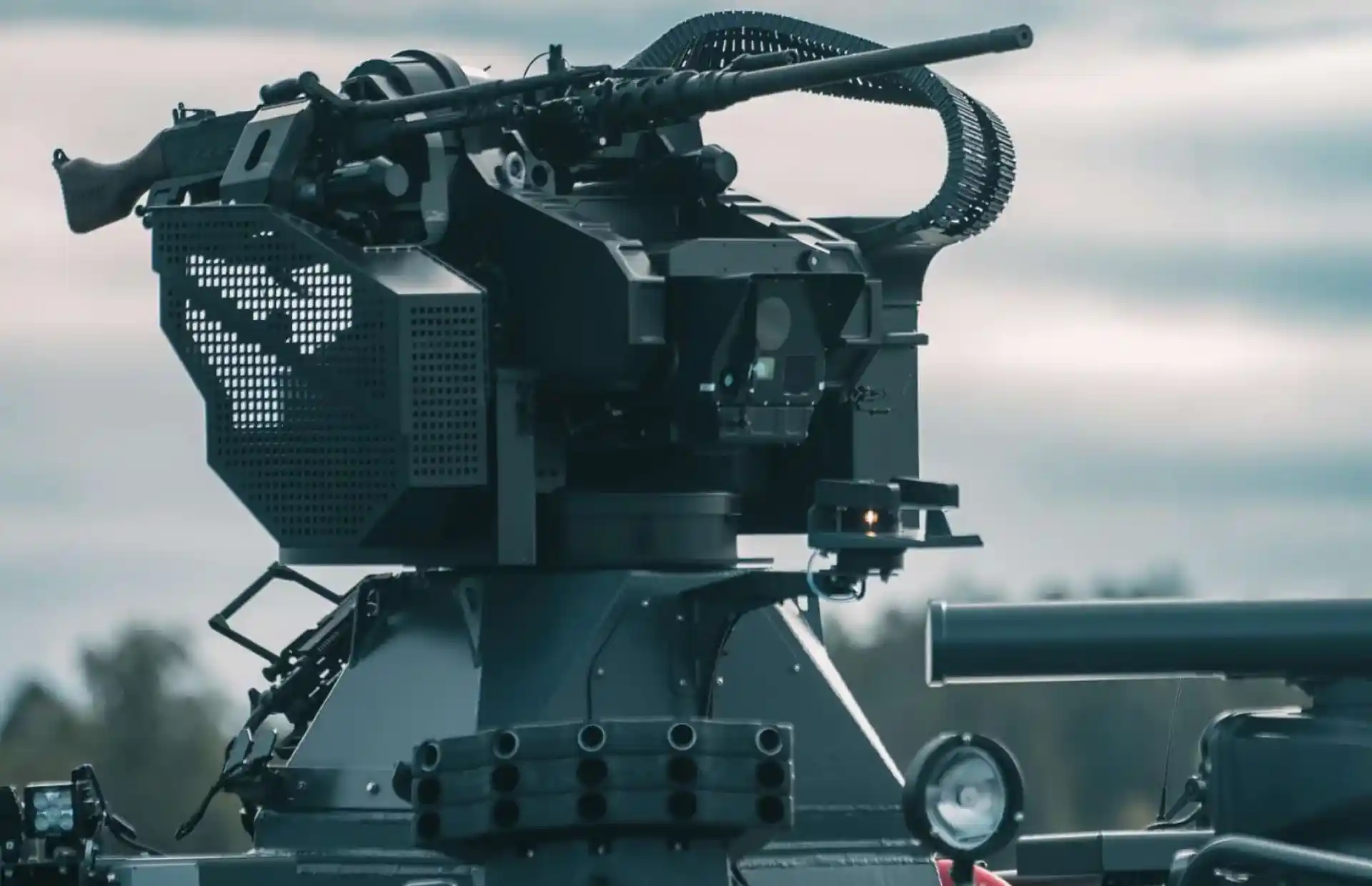
What sets Trackfire ARES apart is its sophisticated sensor and fire-control integration, enabling operation in complex, high-motion environments. The station employs a Stabilised Independent Line of Sight (SILOS) architecture, allowing the sensors to remain locked on target independent of weapon recoil or platform movement. This design ensures high-precision tracking and engagement, even aboard fast-moving craft or rugged terrain vehicles.
Key sensor features include:
- Cooled medium-wave thermal imager (3.6–4.2 µm)
- Day camera with zoom capabilities
- Eye-safe 1.55 µm laser rangefinder with detection range beyond 6 km
- 360° rotation and -20° to +55° elevation
- Slew rates up to 120°/s, vital for intercepting fast threats like drones or small boats
These capabilities allow for round-the-clock surveillance and engagement, whether in daylight, low visibility, or during adverse weather conditions. The director unit weighs around 280 kg (excluding weapons)—a manageable load for Sweden’s compact combat platforms, like the Stridsbåt 90HSM.
Platform Integration: Land and Sea Applications
The Trackfire ARES system is designed for cross-platform integration, allowing the same turret to be mounted on naval craft and ground vehicles. FMV has confirmed that the order will equip both new combat boats and land-based systems, including the TGB15 vehicles used by the Swedish Army.
This dual-domain approach is particularly relevant to Sweden’s distributed defense doctrine, which prioritizes survivable nodes across the Baltic archipelago and inland logistics corridors. Protecting airfields, coastal bases, and command outposts from loitering munitions and reconnaissance drones is now essential.
Trackfire’s modular architecture enables integration with battle management systems, supporting sensor fusion and networked targeting. Dual-operator setups allow rapid sensor-to-shooter workflows, reducing lag between threat detection and engagement. Such features are increasingly vital in the modern multi-domain battlespace, where threats evolve in real-time and across platforms.
Amphibious Battalion 2030: Tactical and Strategic Alignment
Sweden’s Amphibious Battalion 2030 program underscores a broader shift in how Stockholm views its role within NATO. These units are designed to operate in coastal choke points, archipelagos, and contested littorals, and require platforms capable of defending against manned and unmanned threats with minimal crew exposure.
Trackfire allows operators to engage targets from protected compartments, preserving survivability while maintaining full situational awareness. Saab highlights its capability to distribute imagery and sensor data throughout a platform, enabling coordinated targeting and shared awareness within a team or flotilla.
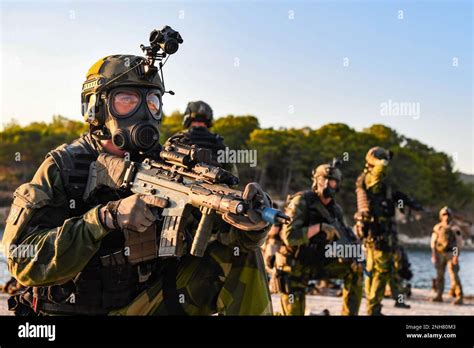
Earlier installations of Trackfire on the Stridsbåt 90HSM already delivered strong performance with 12.7 mm and 7.62 mm weapons. The addition of the 30 mm ARES configuration, however, brings a hard-kill counter-drone capability to the same platforms, providing a step-change in defensive power.
The Air-Land Nexus: NATO Interoperability and Drone Defense
Saab’s operational data points to the “Loke” counter-drone concept, tested during Sweden’s NATO deployments in Poland (2025). These trials combined Giraffe 1X radars, Trackfire turrets, and electronic warfare assets to form a complete counter-UAS defense package, guarding critical NATO infrastructure. This model is likely to influence doctrinal adoption within the alliance, especially as nations seek scalable and affordable responses to drone saturation.
FMV has emphasized that the contract includes operator training, system integration support, and continued product development—pointing to an evolving role for Trackfire within Sweden’s layered air defense network. As the first deliveries roll out between 2026 and 2028, expect Trackfire to be increasingly embedded in both homeland and expeditionary security frameworks.
Sweden’s Posture in a Shifting Baltic Landscape
Sweden’s decision to standardize the Trackfire ARES across multiple domains reflects a broader recognition: the traditional distinction between frontlines and rear areas has evaporated. The ability to field a low-cost, high-efficiency kill chain for small drones and fast boats is no longer optional—it is a core requirement for survival in contested environments.
By investing in an export-independent, modular, and network-capable system, Sweden is reinforcing the vulnerabilities most exposed by modern hybrid warfare—logistics hubs, command posts, and coastal bases. The integration of proximity-fuzed 30 mm firepower with high-acceleration slewing and remote operation offers a tactical edge against swarming drone attacks and ambush-style incursions.
Conclusion: A Cost-Effective Shield for a Modern Warfighting Landscape
Saab’s Trackfire ARES represents more than a weapons contract—it is a technological bridge connecting Sweden’s legacy capabilities to its future as a frontline NATO state. By restoring and expanding its RWS inventory, Stockholm is buying time, resilience, and control over its most critical defense seams.
In the era of drones, loitering munitions, and contested logistics, Sweden has made a smart, scalable choice. Trackfire’s modularity, accuracy, and network integration make it not just a turret, but a node in a resilient defense network—capable of fighting back the moment danger emerges, and long enough for reinforcements to arrive.