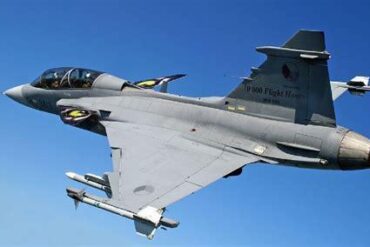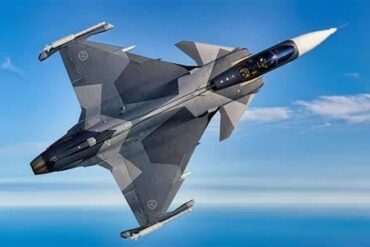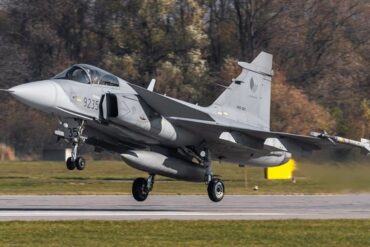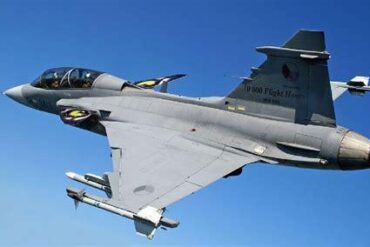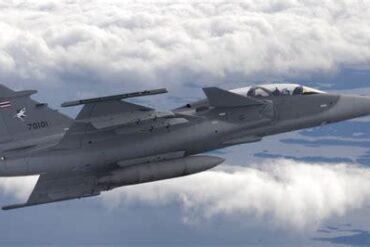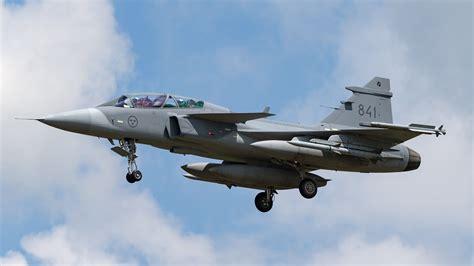
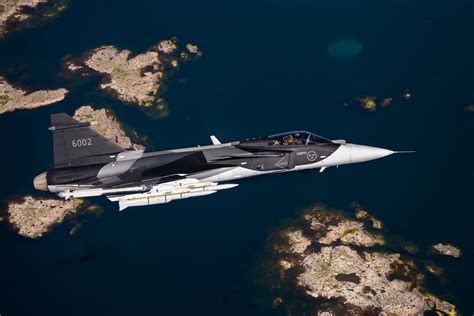
The Saab JAS 39 Gripen is the embodiment of Scandinavian engineering philosophy—compact, capable, and tailored for independence. Developed by Saab AB, this delta-wing, canard-equipped multirole fighter is designed not only for frontline combat but for sustained deployment from remote or improvised bases. With over 271 units delivered, it is a testament to Sweden’s ambition to remain militarily self-sufficient while exporting cutting-edge aerospace technology globally.
The Gripen is often overlooked in global discourse dominated by heavier and costlier jets, but its operational footprint, design philosophy, and tactical flexibility make it a serious contender in modern air warfare.
Origins and Development of the Gripen Program
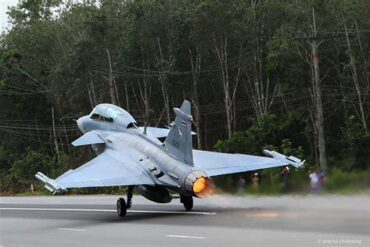
In the late 1970s, Sweden initiated the JAS program—an ambitious project to consolidate the roles of fighter (Jakt), attack (Attack), and reconnaissance (Spaning) aircraft into a single airframe. It was meant to replace aging Saab Draken and Viggen fleets with a Mach 2 platform that could deploy from 800-meter runways, including stretches of Swedish highways.
Sweden evaluated international offerings like the F-16, F/A-18, Northrop F-20, and Dassault Mirage 2000. However, Saab’s indigenous proposal under “Project 2105/2108/2110” won favor for its cost-efficiency and operational fit. In 1980, the IG JAS consortium was created, uniting Saab, Ericsson, Volvo Flygmotor, and FFV Aerotech. The development contract signed in 1982 included five prototypes and 30 production units.
The Gripen’s first flight took place in December 1988, but development faced setbacks. A 1989 crash exposed issues with the fly-by-wire system’s control laws, prompting software overhauls. A 1993 stall incident reinforced the need for flight envelope protections and aerodynamic refinements. These failures, however, became critical learning points that strengthened the aircraft’s design foundation.
Manufacturing Evolution and Export-Oriented Upgrades
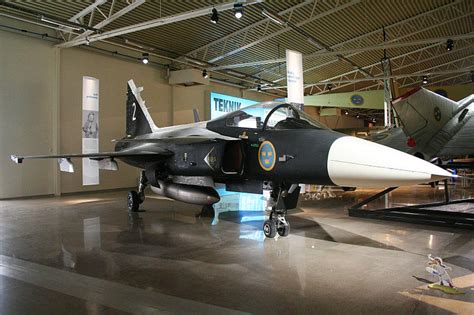
The production trajectory of the Gripen is marked by incremental capability enhancements. Batch I (delivered 1993–1996) operated under a fixed-price contract and included JAS 39A single-seat variants. Batch II added 14 two-seat B variants for pilot training, with improved software and minor avionics refinements.
The transformative leap occurred with Batch III (2002–2008), which introduced the JAS 39C/D. This block came equipped with:
- NATO interoperability protocols
- Air-to-air refueling capability
- On-board oxygen generation systems (OBOGS)
- Enhanced mission computers and secure communications
These features positioned the Gripen for the export market. Early buyers included Hungary, Czech Republic, South Africa, and Thailand. Notably, the program was marred by bribery allegations in the 2000s, which were later closed in 2009 without formal charges.
Gripen E/F: The True Next-Generation Fighter
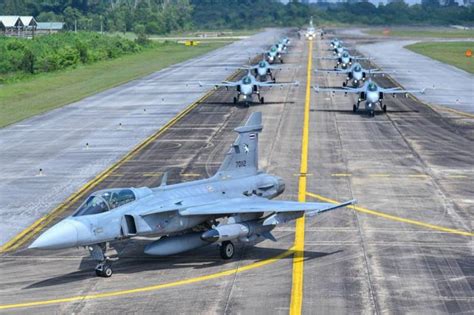
In response to evolving threat environments and export competition, Saab launched the Gripen E/F program. This next-gen variant integrates significant aerodynamic, structural, and sensor improvements. The Gripen E (single-seat) and Gripen F (twin-seat) models were designed with:
- A more powerful General Electric F414G engine, offering 20% thrust increase over the RM12
- 40% greater internal fuel capacity, extending range to over 1,500 km
- Raven ES-05 AESA radar for enhanced tracking and ECCM performance
- Skyward-G IRST for passive detection of stealth targets
- Ten hardpoints, increasing weapons versatility
The first Gripen E was rolled out in May 2016, and by 2019, both Sweden and Brazil had accepted units into service. Brazil has since committed to 36 Gripen E/Fs, with local assembly under Embraer’s partnership.
Design Philosophy and Tactical Systems Integration
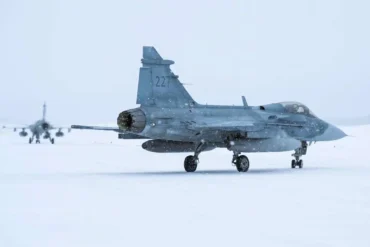
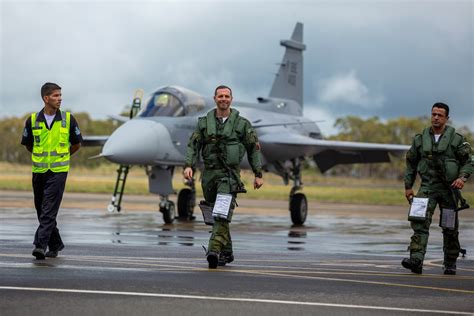
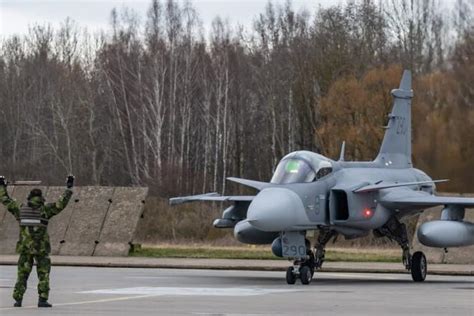
The Gripen’s delta-canard layout, combined with its relaxed static stability and quadruplex fly-by-wire system, grants extraordinary maneuverability. This configuration allows for short-field operations, including 10-minute dispersal takeoffs from snow-covered rural roads.
The aircraft’s PS-05/A radar, a derivative of the British Blue Vixen, offers multi-mode capabilities while supporting future sensor fusion upgrades. Onboard avionics use the Ada programming language, which enables high-reliability code for mission-critical systems. Gripens share mission data via a secure, fast data-link system, ensuring real-time coordination among platforms and ground stations.
Cockpit Environment and Modular Weapons Systems
Gripen pilots operate through an ergonomically designed cockpit, featuring:
- Hands-on-throttle-and-stick (HOTAS) configuration
- Three full-color multifunction displays
- A wide-angle head-up display (HUD)
- Optional helmet-mounted displays (HMD) for off-boresight missile targeting
The aircraft is armed with a 27mm Mauser BK-27 cannon and supports a vast weapons suite:
- Air-to-air: AIM-120 AMRAAM, Meteor BVRAAM, IRIS-T
- Air-to-surface: AGM-65 Maverick, RBS-15 anti-ship missile
- Precision pods: LITENING III targeting, reconnaissance, and ECM pods
- Electronic warfare: BriteCloud expendable active decoys
Operational Cost and Turnaround Efficiency
One of Gripen’s strongest competitive advantages is its extremely low cost per flight hour (CPFH). With operational costs around US$4,700/hour, it undercuts competitors like the F-16, Eurofighter Typhoon, and Rafale by a substantial margin.
Key to this efficiency is its modular design philosophy:
- The RM12 engine can be changed in under 60 minutes by six technicians
- Maintenance crews require minimal ground equipment
- Built-in Health and Usage Monitoring Systems (HUMS) predict component failures
The aircraft can be refueled, rearmed, and relaunched in under 20 minutes from unpaved roads—one of its most strategic features in dispersed warfare doctrine.
Operational Legacy and Combat Contributions
Sweden’s Air Force has fielded 204 Gripens across three batches, all delivered under budget and on schedule. The platform has taken part in international exercises like Red Flag, NATO Tiger Meets, and joint patrols over the Baltic and Arctic regions.
In 2011, Swedish Gripens supported UN operations in Libya, conducting reconnaissance missions that informed allied air strikes. Despite their limited combat engagement, the aircraft demonstrated excellent availability and ISR contributions. By 2027, Sweden aims to deploy 60–80 Gripen E/Fs while keeping some C/D models operational beyond 2025.
Global Strategic Outlook and Competitive Position
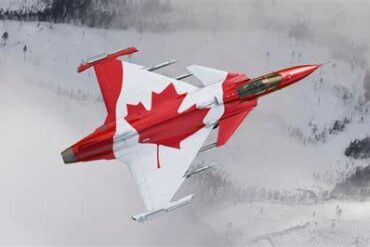
The Gripen continues to pursue market share in a landscape dominated by the F-35 Lightning II, but its pitch remains compelling for countries seeking NATO compatibility, low cost, and ease of operation. Saab has offered offset-heavy deals in India, the Philippines, Colombia, and Canada, leveraging local industry partnerships.
Its strengths remain clear:
- Agile multirole capabilities
- Cost-efficient operations
- Combat-ready from dispersed and austere locations
In an age of contested airspace and budgetary strain, the Gripen remains one of the few fighters designed with true scalability and sustainability in mind—a machine not just for the battlefield, but for the real-world demands of air force logistics and economics.