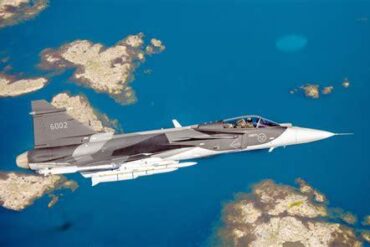
Canada’s reassessment of its future combat aircraft fleet has opened the door to a renewed debate over capability, sovereignty, and industrial return, and Saab has moved decisively to shape that discussion. The Swedish aerospace group has formally offered 72 Gripen E multirole fighters alongside six GlobalEye airborne early warning and control aircraft, positioning the package as a comprehensive alternative as Ottawa reviews its long-planned F-35 acquisition. The proposal arrives at a moment when Canada is balancing operational urgency with economic resilience, and when defense procurement is increasingly viewed as a lever for long-term national industrial strategy rather than a single-purpose military purchase.
The Saab offer is framed not simply as an aircraft sale but as an integrated airpower system. Gripen fighters would deliver interception, strike, and patrol missions across Canada’s immense territory, while GlobalEye aircraft would extend radar coverage far beyond ground-based limits, coordinating air and maritime operations in real time. Saab argues that the combination addresses Canada’s geographic realities, from Arctic approaches to vast coastal waters, while also anchoring high-value aerospace work inside the country.
The industrial dimension is central to Saab’s pitch. According to figures presented to Canadian officials, the combined Gripen–GlobalEye program could support up to 12,600 Canadian jobs, contingent on acquiring both platforms at the proposed scale. Saab has clarified that this employment impact depends on domestic final assembly, testing, integration, and long-term sustainment, rather than simple component offset arrangements. In a political climate increasingly focused on domestic economic returns, that distinction has become one of the proposal’s most influential features.
Strategic Context of Canada’s Fighter Review
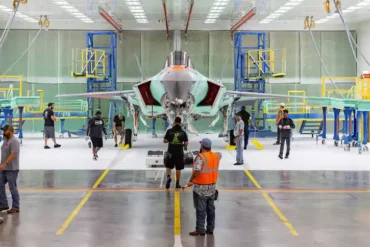
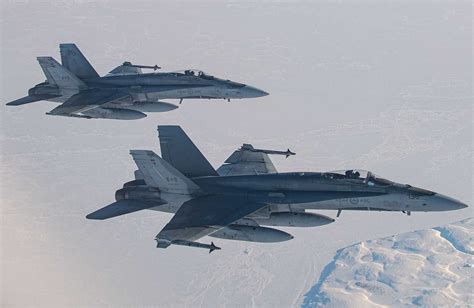
Canada’s current fighter plan centers on 88 Lockheed Martin F-35A Lightning II aircraft, ordered in 2022 after a lengthy competition. Total program costs are now estimated at more than $27 billion, with the first 16 aircraft scheduled for delivery beginning this year. While the initial tranche is proceeding, the government has confirmed that it is reassessing the remainder of the order, examining affordability, sustainment costs, and broader economic implications before committing fully to the original fleet size.
This review does not imply an immediate abandonment of the F-35, but it does reopen questions that were assumed settled only a few years ago. Introducing a second aircraft type, or potentially reshaping the overall mix, raises complex issues related to training pipelines, maintenance infrastructure, and operational doctrine. Saab’s proposal deliberately engages those concerns by presenting Gripen and GlobalEye as complementary systems that can integrate with existing NATO standards while reducing dependence on foreign sustainment chains.
Gripen E and Canada’s Operational Requirements
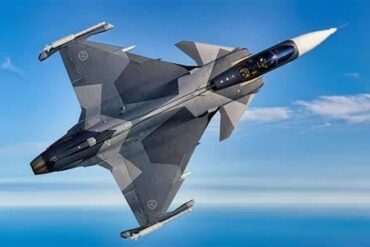
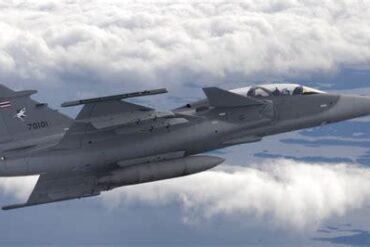
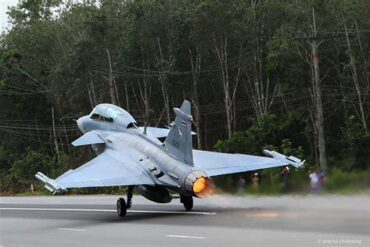
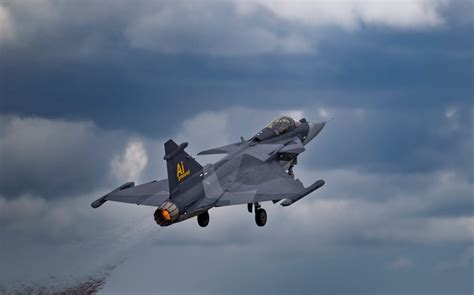
The Gripen E is positioned as a 4.5-generation multirole fighter optimized for dispersed operations and high availability. Designed to operate from shorter runways and austere bases, the aircraft aligns with Canada’s need to project airpower across remote regions where infrastructure is limited. Its logistics concept emphasizes rapid turnaround and reduced manpower, attributes that Saab argues are especially relevant for northern deployments.
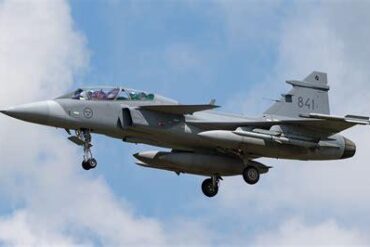
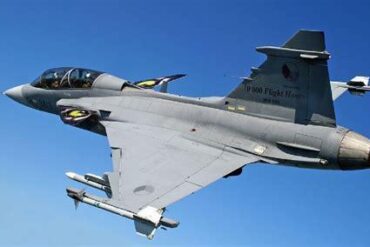
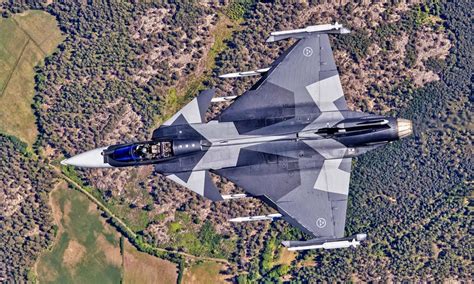
Technically, the Gripen E combines Mach 2 performance with a modern sensor suite, including the Raven ES-05 active electronically scanned array radar and an infrared search and track system capable of passive target detection. These sensors feed into a networked avionics architecture that shares data across formations in near real time, improving situational awareness and allowing Gripen units to operate as distributed nodes rather than isolated aircraft. With ten external hardpoints, the fighter can employ a wide range of NATO-standard weapons, supporting air-to-air defense, precision strike, and maritime attack missions.
GlobalEye and Persistent Situational Awareness
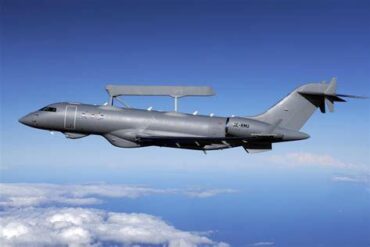
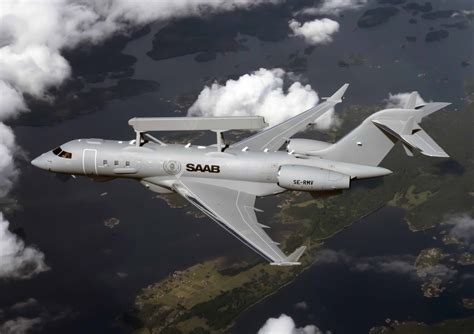
At the heart of Saab’s broader system argument is the GlobalEye airborne early warning and control aircraft, based on Bombardier’s Global Express business jet family. For Canada, which currently lacks a dedicated AEW&C platform, GlobalEye represents a significant capability expansion. Operating at altitude for up to eleven hours, the aircraft provides continuous surveillance over areas far beyond the reach of ground radar, a critical advantage in Arctic and maritime domains.
The platform’s Erieye ER radar, mounted along the fuselage, can detect and track airborne and surface targets at ranges approaching 450 kilometers, while a Seaspray 7500E maritime surveillance radar adds high-resolution surface tracking. This multi-sensor architecture allows GlobalEye to monitor air, sea, and land environments simultaneously, feeding a fused operational picture to commanders and linked assets such as Gripen fighters. Saab emphasizes that this persistent awareness is essential for effective sovereignty patrols and coordinated NORAD operations.
Industrial Participation and Domestic Assembly
One of the most politically resonant aspects of Saab’s proposal is its commitment to domestic production. The company has outlined plans for final assembly, integration, testing, and sustainment activities to take place in Ontario and Quebec, supported by a nationwide supplier network. Partners named include IMP Aerospace, GE Aviation, CAE, and Peraton, firms with established footprints in Canada’s aerospace and defense sectors.
For the GlobalEye component, Saab proposes working closely with Bombardier, leveraging Canadian expertise in business jet manufacturing to produce the airborne early warning variant domestically. This approach is presented as a pathway not only to national self-reliance but also to export participation, with Canada positioned as a production hub for future Gripen and GlobalEye customers abroad.
Employment, Exports, and Economic Leverage
Saab has linked the projected 12,600 jobs to both national requirements and potential export orders assembled in Canada. The company points to Ukraine’s stated interest in more than 100 Gripen aircraft and to GlobalEye demand from countries such as Egypt, France, and Germany as indicators of sustained production potential. While export contracts remain uncertain, the prospect of long-term manufacturing work resonates with policymakers seeking to anchor defense spending within the domestic economy.
Lockheed Martin, for its part, maintains that the existing F-35 program already generates substantial Canadian industrial participation, estimating $15 billion in work for Canadian firms over the life of the program. The ongoing review therefore places Ottawa in the position of evaluating not only headline job numbers but also the credibility, duration, and strategic value of competing industrial commitments.
Procurement Politics and Strategic Alignment
The debate over Canada’s fighter future is unfolding amid a broader increase in defense spending, with projections indicating an $82 billion rise over five years. The appointment of Christiane Fox as deputy minister at the Department of National Defence has been interpreted in Ottawa as a signal of a more assertive approach to procurement oversight, emphasizing value for money and domestic benefit alongside operational effectiveness.
Critics caution that fleet composition should ultimately be driven by military necessity, particularly Canada’s role within NORAD and NATO. Questions remain over how a predominantly Gripen-based fleet, or a mixed Gripen and F-35 force, would integrate with U.S.-led command and control architectures. Saab counters that Gripen is fully interoperable with allied systems and that GlobalEye’s data-fusion capabilities would enhance, rather than complicate, joint operations.
Public Opinion and the Reopened Debate
Public sentiment has added another layer to the decision-making environment. An Ekos survey indicates 43 percent support for a Gripen-only fleet, with an additional 29 percent favoring a mixed Gripen and F-35 approach. Support for an all-F-35 fleet stands markedly lower at 13 percent, with regional variations highlighting stronger backing for Gripen options in British Columbia and Quebec.
Partisan divides mirror these regional trends, with Conservative voters more inclined toward a single-fleet F-35 solution, while Liberal, NDP, and Green supporters show greater openness to Gripen or mixed alternatives. This distribution underscores how the current review has reopened a choice that many assumed was finalized in 2023, transforming a technical procurement decision into a broader national conversation about sovereignty, industry, and alliance management.
A Decision with Long-Term Consequences
Saab’s proposal of 72 Gripen fighters and six GlobalEye aircraft has injected renewed momentum into Canada’s fighter debate by offering a vision that blends operational capability with industrial sovereignty. Whether Ottawa ultimately adjusts its F-35 plans, adopts a mixed fleet, or reaffirms its original commitment, the outcome will shape Canada’s airpower posture and aerospace industry for decades. The review now underway is less about choosing between aircraft types than about defining how Canada balances alliance obligations, domestic economic resilience, and control over its own defense capabilities in an increasingly contested global environment.